
In this guide 18 sections
- How much should you budget for company closure?
- Strike-off or liquidation: which route affects your cost?
- Can your private limited company apply for strike-off?
- Why pending filings can increase the bill
- Documents and preparation that affect professional charges
- Other registrations and taxes need separate attention
- A practical process for getting an accurate closure quote
- Frequently asked questions
- Get a company-specific closure cost review
Last Reviewed 07 November 2026
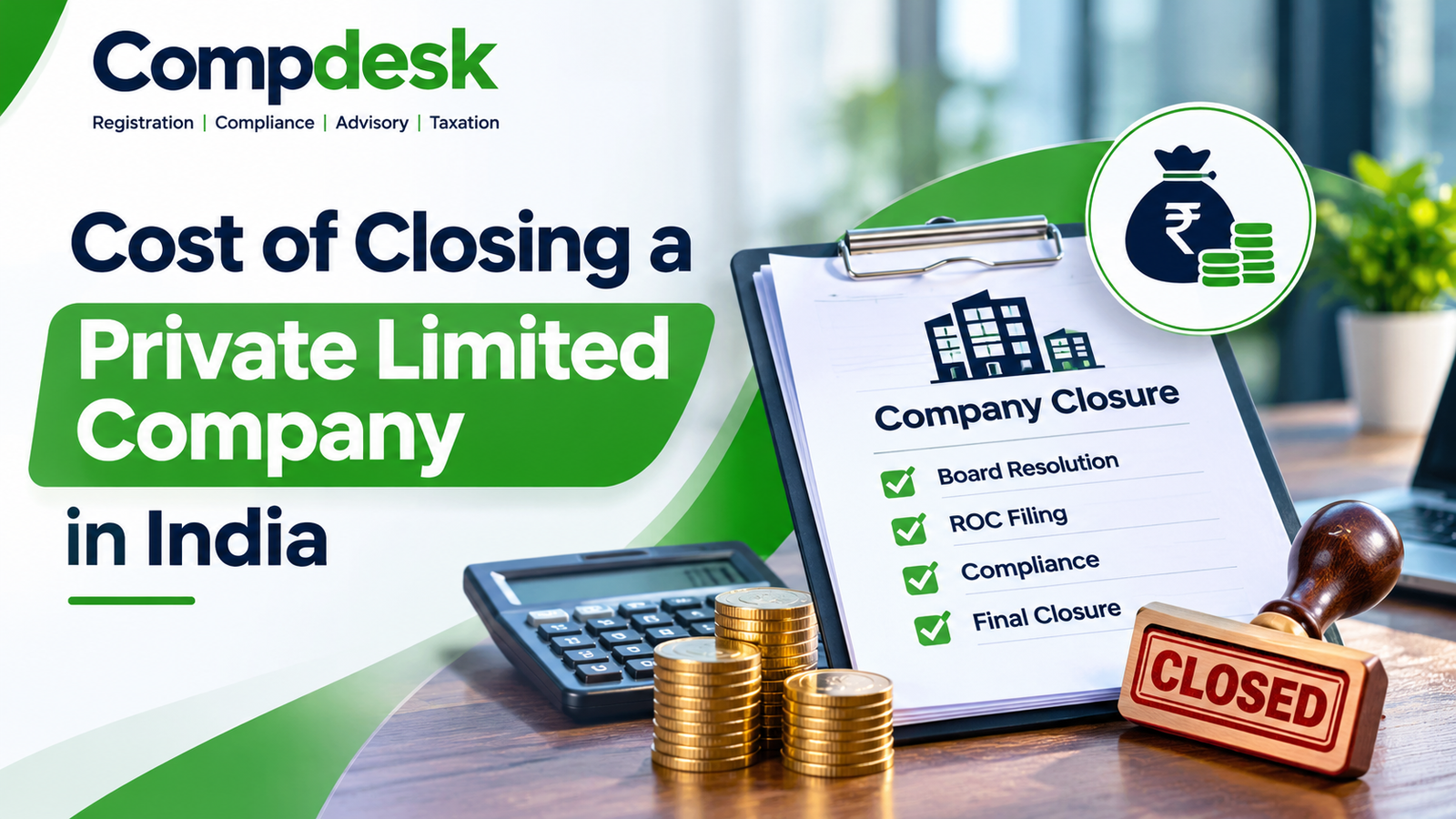
The cost of closing a private limited company in India depends first on whether it qualifies for strike-off or needs a liquidation process. For an eligible company applying for voluntary strike-off, the standard government fee for Form STK-2 is ₹10,000. Professional charges, applicable taxes, document execution and any work needed to clear pending compliance are additional.
That government fee is not the total closure cost. A company with reconciled accounts and settled liabilities needs a different budget from one with overdue annual returns, unpaid taxes, shareholder disputes or assets requiring realisation.
This guide explains the cost components, the eligibility checks and the questions to ask before accepting a closure quote.
How much should you budget for company closure?
For an eligible STK-2 application, use this formula:
Total cash budget = ₹10,000 standard STK-2 government fee + agreed professional charges + applicable taxes + document and third-party expenses + compliance clean-up costs + outstanding amounts to be settled.
Outstanding debts and taxes are not professional closure fees, but they can be essential cash outflows before closure is possible.
| Cost component | What it covers | How the amount is determined |
|---|---|---|
| STK-2 government fee | Application to remove the company's name | Standard fee: ₹10,000 |
| Professional charges | Eligibility review, document preparation, certification and filing support, as agreed | Written quote based on the company's records and scope |
| Accounts preparation | Reconciliation and preparation of the required statement of accounts | Depends on record quality and work already completed |
| Pending ROC filings | Required financial statements, annual returns and other outstanding filings | Relevant forms, years, filing fees and applicable additional fees |
| Document execution | Notarisation, stamp paper, courier or overseas authentication where needed | State, document and signatory circumstances |
| DSC or data corrections | Signature renewal and necessary record corrections | Only where required |
| Tax and registration work | Relevant GST, income-tax, TDS, payroll or licence-related closure tasks | Registrations, transactions and outstanding obligations |
| Liabilities | Creditors, loans, employee dues and government dues | Actual amounts payable; assessed separately from service fees |
The standard application fee follows Rule 4 of the Companies (Removal of Names of Companies from the Register of Companies) Rules. It is reflected in the IFSCA government report reproducing the fee provision and the ICSI's updated compilation of Rule 4. Confirm the live MCA fee and any currently applicable relief when filing.
What does Compdesk charge?
The Compdesk closure service and pricing pages reviewed did not provide a fixed professional fee specifically for private limited company closure. Obtain a company-specific written quote instead of treating an unrelated registration or annual-compliance package as a closure price.
Ask for separate amounts for the application, government fee, accounts work, pending filings, document execution and tax-registration work. The quote should also explain whether responses to filing queries are included and how additional work is charged.
Strike-off or liquidation: which route affects your cost?
| Route | When it may be relevant | Main cost drivers |
|---|---|---|
| Voluntary strike-off under section 248(2) | A company meeting a statutory ground and the applicable restrictions, after extinguishing liabilities | STK-2, accounts, documents, professional certification and compliance clean-up |
| Voluntary liquidation under the Insolvency and Bankruptcy Code | An eligible corporate person seeking formal liquidation; requires a separate legal assessment | Liquidator's remuneration, asset realisation, claims, valuation where applicable, reporting and dissolution work |
| Insolvency proceedings or Tribunal winding-up | Financial distress or another applicable legal ground | Case-specific professional and proceeding costs; unsuitable for a standard strike-off quotation |
The MCA STK-2 instruction kit identifies the application as a company-initiated exit through the Centre for Processing Accelerated Corporate Exit (C-PACE). Liquidation follows a different framework: see section 59 published by IBBI and the IBBI regulations index, which lists updated voluntary-liquidation regulations.
A company with remaining assets is not automatically insolvent. Equally, an unpaid creditor cannot simply be ignored to obtain a cheaper exit. Have the balance sheet and proposed settlement plan reviewed before choosing the route.
Can your private limited company apply for strike-off?
Common statutory grounds include failure to commence business within one year of incorporation, or no business or operations during the two immediately preceding financial years without seeking dormant status during that period. Other statutory grounds exist; eligibility needs review against the company's actual history. These grounds are reflected in C-PACE notices published in the Official Gazette in 2026.
Section 248(2) requires extinguishing liabilities and approval by a special resolution or consent of members representing 75% of paid-up share capital. Section 249 imposes restrictions, including specified activities in the preceding three months. Section 8 companies cannot use section 248(2). See the Companies Act on India Code, sections 248–249.
For a cost review, disclose:
- Loans from directors, shareholders, banks or other lenders.
- Unpaid suppliers, employee dues and tax demands.
- Bank balances, receivables, investments and other assets.
- Pending litigation, investigations, charges or regulatory restrictions.
- Recent changes in name, registered-office state or business activity.
- Any strike-off notice already received from the Registrar.
Do not write off a genuine liability merely to make the accounts appear suitable for closure. Settlement, waiver and asset-disposal decisions may have accounting, tax and legal consequences.
Why pending filings can increase the bill
Under Rule 4, the ordinary pre-application requirement covers overdue financial statements and annual returns through the financial year in which operations ceased. If the Registrar has already initiated section 248(1) action, all pending financial statements and annual returns must be filed before the application. A later statutory notice stage can prevent a company-initiated application. The ICSI Rule 4 compilation sets out these distinctions.
Ask the professional to prepare a form-by-form, year-by-year list before quoting the clean-up work. This avoids both underestimating the bill and assuming every post-cessation year must automatically be filed in every case.
The review should separate normal filing fees, additional fees, professional preparation charges and any distinct statutory penalty exposure. A decision to close does not itself waive these amounts. Any available relief must be checked for its forms, period and conditions.
Avoid using an expired concession as today's price
MCA's official announcement for CCFS-2026 identified 15 September 2026 as the extended closing date. That date has passed as of this article's review. Do not use scheme-era discounted prices for a fresh application unless a later applicable notification supports them. See MCA's announcement of Circular 04/2026.
Documents and preparation that affect professional charges
Prepare an initial review folder containing:
- CIN, incorporation documents, PAN and current company master data.
- Latest financial statements, trial balance and bank statements.
- Filed ROC forms, acknowledgements and a list of pending returns.
- Director and shareholder details, shareholding records and DSC information.
- Evidence supporting the date business ceased or the relevant eligibility ground.
- Loan, creditor, employee, asset and tax-registration details.
- Notices, litigation records and regulatory approvals, where applicable.
The closure documentation ordinarily includes the STK-3 indemnity bond, STK-4 affidavits and a CA-certified statement of accounts in STK-8. The statement must be made up to a date not more than 30 days before the application. This timing matters: prepare it once the records and filing schedule are ready, so it does not need to be refreshed unnecessarily. See the ICSI's 2025 corporate restructuring and closure guidance.
Overseas signatories, missing historical accounts and unresolved ownership records can require extra work. Obtain the current checklist before arranging notarisation or authentication.
Other registrations and taxes need separate attention
Do not assume an MCA application automatically completes GST cancellation, tax returns, payroll obligations or licence surrender. Review each registration and the company's final transactions separately.
For GST-registered companies, assess cancellation, outstanding returns, stock-related adjustments and any applicable final return. Where GSTR-10 is required, the GST portal's guidance gives a period of three months from cancellation or the cancellation order, whichever is later. Applicability depends on taxpayer category. See the GST portal's taxpayer welcome kit.
Ask your adviser to identify tax consequences of asset sales, loan settlements and payments or distributions to shareholders. These amounts cannot be determined from the STK-2 fee alone.
A practical process for getting an accurate closure quote
- Establish eligibility. Review the company's status, operating history, assets, liabilities and notices.
- List the preparatory work. Identify required returns, reconciliation, settlements and registration-related tasks.
- Agree a written scope. Separate government fees, professional fees, taxes and actual third-party costs.
- Complete approvals and documents. Coordinate resolutions, accounts, signatures and certification.
- File and monitor the application. Keep submission and payment evidence and respond to queries within the applicable time.
- Verify the final outcome. Retain the dissolution notice and preserve the company's records and registration-related evidence.
Submission of STK-2 is not itself dissolution. The process includes scrutiny and public-notice steps, so avoid relying on a guaranteed closure date. Obtain an estimate distinguishing preparation time from regulatory processing. The removal-of-names rules on India Code describe the notice framework.
Compare the same scope across quotes
A low professional fee may cover only preparing STK-2. Another quote may also include accounts, documents and query handling. Compare the deliverables rather than the headline amount. Request a clear explanation of exclusions, extra-work charges and the treatment of costs if the application cannot proceed.
Frequently asked questions
Is ₹10,000 the full cost of closing a private limited company?
No. It is the standard STK-2 government application fee. Professional charges, taxes, document expenses and necessary clean-up work are separate.
Can I close a company that never started business?
Potentially, if it meets the relevant statutory ground and other conditions. Never commencing business does not automatically remove filing, tax or documentation requirements.
Is closing a company free if it has no turnover?
No. Nil turnover does not waive the standard application fee or eliminate the work required to establish eligibility and prepare the application.
Is there a fixed government professional fee for company closure?
The STK-2 filing fee is prescribed. The professional service charge depends on the engagement; obtain a written quote for your company's facts.
Does strike-off cancel all director liabilities?
No. Section 248(7) preserves specified liabilities, and section 251 addresses fraudulent applications. Strike-off should not be treated as a way to avoid creditors or existing legal exposure. See the Companies Act.
Can the company stop complying as soon as STK-2 is filed?
Do not assume that. Filing is an application, and obligations during the pending period require review. Track the final outcome and address other registrations separately.
Get a company-specific closure cost review
Share your company's CIN, last operating year, accounts, pending filings and outstanding liabilities with Compdesk. We can help review the suitable ROC closure route and explain the proposed scope and charges. Explore our company closure service or request a consultation before deciding how to proceed.

Meera is the Compliance Head at Compdesk, with over 10 years of experience in ROC filings, GST, income tax, and statutory compliance. She helps businesses understand regulatory requirements, maintain accurate filings,...
View full profileDon’t let private Limited Company Annual Compliance eat your week.
Our experts handle the filing end to end. You track every step online.