
In this guide 16 sections
- MCA Extended ROC Filing Due Dates for FY 2025-26 (AOC-4 & MGT-7)
- Which companies and financial years does the relief cover?
- Does the ROC Extension Cover AGM Due Dates? (Section 96 Rules)
- What fees remain payable?
- Penalty & Additional Fee Rule If You Miss the Extended ROC Deadline
- Are ADT-1 and LLP Form 8/11 Covered Under the Extension?
- What should your company do now?
- Frequently asked questions
- Complete your annual ROC filings with Compdesk
Last Reviewed 07 November 2026
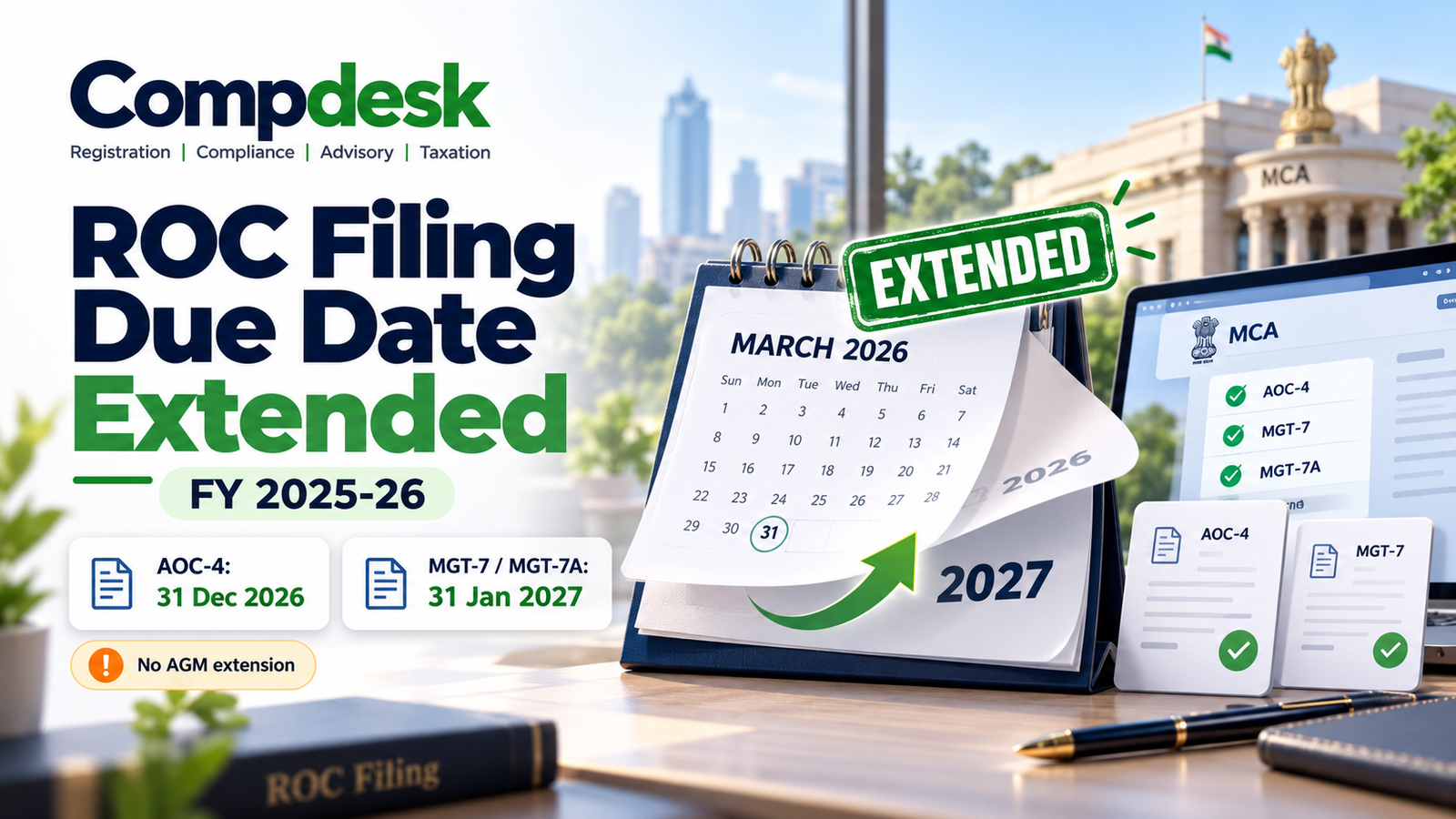
Companies completing annual ROC filings for the year ended 31 March 2026 have two different relief deadlines to track. The listed financial-statement forms can be filed without additional fees up to 31 December 2026, while annual returns in MGT-7 and MGT-7A can be filed up to 31 January 2027.
The relief comes under MCA General Circular No. 05/2026, dated 24 October 2026. It gives companies time to complete specified filings for FY 2025-26, but does not extend the statutory time for holding an Annual General Meeting (AGM).
This guide explains the covered forms, the fee conditions and the checks your company should complete before filing.
MCA Extended ROC Filing Due Dates for FY 2025-26 (AOC-4 & MGT-7)
Paragraph 2 of the circular sets out the following filing windows for FY 2025-26:
| Filing category | Forms expressly covered | Last date without additional fees |
|---|---|---|
| Financial statements | AOC-4, AOC-4 (CFS), AOC-4 (XBRL), AOC-4 NBFC (Ind AS), AOC-4 CFS NBFC (Ind AS) | 31 December 2026 |
| Annual return | MGT-7 and MGT-7A | 31 January 2027 |
Source: MCA General Circular 05/2026, scanned copy hosted by CSM & Co LLP, paragraphs 2–4. The document is an MCA circular; this linked copy is hosted on a professional firm's website.
The December deadline applies to the financial-statement forms listed above. The January deadline applies to the annual-return forms. Do not use one common date for both categories.
Which companies and financial years does the relief cover?
The circular permits companies to complete the named annual filings for FY 2025-26. It does not restrict the relief to companies in a particular state.
For a private limited company, the practical first step is to identify its applicable financial-statement form and annual-return form. The extension does not change the underlying form-selection or certification requirements. For example, a company cannot choose an ordinary financial-statement form merely to avoid an applicable XBRL requirement.
Keep older-year defaults on a separate checklist. This circular does not grant a general waiver for all historic ROC filings, and it does not automatically extend filings for FY 2026-27.
Companies that already completed the relevant filings should check their acknowledgements and processing status. The announcement itself does not require duplicate filing.
Does the ROC Extension Cover AGM Due Dates? (Section 96 Rules)
No. Paragraph 3 expressly preserves the statutory AGM timeline and the liability arising from failure to comply with it.
Separate these two questions when reviewing your records:
- Was the AGM held within the period legally applicable to the company, including any valid company-specific extension?
- Have the financial statements and annual return been filed within the relevant relief window?
A late AGM is not made timely by filing the forms during the extended window. If the meeting was not held, or accounts were not adopted, seek advice on the correct disclosures and filing route. Do not insert an assumed meeting date merely to complete a form.
Under the ordinary framework, section 137 generally links financial-statement filing to a 30-day period after the AGM, while section 92(4) provides a 60-day annual-return period. Special cases, including OPC financial statements and situations where an AGM was not held, need separate treatment. See the Companies Act on India Code.
What fees remain payable?
The circular relaxes additional filing fees for the specified forms within the stated windows. Normal filing fees remain payable. Professional service charges, applicable taxes and the cost of completing accounts or audit work are separate.
| Cost or obligation | Effect of this circular |
|---|---|
| Normal MCA filing fee | Remains payable |
| Additional fee on covered FY 2025-26 forms filed within the applicable window | Relaxed |
| Professional preparation and filing charges | Depend on the agreed engagement |
| AGM default or other compliance exposure | Requires separate assessment |
Ask for a quote that distinguishes government charges from professional work. Confirm whether it includes accounts preparation, audit coordination, Board documentation, annual-return certification and any pending corrections. A filing extension does not reduce the information or supporting documents needed for an accurate return.
Penalty & Additional Fee Rule If You Miss the Extended ROC Deadline
Paragraph 4 is particularly important: a filing made after the applicable relief window attracts fees, including additional fees under the Companies (Registration Offices and Fees) Rules, 2014, from the date the filing was originally due under the Act.
The end of the relief window does not become a new starting point for calculating the original delay.
Example: AGM held on 30 September 2026
Assume an ordinary company held its AGM on that date and the standard post-AGM filing periods apply:
| Form | Original statutory filing date | Example filing date | Treatment under this circular |
|---|---|---|---|
| AOC-4 | 30 October 2026 | 15 December 2026 | Within the financial-statement relief window |
| AOC-4 | 30 October 2026 | 5 January 2027 | Outside that window; additional fees refer back to the original due date |
| MGT-7 | 29 November 2026 | 5 January 2027 | Within the annual-return relief window |
This is an illustration of the timing rule, not a government-fee quotation. The amount payable depends on the applicable fee rules, actual filing date and company circumstances. Additional fees and statutory penalties are separate concepts; do not assume the circular grants immunity from every compliance default.
Are ADT-1 and LLP Form 8/11 Covered Under the Extension?
This circular names the financial-statement and annual-return forms in the first table. It does not itself extend ADT-1, DPT-3, MSME Form I, director-related forms or LLP Form 8 and Form 11. Check any separate relief applicable to those obligations.
Likewise, income-tax, GST, TDS and sector-specific reporting follow their own requirements. A company with several registrations should maintain a separate deadline for each obligation.
What should your company do now?
Use the available time to resolve incomplete records and finish the filings:
- Confirm the year and applicable forms. Check whether standalone, consolidated, XBRL or NBFC reporting is required.
- Review meeting records. Verify Board approvals, AGM dates, adoption of accounts and supporting minutes.
- Reconcile the accounts and annual return. Compare capital, shareholding, director details and other disclosures against the statutory records.
- Complete signatures and certification. Check DSC validity and availability of the required signatories and professionals.
- Submit and verify completion. Retain filed forms, SRNs, payment challans and acknowledgements, and check the processing status.
Keep the audited financial statements and reports, Board's report, relevant meeting records, director and shareholder details, share-capital records and previous filings ready. Your professional may request further documents based on the company's transactions and reporting requirements.
Compdesk's company annual compliance service can help review the applicable annual filing work and supporting documentation under an agreed scope.
Frequently asked questions
Has ROC filing been extended for the year ended 31 March 2026?
Yes. General Circular 05/2026 provides additional-fee relief for the listed FY 2025-26 company forms within the two filing windows shown above.
Can AOC-4 be filed up to 31 January 2027 without additional fees?
Not under this circular. The AOC-4 family has the earlier cutoff of 31 December 2026. The January date belongs to MGT-7 and MGT-7A.
Does the company need to apply individually for this filing relief?
The circular states a general permission for the specified filings and does not prescribe a separate company-level application for that relief. Any application concerning an AGM extension is a different matter.
Does filing during the window correct a delayed AGM?
No. Review AGM compliance separately, including any valid extension already granted to the company.
Does a company with no turnover still need to review annual filing?
Yes. Lack of revenue does not by itself remove an active company's annual filing obligations. Check the company's legal status and applicable requirements.
If a form is already filed, should it be submitted again?
Not merely because an extension was announced. Verify the existing filing status and address an actual defect or resubmission requirement through the appropriate process.
Disclaimer: This article provides general information based on the circular and legal provisions reviewed on 30 October 2026. Later MCA notifications may change the position. Requirements depend on the company's facts; obtain professional advice for specific filings, defaults or notices.
Complete your annual ROC filings with Compdesk
If your FY 2025-26 filings are pending, Compdesk can help review the applicable forms, supporting records and compliance gaps before submission. Request company annual compliance support and confirm the scope and charges for your company.

Meera is the Compliance Head at Compdesk, with over 10 years of experience in ROC filings, GST, income tax, and statutory compliance. She helps businesses understand regulatory requirements, maintain accurate filings,...
View full profileDon’t let private Limited Company Annual Compliance eat your week.
Our experts handle the filing end to end. You track every step online.