
In this guide 10 sections
Last Reviewed 07 November 2026
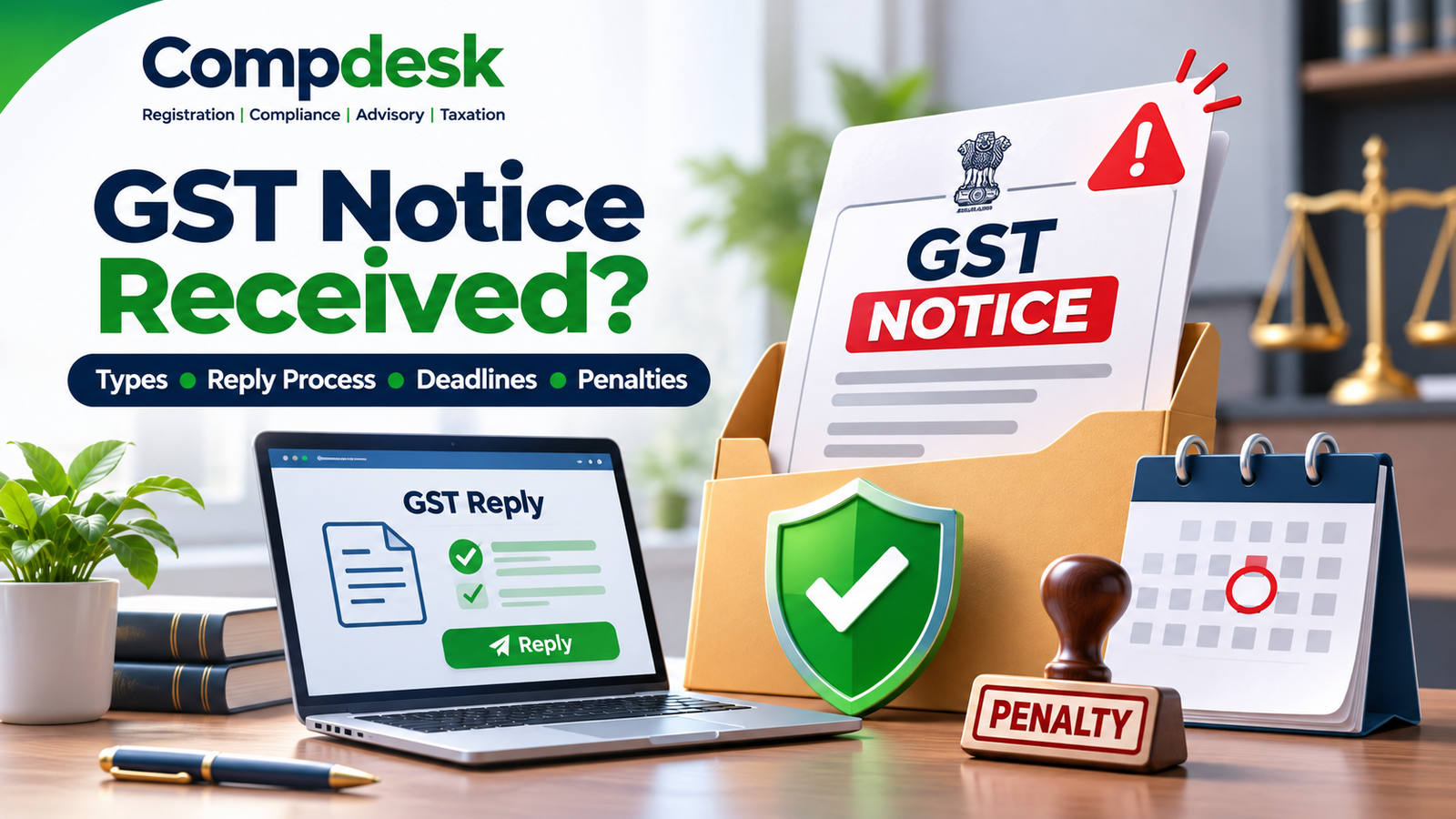
Open the GST communication and record its form number, tax period and reply deadline. Those details tell you whether to file a missing return, explain a mismatch, defend a proposed demand or act on an order. A reply prepared for the wrong form can leave the actual proceeding unanswered.
Identify the form and mark the deadline
| Form received | Why it is issued | What to file and when |
|---|---|---|
| GSTR-3A | A required return is outstanding | File the return within 15 days under Rule 68. Continued default can lead to a best-judgment assessment under section 62. |
| ASMT-10 | The officer has identified discrepancies during return scrutiny | Reply in ASMT-11 by the date specified. Rule 99 ordinarily allows the officer to set a period of up to 30 days from service, with further time if permitted. |
| DRC-01B Part A | Outward tax liability in GSTR-1 or IFF exceeds liability in GSTR-3B beyond the system threshold | Submit Part B within seven days under Rule 88C. Report any applicable payment and explain any remaining difference. |
| DRC-01C Part A | ITC claimed in GSTR-3B exceeds the amount available in GSTR-2B beyond the system threshold | Submit Part B within seven days under Rule 88D. Explain the difference and report any applicable payment. |
| REG-03 | An officer seeks clarification on a registration application | Submit REG-04 within seven working days of receipt under Rule 9. |
| REG-17 | The officer proposes cancellation of registration | Reply in REG-18 within seven working days of service under Rule 22. Check whether the registration is already suspended. |
| DRC-01A Part A | The officer communicates an amount before a possible show cause notice | Review the working and respond in Part B as applicable. Use the deadline in the communication. |
| Show cause notice with DRC-01 summary | The officer proposes a demand for tax, interest or penalty | Download the detailed notice and annexures. File the representation in DRC-06 for a demand proceeding by the deadline stated in the notice. |
| Order with DRC-07 summary | The officer has decided the demand | Download the full order and check the payment and appeal deadlines. |
The statutory period and the date displayed on the portal should be checked together. Record the issue date, date of service and hearing date separately. GST communications can be served through the common portal or other statutory modes, including registered email. If two dates appear inconsistent, raise the issue promptly and work to the earlier deadline where possible. CBIC guidance on return defaults · Return scrutiny instructions · Rules 88C and 88D as reproduced in state notifications · Registration Rule 9 · CGST Rules, Rule 22 · GST portal forms list · CBIC Circular 258/04/2026-GST.
An unanswered DRC-01B or DRC-01C can block GSTR-1 or IFF filing for a subsequent period. Deal with the portal response as well as any amount payable. GSTN guidance for DRC-01B · GSTN guidance for DRC-01C.
How to submit a GST notice reply online
- Open the correct GSTIN on the GST portal. For demand proceedings, start at Services → User Services → View Additional Notices/Orders. For DRC-01B or DRC-01C, use Services → Returns → Return Compliance. Search by reference number if needed. Official GST portal · GSTN guidance on DRC-01 · GSTN Return Compliance guide.
- Download the full communication. Keep the notice, summary, annexures and any relied-upon records together. Use Verify RFN for a portal-issued document with a reference number. GSTN RFN verification advisory.
- Reconcile each allegation. Match the notice amounts to the returns and source documents. Separate amounts already paid, amounts accepted as payable and amounts disputed. Show the reconciliation by GSTIN, period and tax head.
- Write a point-by-point reply. Cite the notice paragraph, explain the facts, attach the relevant evidence and state the outcome you seek. If you need relied-upon documents or more time, request them promptly. Treat the existing deadline as active unless the officer grants additional time.
- Submit and save the filing proof. Upload the signed reply and annexures through the applicable module. Include payment references where relevant and retain the submitted reply, attachments and acknowledgement. Monitor the case for a hearing or an order.
What should the reply contain?
Give the officer a short reconciliation they can check against the annexures. For a sales mismatch, start with GSTR-1 or IFF, GSTR-3B, sales invoices, credit notes and payment records for both the disputed period and any period in which the transaction was reported or paid. For an ITC mismatch, build an invoice-level bridge from the purchase register to GSTR-2B and GSTR-3B. Include supporting invoices, debit notes, reversals or reclaims and import records where relevant.
Illustration. An invoice appears in March GSTR-1, but the business says the related tax was paid in February GSTR-3B. Identify the invoice, show where the payment appears in the earlier return and reconcile both months. A general statement that the difference is due to timing leaves the officer without a way to verify the amount.
For a disputed demand, request a personal hearing in writing where appropriate. Section 75(4) requires an opportunity of hearing when the taxpayer requests one in writing or the officer contemplates an adverse decision. CBIC Circular 258/04/2026-GST, paragraph 10.1.
Which demand section and penalties apply?
Use the financial year covered by the allegation. Sections 73 and 74 govern the relevant demands through FY 2023–24. Section 74A applies from FY 2024–25 onward and covers both types of case. If a notice spans years, review the legal provision and computation separately for each period. CBIC’s October 2026 circular directs officers to explain the specific facts supporting allegations of fraud, wilful misstatement or suppression to evade tax. Finance (No. 2) Act, 2024, sections 136–139 · CBIC Circular 258/04/2026-GST.
| Demand provision | Standard adjudicated penalty | Concessional treatment for qualifying full payment of tax and applicable interest |
|---|---|---|
| Section 73, non-fraud | Higher of 10% of tax or ₹10,000 | Penalty relief can apply before notice or within 30 days of notice issue. |
| Section 74, fraud or specified evasion grounds | 100% of tax | 15% before notice, 25% within 30 days of notice issue, or 50% within 30 days of order communication. |
| Section 74A, non-fraud | Higher of 10% of tax or ₹10,000 | Penalty relief can apply before notice or within 60 days of notice issue. |
| Section 74A, fraud or specified evasion grounds | 100% of tax | 15% before notice, 25% within 60 days of notice issue, or 50% within 60 days of order communication. |
Percentages in the table are of the tax amount. Check the statutory conditions and exceptions, particularly for unpaid self-assessed tax or tax collected and left unpaid. Late fees for overdue returns, interest on the underlying liability and demand penalties should be calculated separately. The GST Council’s October 2026 recommendation for a 5% penalty in specified non-fraud cases after adjudication was a proposal. Confirm the operative provision before applying any proposed relief. CGST Act, section 73 · Section 74 · Finance (No. 2) Act, 2024, section 138 · 57th GST Council recommendations.
Keep two dates on your calendar. The reply date in the notice and the statutory payment window serve different purposes. For example, if a section 74A notice sets a reply deadline earlier than the 60-day payment window, file the reply by the earlier date while evaluating settlement. If you accept only part of a demand, identify the accepted amount and payment references separately from the disputed balance.
What if you missed the deadline or received an order?
If the reply date has passed, check the portal for a hearing or an order immediately. Where the proceeding is still open, seek permission to submit your explanation and file it if the available process permits. If the officer has issued an order, obtain the full decision and record when it was communicated.
For a taxpayer’s first appeal under section 107, the ordinary period is three months from communication. The appellate authority may allow one further month if sufficient cause is shown. Review the appeal grounds and applicable pre-deposit together. A request to correct an order should not be assumed to suspend the appeal clock. CGST Act, section 107 · GST portal appeal FAQs.
Frequently asked questions
Is DRC-01 the complete show cause notice?
DRC-01 summarises the notice. Read the full notice and annexures to see the allegations, computation and response deadline.
Can I ignore a GST notice because I already paid the tax?
Respond through the applicable workflow. Identify the period, amount and payment reference, and show how the payment relates to the notice. Save any acknowledgement or closure order.
Is there a fixed fee for getting help with a GST notice reply?
Ask for a written quote based on the number of periods, reconciliation work and whether the engagement includes filing, a hearing or an appeal. Tax, interest, penalties and appeal pre-deposits depend on the case and are separate from professional fees.
This article provides general information. GST rules and portal procedures can change, and the appropriate response depends on the facts and documents in your case. Seek professional advice for a specific notice, demand or appeal.
Get help with your GST notice reply
Share the notice and annexures, the tax periods involved and the response deadline with Compdesk. The team can review the reconciliation and agree the scope for preparing a reply or assessing next steps. Contact Compdesk for GST compliance support.

Meera is the Compliance Head at Compdesk, with over 10 years of experience in ROC filings, GST, income tax, and statutory compliance. She helps businesses understand regulatory requirements, maintain accurate filings,...
View full profileDon’t let GST Registration eat your week.
Our experts handle the filing end to end. You track every step online.