
In this guide 22 sections
- What is Form INC-20A?
- Who must file INC-20A, and who need not
- INC-20A due date: how the 180 days are counted
- Documents and information needed for INC-20A
- Step-by-step: how to file INC-20A
- MCA fee for INC-20A
- Penalty for not filing INC-20A on time
- Can the company do business before filing INC-20A?
- Penalty vs fee vs strike-off: a quick timeline
- Common mistakes to avoid
- Frequently asked questions
- When professional help is useful
- Need help with INC-20A?
Last updated on 11 November 2026
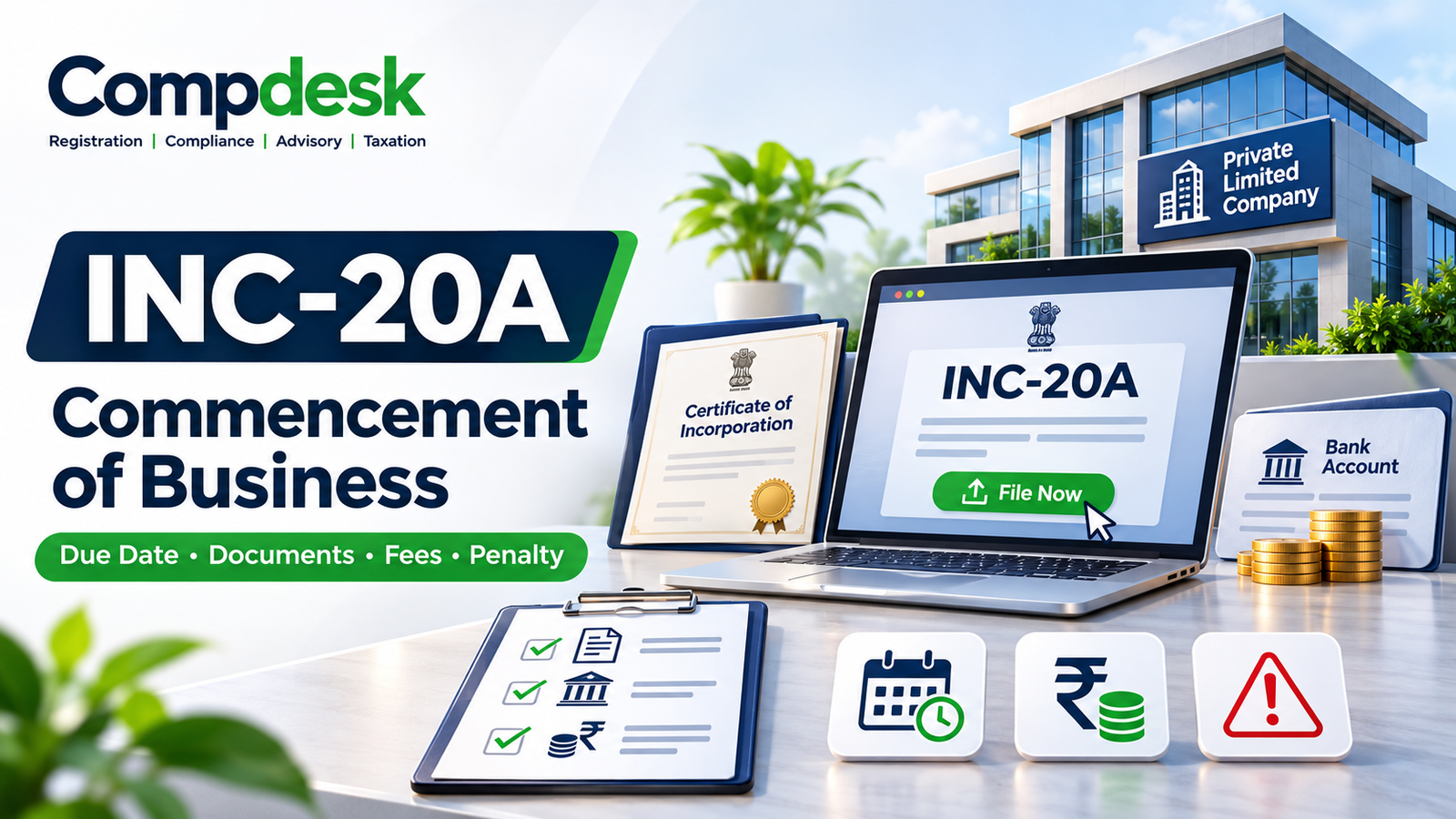
You have your Certificate of Incorporation, the PAN and TAN are in hand, and the first client is waiting. It is tempting to start invoicing straight away. But if your company has share capital and was incorporated on or after 2 November 2018, the Companies Act, 2013 puts one more filing in your way: Form INC-20A, the declaration of commencement of business. Until it is filed, the company is not supposed to commence business or exercise borrowing powers, and missing the 180-day deadline invites a penalty on the company and on its directors.
This guide explains who must file INC-20A, how the 180-day deadline is counted, which documents you need, what the MCA fee and late fee look like, and what the penalty exposure is if you have already missed the date. The position stated here is as of 11 November 2026.
What is Form INC-20A?
INC-20A is the declaration a director files with the Registrar of Companies (RoC) to confirm that every subscriber to the company's Memorandum of Association has paid for the shares they agreed to take. It is filed under Section 10A(1)(a) of the Companies Act, 2013, read with Rule 23A of the Companies (Incorporation) Rules, 2014.
Section 10A sets two conditions before a company can start business or exercise borrowing powers:
- A director files the INC-20A declaration within 180 days of the date of incorporation, confirming subscribers have paid for their shares.
- The company has filed verification of its registered office as required under Section 12(2).
It is a one-time filing, not an annual one. It is separate from annual compliances such as financial statements and annual returns.
Who must file INC-20A, and who need not
Section 10A applies to a company that has a share capital and was incorporated after the provision came into effect on 2 November 2018. The size of the capital does not matter; a company with a small authorised capital is in scope just like a larger one.
| Situation | INC-20A required? |
|---|---|
| Private limited company incorporated on or after 2 Nov 2018 | Yes |
| One Person Company (OPC) with share capital, incorporated on or after 2 Nov 2018 | Yes |
| Public company with share capital, incorporated on or after 2 Nov 2018 | Yes |
| Company incorporated before 2 Nov 2018 | No |
| Company without share capital (for example, a company limited by guarantee) | No |
| LLP | No, Section 10A applies to companies |
If your company has a sectoral regulator (for example, an NBFC regulated by the RBI), Rule 23A also requires the regulator's registration or approval to be attached to the declaration.
INC-20A due date: how the 180 days are counted
The deadline is 180 days from the date of incorporation shown on the Certificate of Incorporation. It is not linked to your first AGM, your financial year-end or the date you open the bank account.
A simple way to plan it:
- Take the date of incorporation as day zero and count 180 calendar days forward.
- Illustration only: for a company incorporated on 10 June 2026, the 180-day period ends on 7 December 2026.
- Start preparing well before that date, because the bank statement, subscriber payments and professional certification all take time to line up.
Companies incorporated during the COVID-19 relaxation window had a longer period, but that applied only to a past incorporation window and is not relevant to companies incorporated now.
Documents and information needed for INC-20A
Based on Rule 23A and the MCA instruction kit for the form, keep the following ready:
| Item | Why it is needed |
|---|---|
| Proof of payment of share subscription money by each subscriber | Core attachment. A bank statement of the company's account showing the credits is the usual proof. The MCA V3 form also asks for subscriber-wise details such as bank, account and date of credit |
| Board resolution authorising a director to sign and submit the declaration | The form's declaration refers to the resolution number and date |
| Director's valid Digital Signature Certificate (DSC), registered on MCA, and the director's DIN | Only a director can sign the form |
| Verification by a practising Company Secretary, Chartered Accountant or Cost Accountant | Rule 23A requires the contents of the form to be verified by a professional in practice |
| Regulator's registration or approval, where applicable | Mandatory attachment if the company's affairs are regulated, for example by the RBI or SEBI |
| Registered office already verified | Through SPICe+ Part B at incorporation, or through Form INC-22 where it was not |
A practical tip: match the subscriber names and amounts in the bank statement to the Memorandum of Association before you start. A mismatch is the most common reason a filing has to be redone.
Step-by-step: how to file INC-20A
- Confirm registered office status. If the office was declared at incorporation through SPICe+ Part B, verification is generally already on record. If not, file INC-22 first.
- Collect subscription money. Each subscriber must have paid the value of the shares they agreed to take, as per the Memorandum. In practice this is paid into the company's bank account, which is what the statement attached to the form evidences.
- Prepare the board resolution authorising the declaring director.
- Fill in the form on the MCA V3 portal (mca.gov.in). Enter the CIN and use the pre-fill option; then complete the regulator and subscriber payment details.
- Attach proof of payment and any regulator approval, if applicable.
- Sign and certify. The director signs with DSC, and a practising CS, CA or CMA verifies the form with their own DSC.
- Pay the fee and note the SRN. Per the MCA instruction kit, the form is processed in STP (auto-approval) mode and an acknowledgement is sent to the company's email ID.
MCA fee for INC-20A
The normal government fee depends on the company's nominal (authorised) share capital, under the Companies (Registration Offices and Fees) Rules, 2014, as reproduced in the MCA instruction kit:
| Nominal share capital | Normal fee |
|---|---|
| Less than ₹1,00,000 | ₹200 |
| ₹1,00,000 to ₹4,99,999 | ₹300 |
| ₹5,00,000 to ₹24,99,999 | ₹400 |
| ₹25,00,000 to ₹99,99,999 | ₹500 |
| ₹1,00,00,000 or more | ₹600 |
Some online guides describe a flat ₹200 fee. The fee schedule in the MCA instruction kit is slab-based, so treat the amount shown on the MCA V3 payment screen at the time of filing as the final figure. Fees are also subject to change by amendment of the rules.
Additional fee for late filing
If you file after the 180-day period, an additional fee applies on top of the normal fee, calculated as a multiple of it:
| Delay beyond the due date | Additional fee |
|---|---|
| Up to 30 days | 2 times the normal fee |
| 31 to 60 days | 4 times |
| 61 to 90 days | 6 times |
| 91 to 180 days | 10 times |
| More than 180 days | 12 times |
Worked example (illustrative): a company with ₹10 lakh authorised capital pays a normal fee of ₹400. If it files 44 days after the due date, the additional fee is 4 × ₹400 = ₹1,600, on top of the ₹400 normal fee.
This additional fee is only the portal charge. It is not the Section 10A penalty described next.
Penalty for not filing INC-20A on time
Section 10A(2) sets the statutory penalty for default:
| Who | Penalty under Section 10A(2) |
|---|---|
| The company | ₹50,000 |
| Every officer in default | ₹1,000 for each day the default continues, subject to a maximum of ₹1,00,000 |
A few points that matter in practice:
- The daily penalty builds up quickly. At ₹1,000 a day, the ₹1,00,000 ceiling is reached after 100 days of default.
- Filing late does not erase the exposure. The RoC can adjudicate the penalty under Section 454 even after the form is filed. Published RoC adjudication orders show companies being penalised for delays measured in weeks as well as in years, and some companies have approached the RoC with a suo motu adjudication application before any notice reached them. Outcomes depend on the facts, so the figures above are the statutory ceiling, not a prediction.
- Lower penalties for some companies. Under Section 446B, where the company is a One Person Company, a small company, a start-up company (recognised as such) or a producer company, the penalty is capped at half of the amount specified, subject to an overall maximum of ₹2 lakh for the company and ₹1 lakh for an officer. Whether the company qualifies is a question of its facts and should be checked by a professional.
- Strike-off risk. Under Section 10A(3), if the declaration is not filed within 180 days and the Registrar has reasonable cause to believe the company is not carrying on any business or operations, the Registrar may start action to remove the company's name from the register under Chapter XVIII. Section 248(1) also contains a related ground connected with Section 10A.
Can the company do business before filing INC-20A?
Section 10A(1) says a company shall not "commence any business or exercise any borrowing powers" until the conditions are met. The phrase "commencement of business" is not defined in the Act, and professionals have debated how far it extends to preparatory steps. For a business owner, the safe reading is straightforward: do not treat the 180 days as a free trading window, and do not take a loan or other borrowing before the declaration is on record. If you have already started trading, speak to a professional about how to regularise the position.
Penalty vs fee vs strike-off: a quick timeline
| Stage | What it means |
|---|---|
| Day 0 | Date of incorporation on the certificate |
| Day 1 to 180 | Window to file INC-20A at the normal fee, with no additional fee and no Section 10A default |
| After day 180 | Additional fee on filing, and Section 10A(2) penalty exposure for the company and officers |
| Continuing delay | Daily officer penalty accrues up to the statutory cap, and RoC strike-off action is possible if the company appears inactive |
Common mistakes to avoid
- Waiting until the last week. Subscriber payments, DSCs and professional certification take longer than expected.
- Money not traceable to subscribers. The payment proof should clearly link credits to the persons named in the Memorandum.
- Forgetting registered office verification. Section 10A(1)(b) makes it a condition; confirm it was completed through SPICe+ or INC-22.
- Assuming "no business yet" pauses the clock. The 180-day period runs from incorporation regardless.
- Assuming a late filing closes the matter. The additional fee is paid at filing, but penalty adjudication under Section 10A(2) is a separate process.
- Treating INC-20A as an annual form. It is filed once.
Frequently asked questions
Is INC-20A mandatory for every private limited company?
It is mandatory for companies that have share capital and were incorporated on or after 2 November 2018. Companies incorporated earlier and companies without share capital are outside Section 10A.
What is the INC-20A due date?
Within 180 days of the date of incorporation on the Certificate of Incorporation.
Who signs INC-20A?
A director signs the declaration with a valid DSC, and the form is verified by a practising CS, CA or Cost Accountant under Rule 23A.
Can INC-20A be filed after 180 days?
Yes, the form can still be filed on the MCA portal with the additional fee, but the company and its officers remain exposed to the Section 10A(2) penalty, which the RoC adjudicates.
What is the government fee for INC-20A?
The normal fee is ₹200 to ₹600 depending on nominal share capital, per the fee schedule in the MCA instruction kit. Confirm the amount on the portal when paying.
Is INC-20A required every year?
No. It is a one-time declaration after incorporation.
What happens if INC-20A is never filed?
Besides the penalty exposure, the Registrar may initiate removal of the company's name under Section 10A(3) where the company appears to be carrying on no business or operations.
Does a startup or small company pay a lower penalty?
Section 446B can reduce penalties for One Person Companies, small companies, recognised start-ups and producer companies. Eligibility depends on the company's facts.
When professional help is useful
Seek professional guidance if you have missed the deadline, if subscriber payments do not match the Memorandum, if your company is regulated by the RBI or another sectoral regulator, or if you have already started trading or borrowed money before filing. A short review before you file is usually far cheaper than responding to an adjudication or strike-off notice.
Need help with INC-20A?
If you are unsure whether INC-20A applies to your company, or want the declaration prepared and filed correctly before the 180-day window closes, Compdesk can help you review your requirements and choose the appropriate ROC compliance service. You can see our service categories or check pricing to get started.

Meera is the Compliance Head at Compdesk, with over 10 years of experience in ROC filings, GST, income tax, and statutory compliance. She helps businesses understand regulatory requirements, maintain accurate filings,...
View full profileDon’t let private Limited Company Annual Compliance eat your week.
Our experts handle the filing end to end. You track every step online.