
In this guide 27 sections
- GST cancellation, suspension and revocation: what is the difference?
- When can you cancel GST registration?
- How to cancel GST registration online: Form GST REG-16
- When does the GST department cancel registration?
- GST revocation: who can apply and how?
- GST cancellation and revocation fees
- What happens after GST registration is cancelled?
- Common mistakes to avoid
- Frequently asked questions
- Get help with GST cancellation or revocation
- Official sources and further reading
Last Reviewed 07 November 2026
Closing a business, moving to a different legal entity or discovering that your GSTIN has been cancelled can create immediate compliance questions. Should you cancel the registration yourself? Can you restore a GSTIN cancelled by the department? What happens to pending returns, input tax credit and closing stock?
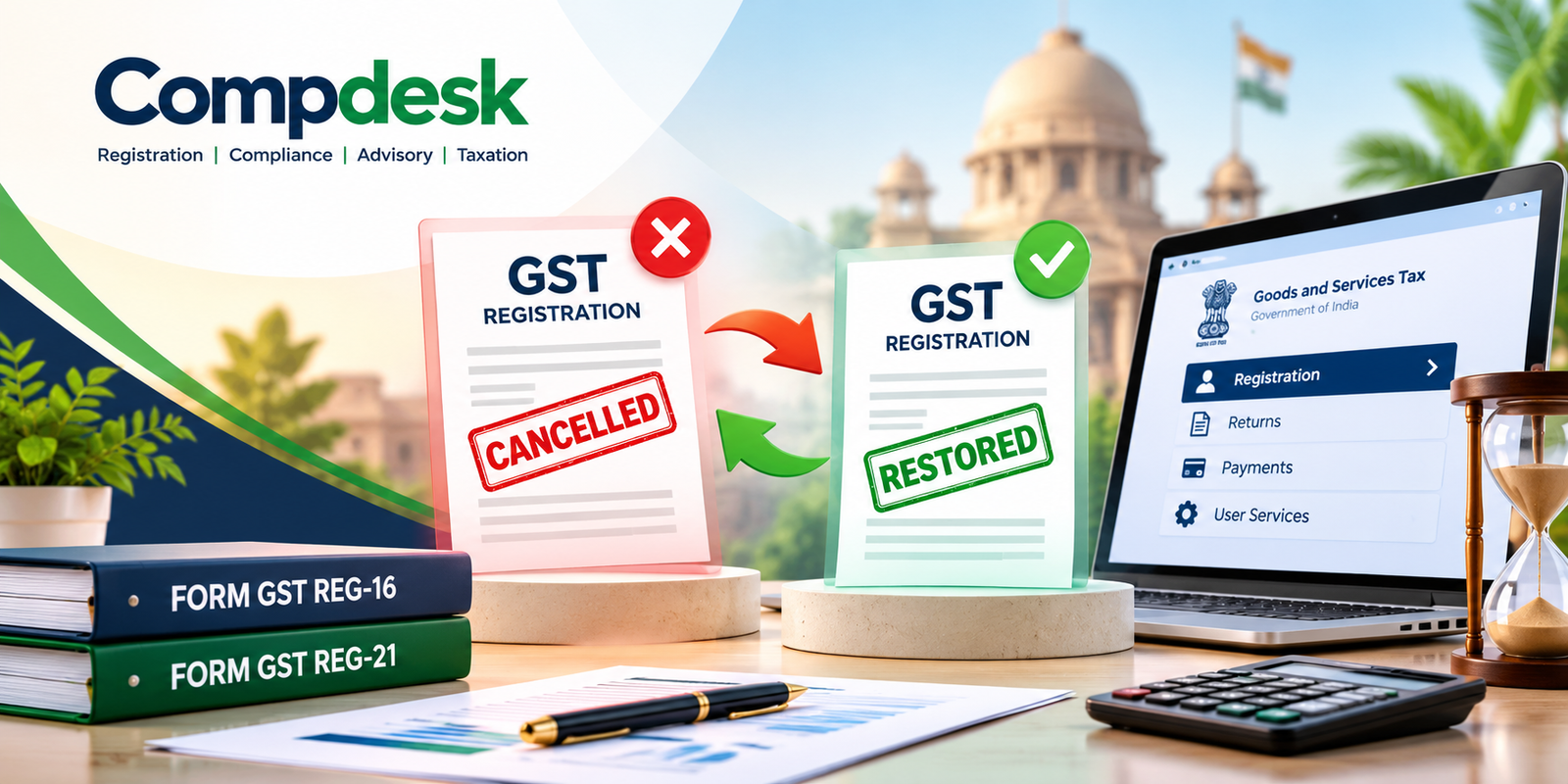
This guide explains GST registration cancellation and revocation in India, including the applicable forms, online process, government fees and time limits.
GST cancellation, suspension and revocation: what is the difference?
| Term | Meaning | Practical consequence |
|---|---|---|
| Cancellation | GST registration is terminated from the effective date specified in the order | The taxpayer must settle applicable past obligations and assess final-return requirements |
| Suspension | Registration is temporarily placed on hold while cancellation proceedings or specified compliance checks are pending | Restrictions apply to taxable supplies during suspension; see Rule 21A |
| Revocation | An officer-initiated cancellation is withdrawn through the prescribed process | Registration can be restored, subject to compliance with applicable conditions |
Important: A taxpayer who voluntarily applied for cancellation cannot ordinarily use the standard REG-21 revocation route. That route concerns cancellation initiated by the proper officer on the officer's own motion.
When can you cancel GST registration?
Section 29 of the CGST Act covers circumstances including:
- Permanent closure or discontinuance of business.
- Transfer of business, including qualifying business succession or disposal.
- Amalgamation, demerger or a change in constitution requiring a different registration or PAN.
- No longer being liable for compulsory registration, subject to the relevant statutory conditions.
- Opting out of a voluntarily obtained registration where permitted.
Falling below a turnover threshold does not automatically cancel an existing GSTIN. Consider compulsory-registration provisions, interstate supplies, e-commerce arrangements and other facts before applying.
The proper officer can also initiate cancellation for specified statutory or rule-based non-compliances, including relevant return defaults or other registration violations. The applicable grounds and notice should be checked against the law in force on the date of proceedings.
How to cancel GST registration online: Form GST REG-16
- Sign in at the official GST portal.
- Navigate to Services > Registration > Application for Cancellation of Registration.
- Select the appropriate cancellation reason and effective date requested.
- Complete the information requested about business closure or transfer, closing stock, capital goods and associated tax liability, as applicable.
- Review return-filing status and outstanding dues; attach supporting documents when relevant.
- Submit Form GST REG-16 using the permitted DSC or EVC verification method.
- Retain the application reference number (ARN) and monitor notices and the eventual cancellation order.
The general application period is 30 days from the event warranting cancellation under Rule 20. The government's October 2026 FAQ notes an exception to this filing-time requirement in the case of death of a sole proprietor.
A cancellation application is not itself proof that every historical GST liability has ended. The effective cancellation date, pending returns, tax balances and final-return position require separate checks.
Documents and information to prepare
The portal requirements vary with the cancellation reason. Typically prepare the GSTIN and authorised-signatory access, the date and reason for closure, evidence of closure or transfer if relevant, a closing-stock and capital-goods reconciliation, details of any successor entity, and an outstanding-tax and return-filing reconciliation.
When does the GST department cancel registration?
The department may issue a show-cause notice where the proper officer considers that cancellation grounds exist. Common situations include non-filing of prescribed returns, business not operating from the declared place, or other violations covered by the Act and rules.
Do not assume every portal warning is a final cancellation order. Review the notice, the deadline to reply, the effective date and the precise legal ground. In appropriate cases, timely compliance and a reasoned response may prevent cancellation.
GST revocation: who can apply and how?
Under Section 30 and Rule 23, a taxpayer whose registration was cancelled by the proper officer on the officer's own motion may seek revocation using Form GST REG-21.
Steps to apply for revocation
- Download the cancellation order and identify the date it was served.
- Establish why cancellation occurred and whether REG-21 is the correct remedy.
- Where cancellation was due to non-filing, furnish the required outstanding returns and pay tax, interest, penalty and late fees as applicable before seeking revocation.
- Log in to the GST portal and use the Revocation of Cancelled Registration service to submit REG-21, giving a clear explanation and supporting evidence.
- Track the application and respond promptly to any notice in REG-23 through REG-24.
- If revocation is approved, retain the order in REG-22 and complete applicable returns for the intervening period.
If the officer is not satisfied, the application can be rejected in REG-05, subject to the prescribed opportunity of being heard. A disputed rejection may require consideration of the statutory appeal route rather than simply repeating the same application.
Revocation time limits under Rule 23
| Requirement | Time limit under the verified Rule 23 framework |
|---|---|
| Ordinary REG-21 application | Within 90 days from service of the cancellation order |
| Possible extension | Up to 180 additional days, on sufficient cause and approval by the specified senior authority |
| Reply to REG-23 notice | Within 7 working days from service |
| Order where revocation is allowed | Ordinarily within 30 days from receipt of application |
| Decision after receiving REG-24 clarification | Within 30 days from receipt of clarification |
| Returns for prescribed intervening periods following revocation | Generally within 30 days of the revocation order, as provided by Rule 23 |
Do not confuse 90 days plus a possible 180-day extension with an automatic 270-day entitlement. An extension is discretionary and requires sufficient cause and the prescribed approval.
Important October 2026 procedural update
The Press Information Bureau FAQ published on 9 October 2026 describes further automated cancellation arrangements and a 180-day system-based revocation facility for specified non-compliances. It also refers to phased automated processing of voluntary cancellation applications and proposed changes to cancellation grounds.
These announcements must be checked against the relevant commencement notifications, amended statutory provisions, portal implementation and eligibility conditions before a taxpayer relies on them. The ordinary Rule 23 timeline above should not be replaced with a blanket claim that every cancelled GSTIN can be revived automatically within 180 days.
GST cancellation and revocation fees
| Cost component | What to expect |
|---|---|
| Government application fee for REG-16 | No separate filing fee ordinarily prescribed |
| Government application fee for REG-21 | No separate filing fee ordinarily prescribed |
| Outstanding GST liability | Payable where applicable |
| Interest and statutory late fees | Depend on the relevant return, default and applicable relief provisions |
| Professional assistance | Commercial fee charged by the service provider; not a government fee |
A nil government application fee does not mean nil cost of cancellation. Taxpayers should first quantify unresolved liabilities and possible closing-stock adjustments. Avoid relying on generic online professional-fee quotations without checking scope, return backlog and notice complexity.
What happens after GST registration is cancelled?
Final return: GSTR-10
Section 45 generally requires eligible taxpayers whose registration has been cancelled to file Form GSTR-10 within three months of the effective cancellation date or the cancellation-order date, whichever is later. Certain categories, including composition taxpayers, are treated differently under the relevant provisions. Confirm the category-specific applicability before filing.
Closing stock and input tax credit
Section 29(5) may require payment relating to inputs held in stock, inputs contained in semi-finished or finished goods, and capital goods or plant and machinery, subject to the statutory computation rules. The liability is not simply a blanket reversal of every input tax credit ever claimed.
Prepare an item-wise closing inventory and fixed-asset reconciliation and examine the relevant credit and output-tax comparison, including the rules for capital goods.
Historical liabilities remain
Cancellation does not erase tax, interest, penalties or other obligations relating to periods before cancellation. The final return, where required, is not a substitute for resolving earlier GSTR-1, GSTR-3B or other outstanding obligations.
Practical example
A company stops operating and applies to cancel its GST registration. Before submission, its finance team identifies unfiled returns and stock on which input tax credit was claimed. The team should reconcile those returns, establish the effective cessation date, calculate any applicable stock-related liability and determine whether GSTR-10 is required. Merely stopping sales does not complete GST closure.
Common mistakes to avoid
- Treating GST cancellation as automatic when business activity stops.
- Selecting a cancellation date without reconciling invoices and returns.
- Ignoring a show-cause notice because the business is no longer operating.
- Assuming REG-21 is available after voluntary cancellation.
- Applying for revocation after a non-filing cancellation without first clearing required returns and dues.
- Overlooking closing-stock and capital-goods implications.
- Assuming announced automation reforms apply to every GSTIN without checking commencement and portal availability.
Frequently asked questions
Can I cancel GST registration online without visiting the department?
Yes. The normal taxpayer-initiated cancellation process is available online through Form GST REG-16 on the GST portal. Additional verification or officer interaction may arise in individual cases.
What is the time limit to apply for GST cancellation?
The general Rule 20 period is 30 days from the event warranting cancellation. Specific exceptions and portal procedures should be checked for the facts involved.
Can a cancelled GST number be activated again?
Where cancellation was initiated by the proper officer, the prescribed revocation route may be available. A voluntarily cancelled registration does not ordinarily qualify for the same REG-21 route.
Is GST revocation possible after 90 days?
Rule 23 permits a further extension of up to 180 days with the prescribed approval and sufficient cause. Do not assume an extension is automatic; also check whether any later notified special procedure applies.
Which form is used for GST revocation?
Form GST REG-21 is the application. REG-22 is the revocation approval order, REG-23 is the notice proposing rejection, and REG-24 is the taxpayer's reply.
Is there a government fee for GST cancellation or revocation?
No separate ordinary application fee is prescribed, but tax, interest, late fees, penalties and professional charges may arise depending on the circumstances.
Is GSTR-10 mandatory after every GST cancellation?
No. Its applicability depends on the taxpayer category and statutory exclusions. Eligible taxpayers should check the three-month filing deadline.
Does GST cancellation remove earlier tax dues?
No. Cancellation does not discharge liabilities relating to earlier periods.
Get help with GST cancellation or revocation
Whether you are closing a business, correcting a cancellation caused by return defaults or responding to a GST notice, the correct approach starts with reviewing the GSTIN status, cancellation order, return backlog and financial exposure.
Compdesk can assist with reviewing the facts, identifying the appropriate filing route and coordinating the relevant GST compliance work. Explore our GST and other compliance services or service pricing.
Official sources and further reading
- CBIC: CGST Act, Section 29 — Cancellation or suspension of registration
- CBIC: CGST Rules, Rule 23 — Revocation of cancellation
- CBIC: CGST Rules, Rule 21A — Suspension
- PIB: FAQs on cancellation of GST registration, 9 October 2026
- GST Portal: Registration user guides
- CBIC: Circular 69/43/2018-GST on cancellation and final returns

Meera is the Compliance Head at Compdesk, with over 10 years of experience in ROC filings, GST, income tax, and statutory compliance. She helps businesses understand regulatory requirements, maintain accurate filings,...
View full profileDon’t let GST Registration eat your week.
Our experts handle the filing end to end. You track every step online.