
In this guide 71 sections
- LLP Annual Compliance at a Glance
- What Is LLP Annual Compliance?
- Is Annual Filing Mandatory for Every LLP?
- LLP Annual Compliance Due Dates for FY 2025–26
- LLP Form 11 — Annual Return
- What Information Is Reported in Form 11?
- Can Form 11 Be Filed Before Completing Form 8?
- Professional Certification of Form 11
- Practical Checks Before Filing Form 11
- LLP Form 8 — Statement of Account and Solvency
- What Does Form 8 Contain?
- Form 8 Attachments
- Who Signs Form 8?
- LLP Audit Requirement — The Rule Is Often Misstated
- Important: Form 8 Certification Is Not Worded the Same as the Audit Exemption
- What Is a Small LLP?
- Form 11 and Form 8 Normal MCA Filing Fees
- Additional Fees for Late Form 11 and Form 8 Filing
- Additional Filing Fee Is Not the Same as Statutory Penalty
- Statutory Penalty for Delay in Form 8
- Statutory Penalty for Delay in Form 11
- Important Adjudication Relief for Rectified Annual Filing Defaults
- Reduced Statutory Penalties for Small and Start-up LLPs
- Form 11 vs Form 8 — Key Differences
- Documents and Information to Keep Ready
- Recommended Finance-Team Reconciliations
- Common LLP Annual Compliance Mistakes
- Practical Example 1 — Small LLP With No Turnover
- Practical Example 2 — Turnover ₹70 Lakh, Contribution ₹10 Lakh
- Practical Example 3 — Turnover ₹1 Crore, Contribution ₹50 Lakh
- Annual Compliance Workflow for LLPs
- Frequently Asked Questions
- LLP Annual Compliance Checklist
- Need Help With LLP Annual Compliance?
- Disclaimer
Last Reviewed 07 November 2026
A Limited Liability Partnership (LLP) has fewer corporate-law compliances than a private limited company, but it is not a "no-compliance" structure.
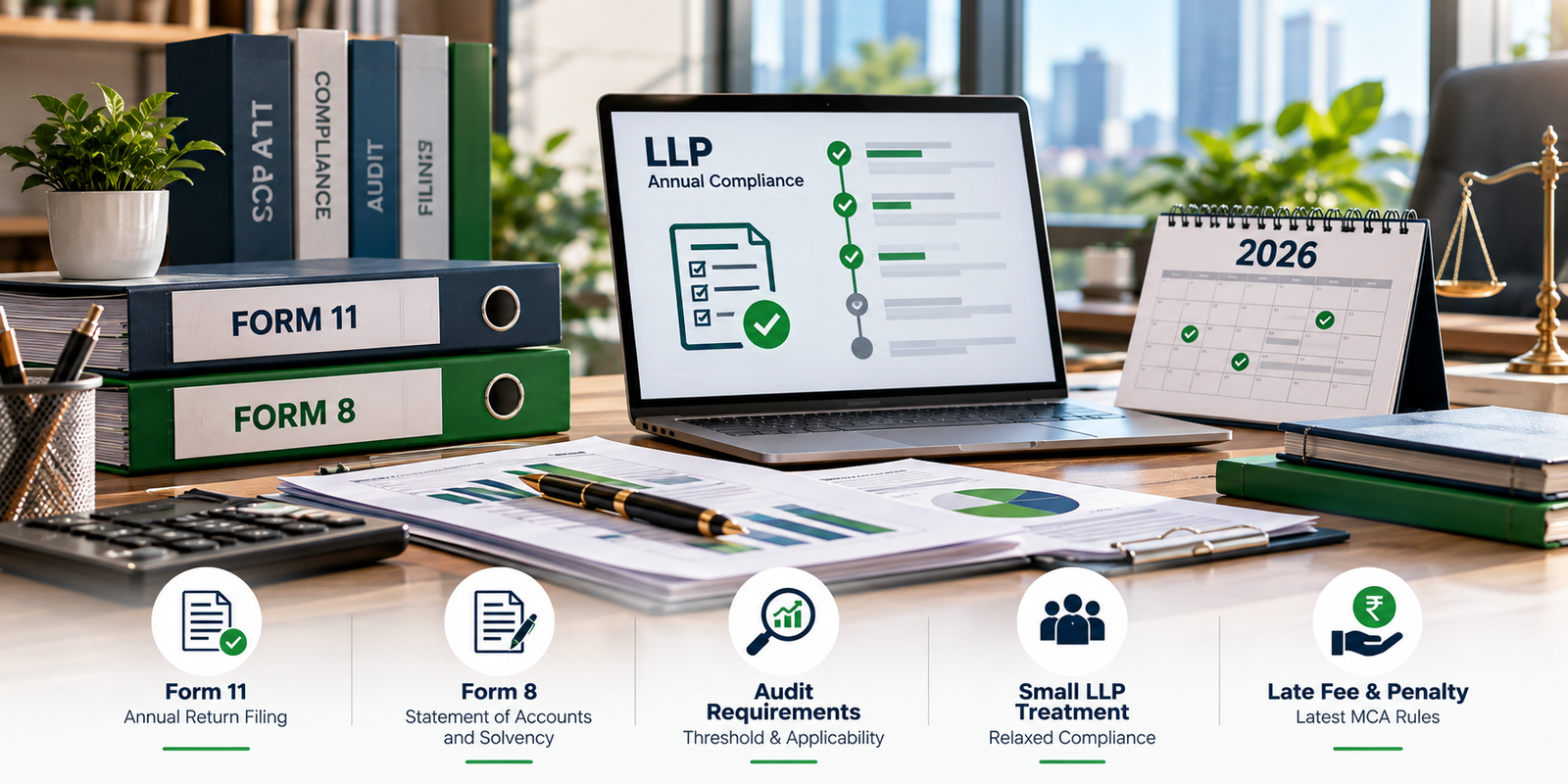
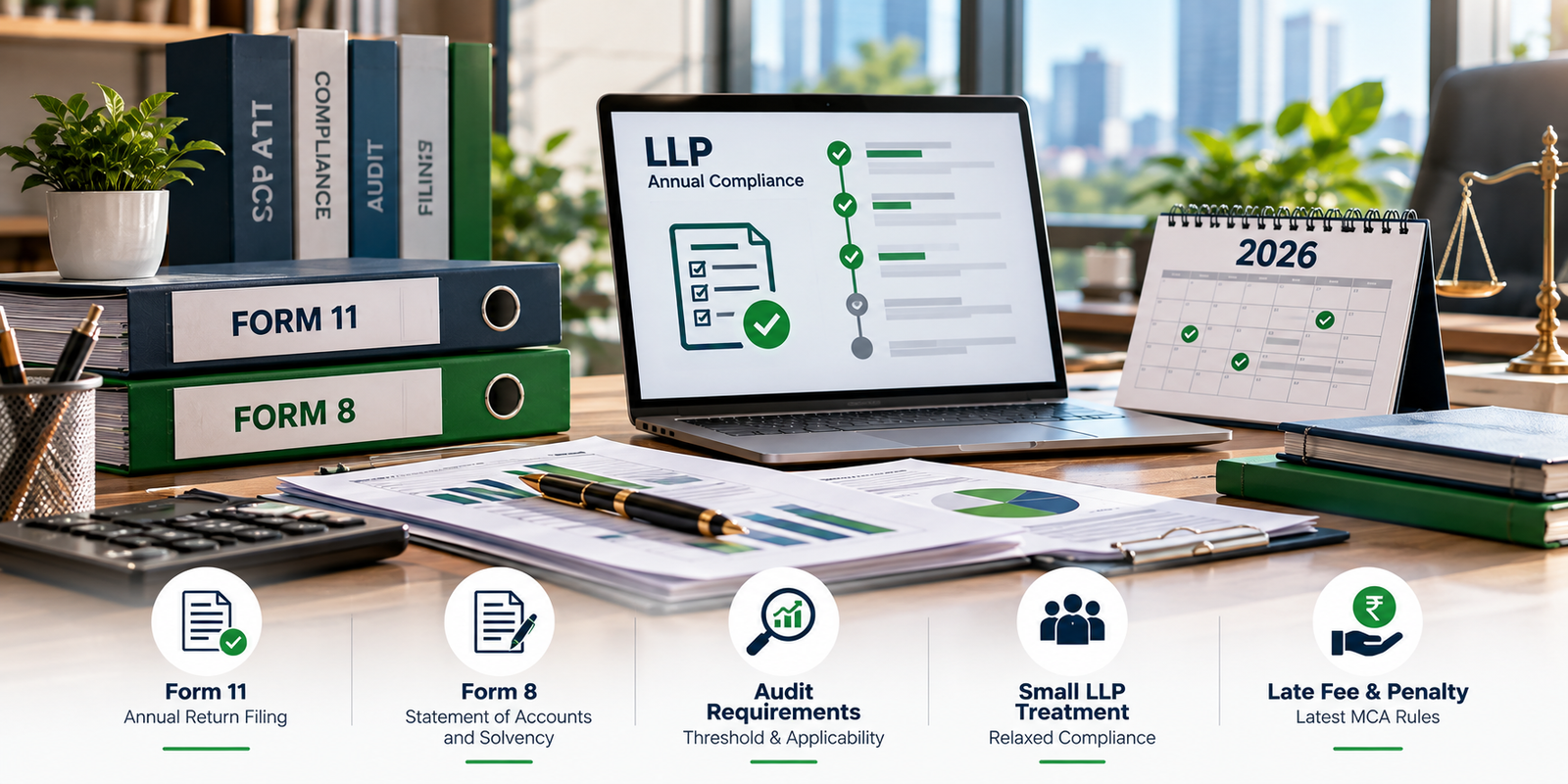
Every registered LLP is generally required to complete annual MCA filings even if it had little business activity, made a loss or had no turnover during the year. For most LLPs, the two core annual filings are:
- Form 11 – Annual Return of LLP
- Form 8 – Statement of Account and Solvency
For FY 2025–26, the normal Form 11 due date was 30 May 2026, while Form 8 is normally due by 30 October 2026 for an LLP following the standard 31 March year-end.
As of 24 September 2026, the normal Form 11 due date for FY 2025–26 has already passed. An LLP that has not yet filed should therefore review the applicable additional filing fee and regularise the default rather than waiting for Form 8.
This guide explains the current LLP annual compliance framework, due dates, audit requirements, Small LLP rules, MCA fees, late-filing consequences and practical filing controls.
LLP Annual Compliance at a Glance
| Compliance | Form / requirement | Normal timeline for 31 March year-end |
|---|---|---|
| Annual Return | LLP Form 11 | Within 60 days of financial-year end — normally 30 May |
| Prepare Statement of Account and Solvency | Section 34 requirement | Within 6 months of financial-year end |
| File Statement of Account and Solvency | LLP Form 8 | Within 30 days after the end of six months — normally 30 October |
| LLP statutory audit | Where Rule 24(8) requires it | Complete before finalising relevant annual accounts/form |
| Income-tax return | ITR-5, generally | Separate Income-tax Act timeline depending on facts |
| GST/TDS and other tax compliances | If applicable | Separate law-specific timelines |
Important: Form 11 and Form 8 are MCA filings under the LLP Act framework. Income-tax, GST, TDS and other tax compliances are separate and do not replace these filings.
What Is LLP Annual Compliance?
LLP annual compliance refers to the recurring financial, statutory and filing obligations that an LLP must complete under the Limited Liability Partnership Act, 2008 and the Limited Liability Partnership Rules, 2009.
The two principal annual filings are:
Form 11 — Annual Return
Form 11 reports key constitutional and partner-related information about the LLP.
Form 8 — Statement of Account and Solvency
Form 8 reports the LLP's prescribed financial information and solvency position.
These forms serve different purposes. Filing one does not eliminate the requirement to file the other.
Is Annual Filing Mandatory for Every LLP?
In general, yes.
An LLP that remains registered with the Ministry of Corporate Affairs ordinarily continues to have annual filing obligations even if:
- it had no turnover;
- no invoices were raised;
- there were only a few bank transactions;
- the LLP made a loss;
- business operations were temporarily stopped; or
- the partners intend to close the LLP later.
A dormant or commercially inactive LLP should therefore not simply stop filing.
Where the LLP is genuinely no longer required, the partners should separately evaluate whether the LLP is eligible for closure/striking-off rather than allowing annual filing defaults to continue accumulating.
LLP Annual Compliance Due Dates for FY 2025–26
For an LLP whose financial year ended on 31 March 2026:
| Filing | Statutory basis | Due date for FY 2025–26 |
|---|---|---|
| Form 11 | Within 60 days of closure of financial year | 30 May 2026 |
| Form 8 | Within 30 days after completion of six months from financial-year end | 30 October 2026 |
Current position as of 24 September 2026
- The normal Form 11 deadline has already passed.
- The normal Form 8 deadline is approaching on 30 October 2026.
- A pending Form 11 should not be ignored merely because Form 8 is not yet due.
Where a Government relaxation, portal-specific extension or case-specific order applies, the actual filing position should be checked against the current MCA notification/circular.
LLP Form 11 — Annual Return
Form 11 is the annual return of an LLP and is governed by Section 35 of the LLP Act read with the applicable LLP Rules.
Every LLP is required to file the annual return within 60 days from the close of its financial year.
For a standard financial year ending 31 March, this normally results in a due date of 30 May.
What Information Is Reported in Form 11?
Form 11 generally captures information such as:
- LLP name and LLPIN;
- registered-office details;
- principal business activities;
- details of partners and designated partners;
- contribution agreed by partners;
- contribution received;
- changes in partners/designated partners;
- turnover information; and
- other prescribed annual-return information.
The partner and contribution information in Form 11 should reconcile with:
- the LLP Agreement;
- Form 3;
- Form 4;
- MCA master data;
- books of account; and
- the corresponding annual financial information.
Can Form 11 Be Filed Before Completing Form 8?
Yes, because Form 11 is due earlier.
In fact, for a 31 March year-end, Form 11 is normally due on 30 May while Form 8 is normally due on 30 October.
However, the figures reported in Form 11 should still be based on reliable financial and statutory records. Filing Form 11 early without reconciling partner contribution, turnover and changes in partners can create inconsistencies that later surface in Form 8.
Professional Certification of Form 11
The current MCA Form 11 instruction framework requires professional certification by a Company Secretary in whole-time practice when the applicable contribution or turnover threshold is crossed.
The current instruction kit activates professional certification where:
- total obligation of contribution is ₹50 lakh or more; or
- turnover is ₹5 crore or more.
Below the applicable certification threshold, the designated partner certifies the annual return through the form workflow.
Because filing logic and certification fields can be updated through MCA V3, the applicable certification requirement should be checked when preparing the actual form.
Practical Checks Before Filing Form 11
Before filing, reconcile:
- opening and closing partner list;
- designated partner details;
- partner contribution as per LLP Agreement;
- contribution actually received;
- Form 3 amendments;
- Form 4 partner changes;
- turnover for the year;
- pending partner-related filings; and
- DSC status of the designated partner.
The current Form 11 instruction kit also warns that filing can be blocked where a relevant Form 4 is pending for payment or processing.
LLP Form 8 — Statement of Account and Solvency
Form 8 is the prescribed filing through which an LLP reports its Statement of Account and Solvency.
Section 34 requires every LLP to prepare the Statement of Account and Solvency within six months from the end of the financial year.
Rule 24 then requires Form 8 to be filed within 30 days from the end of those six months.
For a 31 March year-end:
- six months end on 30 September; and
- Form 8 is normally due by 30 October.
What Does Form 8 Contain?
Form 8 generally captures:
- contribution received from partners;
- reserves and surplus;
- secured and unsecured loans;
- trade payables and other liabilities;
- fixed assets;
- investments;
- loans and advances;
- inventories;
- receivables;
- cash and cash equivalents;
- income and expenditure information;
- statement/declaration regarding solvency; and
- prescribed charge-related information where applicable.
The figures should reconcile with the LLP's books of account and supporting schedules.
Form 8 Attachments
The MCA Form 8 framework requires or permits supporting attachments depending on the facts.
The filing instructions include:
- disclosure under the Micro, Small and Medium Enterprises Development Act, 2006;
- statement of contingent liabilities where applicable; and
- optional supporting information where required.
The LLP should therefore identify MSME creditors and contingent liabilities before the form is prepared rather than treating Form 8 as a simple balance-sheet upload.
Who Signs Form 8?
The current form requires digital signing by the prescribed designated partners/authorised representatives.
Where professional or auditor certification applies, the relevant certification should also be completed before submission.
LLP Audit Requirement — The Rule Is Often Misstated
One of the most common errors in LLP compliance articles is to state:
"Audit is compulsory if turnover exceeds ₹40 lakh OR contribution exceeds ₹25 lakh."
That is not how the current wording of Rule 24(8) is structured.
The rule provides an audit exemption to an LLP:
- whose turnover does not exceed ₹40 lakh; or
- whose contribution does not exceed ₹25 lakh.
Read literally, this means the LLP remains exempt from statutory audit under the LLP Rules if either exemption condition is satisfied.
Accordingly, mandatory statutory audit under Rule 24(8) is triggered where:
- turnover exceeds ₹40 lakh; and
- contribution exceeds ₹25 lakh.
Statutory Audit Test
| Turnover | Contribution | LLP statutory audit under Rule 24(8) |
|---|---|---|
| ≤ ₹40 lakh | ≤ ₹25 lakh | Not mandatory |
| > ₹40 lakh | ≤ ₹25 lakh | Not mandatory under the literal Rule 24(8) exemption |
| ≤ ₹40 lakh | > ₹25 lakh | Not mandatory under the literal Rule 24(8) exemption |
| > ₹40 lakh | > ₹25 lakh | Mandatory |
An LLP that is exempt can still choose to have its accounts audited voluntarily.
Do Not Confuse LLP Audit With Income-Tax Audit
A tax audit is governed by the applicable Income-tax law and uses separate turnover, business/profession and transaction tests.
An LLP may therefore:
- not require an LLP Act audit but require a tax audit; or
- require an LLP Act audit independently of the tax position.
The two tests should be performed separately.
Important: Form 8 Certification Is Not Worded the Same as the Audit Exemption
This is a technical point that deserves separate attention.
The current MCA Form 8 instruction kit states that the webform should be certified by the LLP's auditor where:
- turnover exceeds ₹40 lakh; or
- partner contribution exceeds ₹25 lakh.
That filing-certification language is not identical to the statutory-audit exemption wording in Rule 24(8).
Therefore, an LLP can fall into a crossover situation where one threshold is exceeded but the other remains within the Rule 24(8) exemption.
Example
Suppose an LLP has:
- turnover of ₹70 lakh; and
- contribution of ₹10 lakh.
Under the literal Rule 24(8) wording, the LLP remains within the contribution-based audit exemption because contribution does not exceed ₹25 lakh.
However, the current Form 8 instruction kit uses a separate certification trigger based on turnover exceeding ₹40 lakh.
This is why statutory audit applicability and Form 8 certification should not be treated as the same legal test.
In crossover cases, the filing should be reviewed by a professional against the current MCA form logic and applicable rules before submission.
What Is a Small LLP?
The concept of a Small LLP was introduced into the LLP Act to provide proportionate compliance treatment to smaller entities.
Under Section 2(1)(ta), the currently relevant base thresholds are:
- contribution not exceeding ₹25 lakh; and
- turnover, based on the Statement of Account and Solvency for the immediately preceding financial year, not exceeding ₹40 lakh.
The Act permits higher amounts to be prescribed within specified ceilings, but the base thresholds above remain the relevant current limits for determining Small LLP status unless changed by notification.
Why Small LLP Status Matters
Small LLP status can affect:
- additional filing-fee slabs;
- statutory penalty relief;
- compliance cost; and
- certain procedural requirements.
Do not assume that an LLP is "small" merely because turnover is below ₹40 lakh. Both the contribution and turnover limbs should be tested.
Form 11 and Form 8 Normal MCA Filing Fees
For LLPs registered in India, the current normal document filing fee for Forms 11 and 8 is linked to the LLP's contribution.
| Contribution amount | Normal filing fee |
|---|---|
| Up to ₹1 lakh | ₹50 |
| Above ₹1 lakh and up to ₹5 lakh | ₹100 |
| Above ₹5 lakh and up to ₹10 lakh | ₹150 |
| Above ₹10 lakh and up to ₹25 lakh | ₹200 |
| Above ₹25 lakh and up to ₹1 crore | ₹400 |
| Above ₹1 crore | ₹600 |
These are Government filing fees. Professional fees for accounting, audit, certification or compliance support are separate.
The MCA instruction kits also state that fees remain subject to amendments to the Act, Rules and notifications, so the amount generated by the MCA portal at filing should be treated as the final payable Government fee.
Additional Fees for Late Form 11 and Form 8 Filing
Late filing attracts additional filing fees over and above the normal filing fee.
The current MCA fee structure differentiates between:
- Small LLPs; and
- LLPs other than Small LLPs.
Current Additional Fee Structure
| Delay | Small LLP | Other than Small LLP |
|---|---|---|
| Up to 15 days | 1× normal filing fee | 1× normal filing fee |
| More than 15 days and up to 30 days | 2× | 4× |
| More than 30 days and up to 60 days | 4× | 8× |
| More than 60 days and up to 90 days | 6× | 12× |
| More than 90 days and up to 180 days | 10× | 20× |
| More than 180 days and up to 360 days | 15× | 30× |
| Beyond 360 days | 15× + ₹10 per day beyond 360 days | 30× + ₹20 per day beyond 360 days |
This structure applies in addition to the normal filing fee.
Example of Late Filing Cost
Assume:
- normal filing fee = ₹200;
- LLP is not a Small LLP; and
- filing delay falls between 31 and 60 days.
The applicable additional fee would be:
₹200 × 8 = ₹1,600 additional fee
The normal filing fee would still be payable separately.
This illustration covers the MCA filing-fee consequence only. It does not represent every possible statutory penalty or professional cost.
Additional Filing Fee Is Not the Same as Statutory Penalty
This distinction is important.
Additional filing fee
This is the amount calculated by the MCA system because the form is being filed after its prescribed due date.
Statutory penalty
Sections 34 and 35 of the LLP Act contain separate penalty provisions for continuing filing defaults.
A delayed LLP may therefore face:
- additional filing fees when it eventually files the form; and
- separate statutory penalty exposure under the Act.
Calling both items simply "late fee" can understate the legal exposure.
Statutory Penalty for Delay in Form 8
Section 34(5) provides that where an LLP fails to file the Statement of Account and Solvency within the prescribed time:
- the LLP is liable to a penalty of ₹100 for each day of continuing failure, subject to a maximum of ₹1 lakh; and
- every designated partner is liable to ₹100 for each day of continuing failure, subject to a maximum of ₹50,000 per designated partner.
Section 34 separately contains stronger consequences for failures relating to maintenance of books, preparation of the Statement of Account and Solvency and audit obligations.
Statutory Penalty for Delay in Form 11
Section 35(2) provides that where an LLP fails to file its annual return within the prescribed period:
- the LLP is liable to ₹100 per day of continuing failure, capped at ₹1 lakh; and
- designated partners are liable to ₹100 per day, capped at ₹50,000.
Again, this statutory penalty is conceptually separate from the additional filing fee charged when the overdue form is filed.
Important Adjudication Relief for Rectified Annual Filing Defaults
The LLP Act contains an important compliance-relief mechanism.
Under Section 76A, where a default relating to:
- Section 34(3) — filing of the Statement of Account and Solvency; or
- Section 35(1) — filing of the annual return,
is rectified before or within 30 days of issue of the adjudication notice, no penalty is to be imposed for that default and the adjudication proceeding is treated as concluded.
This does not mean that the original filing due date can be ignored.
It also does not necessarily remove the additional filing fee payable through MCA for delayed submission.
The practical message is simple: if a filing default exists, early rectification is materially better than waiting for enforcement action.
Reduced Statutory Penalties for Small and Start-up LLPs
Section 76A also provides reduced statutory penalty treatment for qualifying:
- Small LLPs; and
- start-up LLPs recognised under the applicable Government framework.
The relief operates through a reduced penalty framework under the Act, subject to the statutory conditions and caps.
This should not be confused with the separate MCA additional-fee slabs, which already differentiate between Small LLPs and other LLPs.
Form 11 vs Form 8 — Key Differences
| Area | Form 11 | Form 8 |
|---|---|---|
| Purpose | Annual Return | Statement of Account and Solvency |
| Core law | Section 35 | Section 34 |
| Normal 31 March year-end due date | 30 May | 30 October |
| Primary focus | Partners, contribution and LLP particulars | Financial position and solvency |
| Financial statements | Not a substitute for accounts | Contains prescribed financial information |
| Professional certification | Triggered under current form rules at prescribed contribution/turnover levels | Certification requirements depend on current Form 8 rules and thresholds |
| Can one replace the other? | No | No |
Documents and Information to Keep Ready
A well-managed LLP should maintain an annual compliance file containing:
- LLP incorporation certificate;
- LLP Agreement and supplementary agreements;
- prior Form 3 filings;
- prior Form 4 filings;
- latest Form 11;
- latest Form 8;
- partner and designated partner list;
- contribution agreed and contribution received schedule;
- trial balance;
- general ledger;
- bank statements and bank reconciliation;
- fixed-asset schedule;
- loan and borrowing schedule;
- trade receivable and payable ageing;
- MSME supplier details;
- contingent liability information;
- tax balances and provisions;
- turnover reconciliation;
- DSC status of designated partners; and
- audit working papers/reports where applicable.
Recommended Finance-Team Reconciliations
Before annual filing, reconcile the following:
| Area | Reconcile between |
|---|---|
| Partner contribution | LLP Agreement, Form 3, books and Form 11 |
| Partner changes | LLP Agreement, Form 4, MCA records and Form 11 |
| Turnover | Trial balance, financial statements, GST records and Form 11/Form 8 |
| Contribution received | Books, partner ledgers and Form 8 |
| Loans | General ledger, agreements and Form 8 |
| MSME creditors | Vendor master, ageing and Form 8 disclosure |
| Taxes | Books, GST/TDS returns and financial statements |
| Designated partners | MCA master data, DIN/DPIN records and DSCs |
A large proportion of annual filing errors arise not from misunderstanding the form, but from using unreconciled underlying records.
Common LLP Annual Compliance Mistakes
1. Assuming No Turnover Means No Filing
An LLP can have no turnover and still be required to file Form 11 and Form 8.
2. Waiting Until October to Start All Annual Compliance
Form 11 is normally due in May. Waiting until Form 8 season means the annual return may already be overdue.
3. Using the Wrong Audit Test
The Rule 24(8) statutory-audit exemption is commonly misquoted. The turnover and contribution wording should be read carefully.
4. Treating Form 8 Certification as Identical to Audit Applicability
The current Form 8 instruction kit uses a separate certification trigger. These should be tested independently.
5. Ignoring Form 3 and Form 4 Mismatches
A partner or contribution change that was never correctly filed can make annual-return preparation difficult.
6. Reporting Contribution Agreed Instead of Contribution Received
These are different concepts and should be reconciled to the LLP Agreement and books.
7. Ignoring MSME Information
Form 8 requires attention to MSME-related disclosure requirements.
8. Confusing Additional Fees With Statutory Penalties
Paying the MCA late fee does not necessarily mean all legal consequences of the default disappear.
9. Filing Without Checking DSC Status
An expired or unassociated DSC can delay submission close to the due date.
10. Treating Tax Audit and LLP Audit as the Same Requirement
They arise under different laws and must be tested separately.
Practical Example 1 — Small LLP With No Turnover
Assume XYZ LLP has:
- contribution of ₹5 lakh;
- no turnover during FY 2025–26; and
- no change in partners.
The LLP may still need to:
- file Form 11;
- prepare the Statement of Account and Solvency;
- file Form 8; and
- complete applicable income-tax and other tax compliances.
Nil turnover does not itself remove MCA annual filing obligations.
Because both contribution and turnover are within the current Small LLP limits, the LLP may qualify as a Small LLP, subject to the complete statutory definition.
Practical Example 2 — Turnover ₹70 Lakh, Contribution ₹10 Lakh
Assume ABC LLP has:
- turnover of ₹70 lakh; and
- contribution of ₹10 lakh.
The LLP does not satisfy the Small LLP turnover test.
However, under the literal Rule 24(8) wording, contribution remains within ₹25 lakh, so the LLP can still fall within the statutory-audit exemption.
At the same time, the current Form 8 instruction kit uses turnover exceeding ₹40 lakh as one of its certification triggers.
This is a classic example where:
- Small LLP classification;
- statutory audit; and
- Form 8 certification
must be analysed separately.
Practical Example 3 — Turnover ₹1 Crore, Contribution ₹50 Lakh
Assume DEF LLP has:
- turnover of ₹1 crore; and
- contribution of ₹50 lakh.
Both Rule 24(8) exemption limits are exceeded, so statutory audit is required.
The LLP is also outside the current Small LLP thresholds.
Its Form 8 certification and Form 11 certification requirements should then be checked under the applicable form instructions.
Annual Compliance Workflow for LLPs
Phase 1 — April: Close the Books
- complete bank reconciliations;
- reconcile partners' capital/current accounts;
- finalise turnover;
- identify MSME creditors;
- review partner changes; and
- check whether Form 3/Form 4 updates are pending.
Phase 2 — Before Form 11
- verify partner details;
- reconcile contribution;
- determine turnover;
- assess Small LLP status;
- check professional-certification requirement; and
- file Form 11 before the applicable deadline.
Phase 3 — Finalise Accounts
- complete accounting adjustments;
- perform audit assessment;
- complete statutory audit where required;
- prepare financial schedules; and
- review solvency information.
Phase 4 — Before Form 8
- reconcile Form 11 with final accounts;
- prepare Statement of Account and Solvency;
- identify MSME and contingent-liability disclosures;
- test Form 8 certification requirement;
- confirm DSC status; and
- file within the applicable deadline.
Phase 5 — Post-Filing Control
- archive SRNs and challans;
- retain filed forms;
- update the compliance calendar;
- document unresolved issues; and
- schedule the following year's compliance well in advance.
Frequently Asked Questions
1. What is the due date for LLP Form 11 for FY 2025–26?
For an LLP with a financial year ending on 31 March 2026, the normal Form 11 due date was 30 May 2026, being 60 days from the close of the financial year.
2. What is the due date for LLP Form 8 for FY 2025–26?
For a standard 31 March 2026 year-end, Form 8 is normally due by 30 October 2026.
3. Is LLP annual filing mandatory when there is no turnover?
Generally, yes. An LLP that remains registered ordinarily continues to have Form 11 and Form 8 filing obligations even if turnover is nil.
4. What is the difference between Form 11 and Form 8?
Form 11 is the LLP's annual return containing partner, contribution and other statutory information. Form 8 contains the Statement of Account and Solvency and prescribed financial information.
5. Is statutory audit mandatory if LLP turnover exceeds ₹40 lakh?
Not necessarily by turnover alone. Rule 24(8) exempts an LLP where turnover does not exceed ₹40 lakh or contribution does not exceed ₹25 lakh. Under the literal rule, mandatory LLP statutory audit arises when both exemption limits are exceeded. Tax-audit rules are separate.
6. What is a Small LLP?
A Small LLP generally means an LLP whose contribution does not exceed ₹25 lakh and whose turnover in the immediately preceding financial year does not exceed ₹40 lakh, subject to the complete statutory definition and any future notified changes.
7. What is the late fee for Form 11 or Form 8?
Additional filing fees are based on the normal filing fee, the length of delay and whether the entity is a Small LLP. The current slabs increase progressively and can continue with daily amounts beyond 360 days.
8. Is the MCA additional fee the only consequence of late LLP filing?
No. The LLP Act separately provides statutory penalties for continuing defaults under Sections 34 and 35. Additional filing fees and statutory penalties are different concepts.
9. Can an LLP file Form 8 if Form 11 is pending?
The forms have separate statutory requirements, but pending earlier filings, inconsistent partner data or other MCA processing issues can affect the annual filing process. It is preferable to regularise Form 11 and reconcile the records before Form 8 is finalised.
10. Do LLPs need to file an income-tax return in addition to Form 11 and Form 8?
Yes, where required under the Income-tax law. ITR filing is separate from MCA annual filing and follows its own due-date and audit framework.
LLP Annual Compliance Checklist
Before completing the FY 2025–26 filing cycle, confirm:
- books of account updated;
- partner contribution reconciled;
- Form 3 amendments reviewed;
- Form 4 partner changes reviewed;
- Small LLP status tested;
- Form 11 filed or pending default regularised;
- statutory-audit test performed correctly;
- tax-audit test separately reviewed;
- final accounts prepared;
- MSME creditor information reviewed;
- contingent liabilities identified;
- Form 8 certification requirement tested;
- Form 8 prepared for filing by the applicable due date;
- DSCs checked;
- Government fees/additional fees verified on MCA;
- SRNs and challans archived; and
- income-tax, GST and TDS compliances separately reviewed.
Need Help With LLP Annual Compliance?
LLP compliance becomes more complicated when partner records, contribution, turnover, audit thresholds and prior MCA filings do not reconcile.
Compliance Desk can help review the LLP's annual compliance position, identify pending filings and support Form 11, Form 8 and related compliance requirements.
Explore Compliance Desk services or review available service and pricing options.
Disclaimer
This article is for general informational purposes and reflects the LLP annual compliance framework reviewed as of 24 September 2026 for the FY 2025–26 filing cycle. MCA forms, fee structures, notifications, tax rules and filing procedures may change, and applicability depends on the LLP's specific facts. Professional advice should be obtained for case-specific filing, audit, tax or regularisation decisions.

Meera is the Compliance Head at Compdesk, with over 10 years of experience in ROC filings, GST, income tax, and statutory compliance. She helps businesses understand regulatory requirements, maintain accurate filings,...
View full profileDon’t let LLP Annual Compliance eat your week.
Our experts handle the filing end to end. You track every step online.