
In this guide 91 sections
- GST Registration 2026 : Quick Answer
- What Is GST Registration?
- GST Registration Turnover Limit in India in 2026
- Who Cannot Use the ₹40 Lakh Goods Exemption?
- What Is "Aggregate Turnover" for GST Registration?
- Who Is Not Liable for GST Registration?
- Compulsory GST Registration : Turnover Threshold May Not Protect You
- Does an Interstate Service Provider Need GST Registration Below ₹20 Lakh?
- Does Selling Through Amazon, Flipkart or Another E-Commerce Platform Require GST Registration?
- When Should You Apply for GST Registration?
- Can You Take GST Registration Voluntarily?
- Documents Required for GST Registration
- Address Proof for GST Registration
- Is a Bank Account Mandatory at the GST Registration Stage?
- GST Registration Process : Step by Step
- Step 1: Go to the GST Portal
- Step 2: Complete Part A of GST REG-01
- Step 3: Generate the Temporary Reference Number
- Step 4: Complete Business Details
- Step 5: Add Promoters / Partners / Directors
- Step 6: Add Authorised Signatory
- Step 7: Add Principal Place of Business
- Step 8: Add Additional Places of Business
- Step 9: Add Goods and Services
- Step 10: Complete Aadhaar Authentication / E-KYC
- Step 11: Sign and Submit GST REG-01
- Step 12: Receive ARN
- Step 13: Respond to Clarification, If Issued
- Step 14: Download GST Registration Certificate
- Aadhaar Authentication and Biometric Verification in 2026
- How Long Does GST Registration Take in 2026?
- GST Registration Government Fees
- GST Registration Is State-Specific
- Common GST Registration Mistakes
- Practical GST Registration Examples
- Frequently Asked Questions
- Need Help With GST Registration?
Last Reviewed 07 November 2026
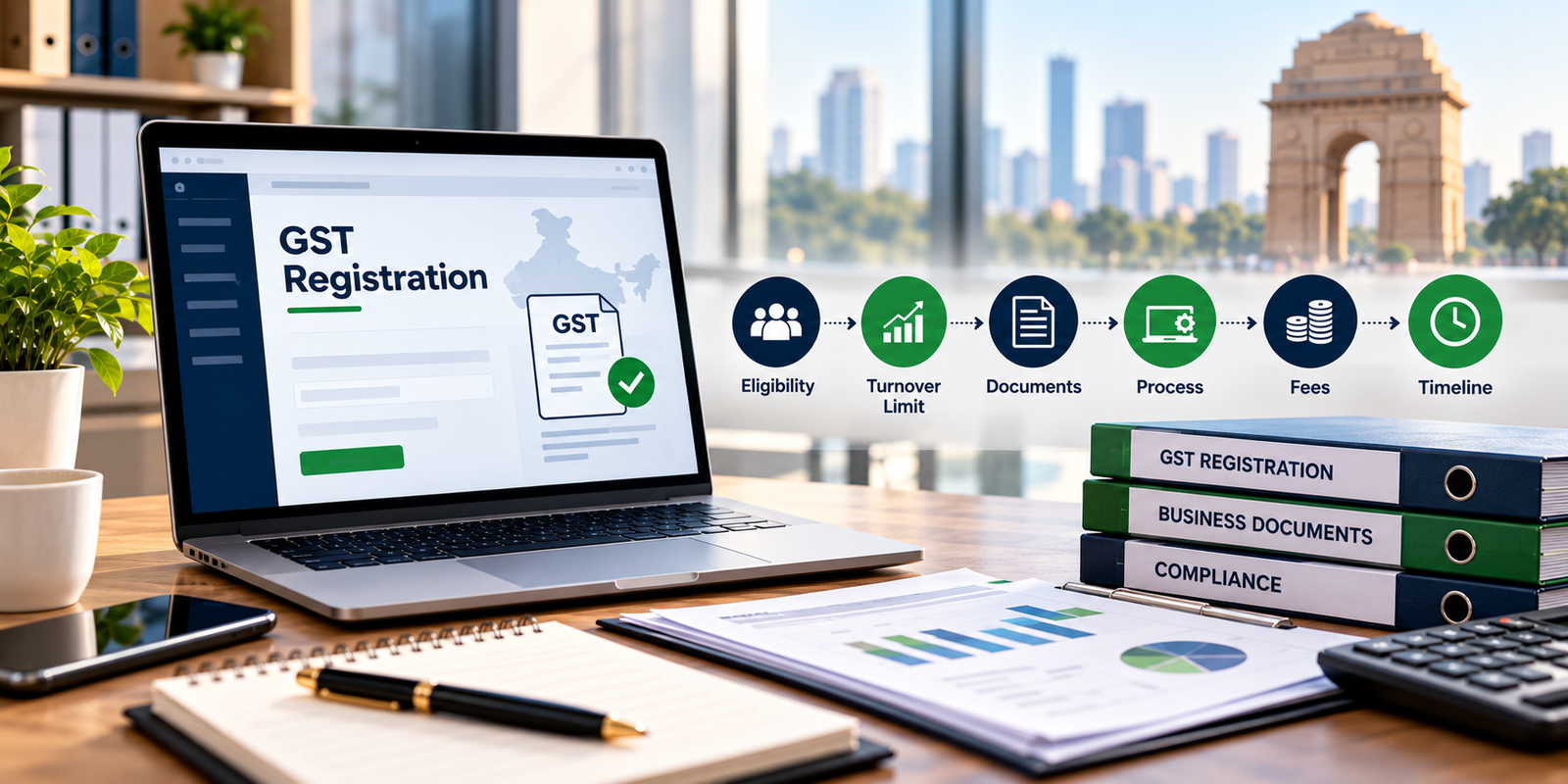
Eligibility, turnover limit, documents, process, fees and timeline
GST registration is not required for every business in India from the day it starts.
Whether registration is mandatory depends on factors such as:
- aggregate turnover;
- whether you supply goods, services or both;
- the State or Union Territory from which supplies are made;
- whether a compulsory-registration provision applies;
- whether you sell through an e-commerce operator;
- whether your supplies are exempt or non-taxable; and
- the nature of your business.
For many businesses, the headline GST registration threshold is ₹40 lakh for eligible suppliers exclusively supplying goods and ₹20 lakh for suppliers of services or mixed supplies. But those numbers are not universal. Lower thresholds apply in specified States, and compulsory-registration rules can override the turnover threshold in certain cases.
This guide explains the GST registration rules applicable in 2026, including current turnover limits, compulsory-registration situations, e-commerce rules, required documents, Aadhaar authentication, the online registration process, Government fees and expected processing timelines.
GST Registration 2026 : Quick Answer
| Question | Current position |
|---|---|
| Normal threshold for eligible exclusive suppliers of goods | Up to ₹40 lakh in most States/UTs, subject to conditions |
| Goods threshold in specified States/UT | ₹20 lakh |
| Normal threshold for services / mixed supplies | ₹20 lakh in most States/UTs |
| Service threshold in specified special-category States | ₹10 lakh |
| Application form | GST REG-01 |
| Portal | GST common portal |
| Government registration fee | Nil |
| Time to apply after becoming liable | Generally within 30 days |
| Normal processing benchmark | 7 working days where Aadhaar authentication/risk conditions permit |
| Physical-verification / non-Aadhaar cases | Can extend to 30 days |
| GSTIN | 15-digit PAN-based, State-specific registration number |
| Separate registration across States | Required where liability arises in more than one State/UT |
Important: The ₹40 lakh threshold is not a blanket exemption for every small business. It is a specific registration exemption for eligible persons engaged in the exclusive supply of goods, subject to exclusions and State-specific limits.
What Is GST Registration?
GST registration is the process through which a person or business obtains registration under the Goods and Services Tax law.
After registration, the taxpayer receives a GST Identification Number (GSTIN).
A GSTIN is PAN-based and State-specific. A business operating from multiple States may therefore require separate GST registrations in the States or Union Territories from which it makes taxable supplies and is liable to register.
Once registered, the person becomes subject to the applicable GST compliance framework, which can include:
- charging GST where applicable;
- issuing prescribed tax invoices;
- maintaining GST records;
- filing GST returns;
- paying GST;
- complying with input-tax-credit requirements; and
- displaying the GST registration certificate and GSTIN as prescribed.
Registration should therefore not be taken casually simply because a customer asks for a GST number. Voluntary registration creates continuing tax and compliance responsibilities.
GST Registration Turnover Limit in India in 2026
The registration threshold depends first on whether the person is:
- exclusively supplying goods;
- supplying services; or
- supplying both goods and services.
Threshold for Suppliers of Goods
Notification No. 10/2019-Central Tax provides an exemption from registration to an eligible person engaged in the exclusive supply of goods where aggregate turnover does not exceed ₹40 lakh, subject to prescribed exclusions.
The ₹40 lakh exemption does not apply in the following States/Union Territory listed in the notification:
- Arunachal Pradesh;
- Manipur;
- Meghalaya;
- Mizoram;
- Nagaland;
- Puducherry;
- Sikkim;
- Telangana;
- Tripura; and
- Uttarakhand.
For eligible suppliers of goods in these jurisdictions, the relevant threshold is generally ₹20 lakh.
Threshold for Suppliers of Services
For suppliers of services, the normal threshold is ₹20 lakh.
A lower ₹10 lakh threshold applies in the relevant special-category States currently covered by the lower service-registration threshold:
- Manipur;
- Mizoram;
- Nagaland; and
- Tripura.
What About a Business Supplying Both Goods and Services?
The higher ₹40 lakh exemption is designed for persons engaged in the exclusive supply of goods, subject to the statutory explanation and notified conditions.
A business making ordinary taxable supplies of both goods and services should therefore generally evaluate the ₹20 lakh / ₹10 lakh Section 22 threshold, rather than automatically applying ₹40 lakh.
GST Registration Threshold Table
| Nature of supply | Most States/UTs | Lower-threshold jurisdictions |
|---|---|---|
| Eligible exclusive supply of goods | ₹40 lakh | ₹20 lakh in Arunachal Pradesh, Manipur, Meghalaya, Mizoram, Nagaland, Puducherry, Sikkim, Telangana, Tripura and Uttarakhand |
| Services | ₹20 lakh | ₹10 lakh in Manipur, Mizoram, Nagaland and Tripura |
| Mixed goods and services | Generally ₹20 lakh | Lower Section 22 threshold where applicable |
The threshold should always be checked together with compulsory-registration provisions because turnover is only one part of the test.
Who Cannot Use the ₹40 Lakh Goods Exemption?
The ₹40 lakh exemption under Notification No. 10/2019 is subject to important exclusions.
It does not apply merely because your turnover is below ₹40 lakh.
Among others, the notification excludes:
- persons required to obtain compulsory registration under Section 24;
- persons supplying specified notified goods; and
- persons making intra-State supplies from the specified lower-threshold States/UT listed above.
The specified goods excluded from this ₹40 lakh exemption include:
- ice cream and other edible ice;
- pan masala; and
- tobacco and manufactured tobacco substitutes.
Voluntarily registered persons who elect to continue registration also do not simply become unregistered because their turnover is below ₹40 lakh.
What Is "Aggregate Turnover" for GST Registration?
This is one of the most important concepts in determining whether GST registration is required.
Under Section 2(6) of the CGST Act, aggregate turnover is computed on an all-India PAN basis.
It broadly includes:
- taxable supplies;
- exempt supplies;
- exports of goods or services or both; and
- inter-State supplies
of persons having the same PAN.
It excludes:
- CGST;
- SGST;
- UTGST;
- IGST;
- compensation cess; and
- inward supplies on which the recipient pays GST under reverse charge.
Example : Multiple Businesses Under One PAN
Assume an individual proprietor has:
- Business A in Delhi: turnover ₹12 lakh; and
- Business B in Haryana under the same PAN: turnover ₹10 lakh.
For threshold testing, you should not look only at each business independently.
Aggregate turnover is generally computed across the same PAN on an all-India basis.
Exempt Turnover Can Still Matter
A common mistake is to count only taxable sales.
Because exempt supplies are generally included in aggregate turnover, a business can cross the registration threshold even where a significant part of its revenue is exempt.
However, a person engaged exclusively in supplying goods or services that are wholly exempt or not liable to tax can fall under Section 23 and may not be liable to registration.
Who Is Not Liable for GST Registration?
Section 23 provides that the following are not liable to registration in the circumstances prescribed:
Person Exclusively Supplying Exempt or Non-Taxable Supplies
A person engaged exclusively in supplying goods or services or both that are:
- not liable to GST; or
- wholly exempt from GST
is generally not required to register merely because turnover is high.
The word exclusively matters. If taxable supplies are also made, the registration position should be reviewed again.
Agriculturist
An agriculturist is not liable to registration to the extent of supply of produce arising from cultivation of land.
The exemption is not a blanket exemption for every business activity undertaken by a farmer.
Compulsory GST Registration : Turnover Threshold May Not Protect You
Section 24 contains categories where registration can be compulsory even if the normal turnover threshold has not been crossed.
However, this section must be read with later exemption notifications. Some categories that appear broad in the Act have been given threshold relief.
Subject to current exemptions and conditions, compulsory-registration categories include situations involving:
- persons making specified inter-State taxable supplies;
- casual taxable persons;
- persons required to pay tax under reverse charge in prescribed situations;
- persons liable under Section 9(5);
- non-resident taxable persons making taxable supplies;
- persons required to deduct GST-TDS;
- specified agents supplying on behalf of other taxable persons;
- Input Service Distributors;
- certain suppliers through e-commerce operators;
- e-commerce operators required to comply with the applicable registration/TCS framework; and
- overseas suppliers of specified online services to persons in India.
The exact Section 24 category should be tested against the notifications currently granting exemptions before concluding that registration is mandatory.
Does an Interstate Service Provider Need GST Registration Below ₹20 Lakh?
Not necessarily.
Although Section 24 refers to persons making inter-State taxable supplies, Notification No. 10/2017-Integrated Tax exempts qualifying persons making inter-State supplies of taxable services from registration where aggregate turnover remains within the applicable threshold.
Therefore, a consultant in Delhi providing services to a client in Maharashtra does not automatically require GST registration merely because the service is inter-State if the person remains within the applicable threshold and no other compulsory-registration provision applies.
This is one of the most common areas where old GST summaries are misleading.
Does Selling Through Amazon, Flipkart or Another E-Commerce Platform Require GST Registration?
The answer depends on:
- whether you supply goods or services;
- whether the e-commerce operator is required to collect TCS;
- whether supplies are intra-State or inter-State; and
- whether you satisfy the relevant exemption conditions.
Services Through an E-Commerce Operator
Notification No. 65/2017-Central Tax provides threshold relief to qualifying suppliers of services through an e-commerce operator required to collect TCS, subject to the notification and excluding specified Section 9(5) services.
Therefore, every small service provider using an online marketplace does not automatically need registration.
Goods Through an E-Commerce Operator — Important Change
Older articles often say that every seller of goods through an e-commerce marketplace must obtain GST registration regardless of turnover.
That is no longer universally correct.
From 1 October 2023, Notification No. 34/2023-Central Tax allows qualifying unregistered suppliers of goods to sell through an e-commerce operator without mandatory GST registration, subject to conditions.
Key conditions include that the person:
- remains within the applicable registration threshold;
- makes supplies through the e-commerce operator only in one State or Union Territory;
- does not make inter-State supplies;
- has a PAN;
- declares the required business details on the GST portal; and
- obtains the prescribed enrolment number before making such supplies.
This relief is important for small online sellers, but it is conditional. A seller shipping goods across State borders cannot simply rely on this exemption.
When Should You Apply for GST Registration?
A person who becomes liable under Section 22 or Section 24 should generally apply for registration within 30 days from the date on which the liability arises.
For a casual taxable person or non-resident taxable person, the application is generally required at least five days before commencement of business.
Why the 30-Day Window Matters
Where a normal taxpayer applies within the prescribed 30-day period, registration can generally take effect from the date on which the person became liable.
If the application is made after the 30-day period, the effective date can instead become the date on which registration is granted.
That distinction can affect:
- tax invoicing;
- GST liability for the intervening period;
- revised invoices;
- input tax credit; and
- return reporting.
Businesses approaching the threshold should therefore monitor turnover before—not after—the limit is crossed.
Can You Take GST Registration Voluntarily?
Yes, Section 25 permits a person who is not otherwise liable to register voluntarily.
Once voluntarily registered, the normal GST provisions applicable to a registered person generally apply.
When Voluntary Registration May Make Commercial Sense
Businesses may consider voluntary registration where:
- most customers are GST-registered businesses;
- customers prefer dealing with GST-registered vendors;
- substantial eligible input tax credit is available;
- the business expects to cross the threshold soon;
- participation in certain commercial/vendor processes effectively requires a GSTIN; or
- the business wants a formal GST compliance trail from an early stage.
When Voluntary Registration May Be Unhelpful
It may create unnecessary cost where:
- turnover is comfortably below the threshold;
- customers are mainly end consumers;
- input tax credit is insignificant; and
- GST compliance costs exceed the commercial benefit.
Voluntary registration should therefore be treated as a business decision, not simply a credibility badge.
Documents Required for GST Registration
The exact documents depend on the constitution of the business and the nature of the premises.
The current GST portal broadly requires information and evidence relating to:
- PAN;
- promoters/partners/directors;
- authorised signatory;
- constitution of business;
- principal place of business;
- additional places of business, where applicable;
- goods/services supplied; and
- Aadhaar/e-KYC requirements.
Basic Documents for Most Applicants
- PAN of the applicant/entity;
- mobile number and email of the primary authorised signatory;
- photographs of relevant promoters/partners/authorised signatory as required;
- proof of constitution of business, where applicable;
- authorisation for the authorised signatory;
- proof of principal place of business; and
- details of goods and/or services to be supplied.
Proprietorship
- proprietor's PAN;
- Aadhaar/details required for authentication;
- photograph;
- business-address proof; and
- authorisation details where another person acts as authorised signatory.
A proprietorship does not have a separate PAN from the proprietor.
Partnership Firm
- PAN of the firm;
- partnership deed;
- partner details;
- photograph of required persons;
- authorised-signatory authorisation; and
- principal-place-of-business proof.
LLP
- LLP PAN;
- incorporation/constitution information;
- designated partner/partner details;
- authorisation;
- business-address proof; and
- DSC for prescribed electronic signing.
Private Limited Company / Company
- company PAN;
- certificate/constitution information;
- director details;
- DIN details as required by the portal;
- Board resolution/authorisation for authorised signatory;
- business-address proof; and
- DSC for prescribed electronic signing.
Trust / Society / Other Entity
- trust deed;
- registration certificate;
- constitution document;
- managing-person details;
- authorisation; and
- address evidence.
Address Proof for GST Registration
The document depends on how the premises are occupied.
Own Premises
The GST portal accepts prescribed ownership-supporting documents such as:
- latest property-tax receipt;
- municipal khata copy; or
- electricity bill.
Rented or Leased Premises
Normally keep:
- valid rent/lease agreement; and
- supporting ownership document of the lessor, such as the applicable property/electricity evidence.
Consent / Shared Premises
Where the premises are used with consent, the GST portal provides for a consent letter together with supporting ownership evidence of the consenter.
This can be relevant for:
- home-based businesses;
- family-owned premises;
- shared offices; and
- premises provided by another person.
The documentation should establish a credible legal right to use the address.
Is a Bank Account Mandatory at the GST Registration Stage?
Bank-account details are not mandatory in the initial registration application.
The GST portal notes that bank-account details were made optional at the application stage. After grant of GSTIN, taxpayers can be prompted to furnish bank-account information through the applicable amendment process.
This is another area where older document checklists can be unnecessarily restrictive.
GST Registration Process : Step by Step
GST registration for a normal taxpayer is filed electronically in Form GST REG-01 through the GST common portal.
Step 1: Go to the GST Portal
Visit the official GST portal and navigate to:
Services → Registration → New Registration
Avoid websites that imitate Government registration pages.
Professional advisers may assist with the application, but the registration itself is granted through the Government GST system.
Step 2: Complete Part A of GST REG-01
Enter details such as:
- taxpayer type;
- State/UT;
- district;
- legal name as per PAN;
- PAN;
- email; and
- mobile number.
The GST system validates the PAN with the income-tax database.
Email and mobile details are authenticated through OTPs.
Step 3: Generate the Temporary Reference Number
After successful validation, the portal generates a Temporary Reference Number (TRN).
Use the TRN to access and complete Part B of the registration application.
Step 4: Complete Business Details
Provide information such as:
- trade name;
- constitution of business;
- district/jurisdiction information;
- date of commencement;
- date on which liability arose;
- existing registrations where applicable;
- reason for obtaining registration; and
- composition-related option where relevant.
The date of liability should be entered carefully because it can affect the effective registration date.
Step 5: Add Promoters / Partners / Directors
Provide the prescribed information for the relevant stakeholders.
Depending on the constitution, this can include:
- PAN;
- DIN;
- Aadhaar details;
- residential address;
- contact information; and
- photograph.
Ensure names agree across PAN, Aadhaar and MCA/constitution records.
Step 6: Add Authorised Signatory
Identify the primary authorised signatory and upload the required authorisation evidence.
For a company, this can involve a Board resolution/authorisation.
For other entities, a letter of authorisation may be used depending on the facts.
Step 7: Add Principal Place of Business
Enter the complete business address and nature of possession.
Upload appropriate documentary evidence.
Incorrect address documents are one of the most common reasons for GST registration queries.
Step 8: Add Additional Places of Business
Where the business operates from warehouses, branches, offices or other additional locations within the State, add them as required.
Separate State registrations may be needed where business establishments are located in different States and registration liability arises there.
Step 9: Add Goods and Services
Select the principal goods and/or services supplied by the business using the appropriate classification.
Avoid selecting irrelevant HSN/SAC categories merely to make the registration look broader.
Step 10: Complete Aadhaar Authentication / E-KYC
The current GST registration process uses Aadhaar authentication and risk-based verification.
Depending on:
- constitution of business;
- risk parameters;
- system selection; and
- authentication outcome,
the applicant may undergo:
- OTP-based Aadhaar authentication;
- biometric authentication at a GST Suvidha Kendra; or
- photo/document verification.
For companies, the portal currently provides for authentication of the relevant primary authorised signatory and one director under the applicable process.
For LLPs, the relevant designated partner/authorised signatory requirements apply.
Step 11: Sign and Submit GST REG-01
After completing the application, submit it using the permitted verification mechanism.
DSC is mandatory for companies and LLPs under the GST portal process.
Other eligible applicants may use the permitted electronic verification mechanism such as EVC/e-sign where available.
Step 12: Receive ARN
After successful submission/authentication as applicable, an Application Reference Number (ARN) is generated.
Use the ARN to track the registration application.
Step 13: Respond to Clarification, If Issued
The proper officer may seek clarification or documents where the application is incomplete or information requires verification.
Respond with clear supporting documents rather than uploading unrelated paperwork.
CBIC's 2025 registration instruction specifically cautions officers against seeking unwarranted documents or raising presumptive queries unrelated to the registration information submitted.
Step 14: Download GST Registration Certificate
Once approved, the registration certificate is issued electronically in the prescribed form and becomes available through the GST portal.
The business should then complete the applicable post-registration setup, including:
- invoicing configuration;
- return calendar;
- input-tax-credit process;
- bank-account update where required;
- e-way bill/e-invoice assessment where applicable; and
- display of registration details.
Aadhaar Authentication and Biometric Verification in 2026
Aadhaar authentication is now an important part of the GST registration control framework.
The GST portal uses risk parameters to determine the applicable authentication/verification route after submission.
OTP-Based Authentication
Where OTP authentication applies, the selected persons receive the Aadhaar authentication workflow through the contact information registered in the application.
Biometric Authentication
Where the application is selected for biometric authentication, the relevant person may need to visit the designated GST Suvidha Kendra (GSK) for biometric/photo and document verification.
If Aadhaar Authentication Is Not Chosen or Fails
The registration application can be subject to physical/document verification and a longer processing timeline.
Applicants should therefore avoid assuming that every GST registration is automatically approved online without further verification.
How Long Does GST Registration Take in 2026?
CBIC's current citizen-service benchmark states:
- 7 days where Aadhaar is authenticated; and
- 30 days where Aadhaar authentication is not opted for, fails, or the applicant is identified for physical verification.
CBIC's Instruction No. 03/2025 also directs that complete, non-risky applications should be approved within 7 working days, while applications requiring the prescribed physical verification can follow the longer 30-day process.
Why Actual Time Can Be Longer
The overall experience can take longer where:
- Aadhaar authentication is incomplete;
- biometric verification is pending;
- premises verification is required;
- the address proof is unclear;
- PAN/name details do not match;
- the officer issues a clarification notice;
- the applicant responds late; or
- supporting documents do not establish possession of the premises.
Therefore, "GST registration in 3 days" should not be presented as a guaranteed Government timeline.
GST Registration Government Fees
There is no Government fee for filing a normal GST registration application.
This is important because many private service providers advertise "GST registration fees" that are actually their professional charges.
Government Fee
₹0 for normal GST registration application.
Professional Fee
A Chartered Accountant, GST practitioner, consultant or compliance platform may charge professional fees for:
- eligibility review;
- application preparation;
- document checking;
- Aadhaar/verification support;
- responding to officer queries; and
- post-registration setup.
These professional charges are not Government GST registration fees.
Casual / Non-Resident Taxpayer Deposit
A casual taxable person or non-resident taxable person can be required to make an advance deposit of estimated tax liability.
That deposit is a tax-related requirement and should not be confused with a Government registration application fee.
GST Registration Is State-Specific
GST registration is linked to the State or Union Territory.
If a business operates from multiple States, registration must be evaluated for each State from which taxable supplies are made.
For GST purposes, separate registrations under the same PAN are treated as distinct persons.
This has important implications for:
- stock transfers;
- inter-branch services;
- cross-charges;
- input tax credit;
- invoicing; and
- return filing.
A growing business should therefore design its GST registration structure before opening warehouses, branches or offices across India.
Common GST Registration Mistakes
1. Assuming Everyone Gets a ₹40 Lakh Threshold
The ₹40 lakh exemption is not the default threshold for every business. It applies to eligible exclusive suppliers of goods and is subject to notified exclusions.
2. Ignoring All-India PAN Turnover
Aggregate turnover is calculated on an all-India basis for persons under the same PAN.
3. Excluding Exempt Supplies From Turnover
Exempt supplies generally form part of aggregate turnover even though GST may not be payable on those supplies.
4. Assuming Every Interstate Service Requires Registration
Threshold relief is available to qualifying inter-State service suppliers under Notification No. 10/2017-Integrated Tax.
5. Assuming Every E-Commerce Goods Seller Must Register
Since October 2023, qualifying small intra-State goods suppliers through e-commerce operators can use the notified exemption subject to conditions and portal enrolment.
6. Applying With Weak Address Documents
Rent agreements without ownership support, outdated electricity bills, inconsistent addresses and incomplete consent documents frequently create queries.
7. Entering the Wrong Date of Liability
This can affect the effective registration date and the tax treatment of supplies made around the registration period.
8. Using Someone Else's Mobile Number or Email
The primary authorised signatory should retain practical control over registration communications and OTPs.
9. Ignoring Aadhaar/Biometric Requirements
Registration can remain incomplete where the prescribed authentication or GSK verification is not completed.
10. Taking Voluntary Registration Without Understanding Compliance
Once registered, return filing, invoicing and other GST obligations begin even if turnover remains below the mandatory threshold.
Practical GST Registration Examples
Example 1 : Delhi Trader Selling Only Goods
A Delhi trader has aggregate turnover of ₹32 lakh and sells only ordinary taxable goods within the applicable framework.
If no compulsory-registration provision or notified exclusion applies, the trader may fall within the ₹40 lakh goods-registration exemption.
Example 2 : Delhi Consultant
A consultant in Delhi has annual aggregate turnover of ₹17 lakh.
The normal services threshold is ₹20 lakh. Registration may not be compulsory merely on turnover, subject to other provisions.
Example 3 : Consultant Serving Clients Across India
The same Delhi consultant provides services to clients in Haryana and Maharashtra but aggregate turnover remains ₹17 lakh.
Inter-State supply of services does not by itself necessarily force registration because Notification No. 10/2017 provides threshold relief, subject to its conditions and other compulsory-registration provisions.
Example 4 : Online Seller Below Threshold
A small seller supplies goods through a qualifying e-commerce operator only within one State and remains below the applicable registration threshold.
The seller may be able to use the Notification No. 34/2023 exemption, provided all conditions—including PAN validation, enrolment and no inter-State supply—are satisfied.
Example 5 : Business With Taxable and Exempt Revenue
A business earns:
- ₹15 lakh from taxable services; and
- ₹8 lakh from exempt supplies.
For registration threshold testing, exempt turnover generally forms part of aggregate turnover. The business should therefore test registration based on ₹23 lakh aggregate turnover rather than only ₹15 lakh taxable revenue.
Frequently Asked Questions
1. What is the GST registration limit in India in 2026?
For eligible persons exclusively supplying goods, the registration exemption can extend to ₹40 lakh in most States/UTs, subject to conditions. A ₹20 lakh goods threshold applies in specified jurisdictions. For services, the normal threshold is ₹20 lakh, with ₹10 lakh applicable in specified special-category States.
2. Is GST registration compulsory after ₹20 lakh turnover?
Not in every case. The threshold depends on the nature of supply and State. An eligible exclusive supplier of goods may have a ₹40 lakh threshold, while service/mixed-supply businesses generally follow the ₹20 lakh or applicable lower threshold.
3. Is GST registration free?
Yes. There is no Government fee for filing a normal GST registration application. Professional service charges, if any, are separate.
4. How long does GST registration take?
The current CBIC service benchmark is generally 7 days where Aadhaar is authenticated and up to 30 days where authentication is not opted for, fails or physical verification is required. Clarifications can affect the actual timeline.
5. What documents are required for GST registration?
Common requirements include PAN, promoter/partner/director information, photograph, authorised-signatory documents, constitution documents where applicable and proof of the principal place of business.
6. Is a bank statement compulsory for new GST registration?
Bank-account details are not mandatory in the initial normal registration application. They can be furnished through the applicable post-registration amendment process.
7. Do I need GST registration for interstate services below ₹20 lakh?
Not merely because the service is inter-State. Notification No. 10/2017-Integrated Tax provides threshold exemption to qualifying inter-State service suppliers, subject to applicable conditions.
8. Can I sell on Amazon or Flipkart without GST registration?
A qualifying small supplier of goods may sell through an e-commerce operator without GST registration under the current notified framework if the prescribed conditions are satisfied, including intra-State supply only and GST portal enrolment. Product- and platform-specific requirements should also be checked.
9. Can I voluntarily apply for GST registration below the threshold?
Yes. Voluntary registration is permitted, but once registered, the applicable GST compliance obligations generally apply.
10. Do I need separate GST registration for every State?
Where registration liability arises in more than one State or Union Territory from which supplies are made, separate State/UT registrations are generally required. Registrations under the same PAN are treated as distinct persons under GST.
Need Help With GST Registration?
GST registration should begin with an eligibility review—not merely filling an online form.
The correct threshold, State, compulsory-registration provision, business constitution and supporting documents should be checked before submission to reduce avoidable queries and future compliance issues.
Compliance Desk can help you assess whether GST registration is required, prepare the registration application and organise the supporting documents.
Explore Compdesk services or review available service and pricing options.

Meera is the Compliance Head at Compdesk, with over 10 years of experience in ROC filings, GST, income tax, and statutory compliance. She helps businesses understand regulatory requirements, maintain accurate filings,...
View full profileDon’t let GST Registration eat your week.
Our experts handle the filing end to end. You track every step online.