

In this guide 69 sections
- Company Registration Cost in India 2026: Complete Fee Breakdown
- Company Registration Cost Components
- 1. MCA Company Registration Fees: SPICe+ and ₹15 Lakh Exemption.
- Should You Keep Authorised Capital at ₹15 Lakh to Save Fees?
- 2. Company Name Reservation Fee
- 3. PAN and TAN Charges
- 4. State-Wise Stamp Duty for MOA & AOA (Delhi, MH, Karnataka)
- Why Stamp Duty Varies
- Illustrative State Examples
- 5. Digital Signature Certificate Cost
- 6. DIN Cost
- 7. Professional Fees vs. Government Charges: What to Expect
- Typical Professional Fee Range
- 8. Foreign Director or Foreign Shareholder Costs
- 9. Registered Office Cost
- 10. Is GST Registration an Extra Company Registration Cost?
- 11. Is EPFO or ESIC an Extra Incorporation Fee?
- 12. Bank Account Opening Fee
- Practical Cost Example : Standard Private Limited Company
- Example : Government Cost for ₹1 Lakh Capital in Selected States
- Company Registration Cost vs Annual Compliance Cost
- Can You Register a Company Yourself and Avoid Professional Fees?
- How to Reduce Company Registration Cost Without Creating Future Problems
- Common Mistakes When Estimating Company Registration Cost
- Frequently Asked Questions
- Need a Transparent Company Registration Quote?
Last Reviewed 07 November 2026
The cost of registering a company in India is often advertised as a single number—₹999, ₹2,999, ₹6,999 or ₹10,000.
That can be misleading.
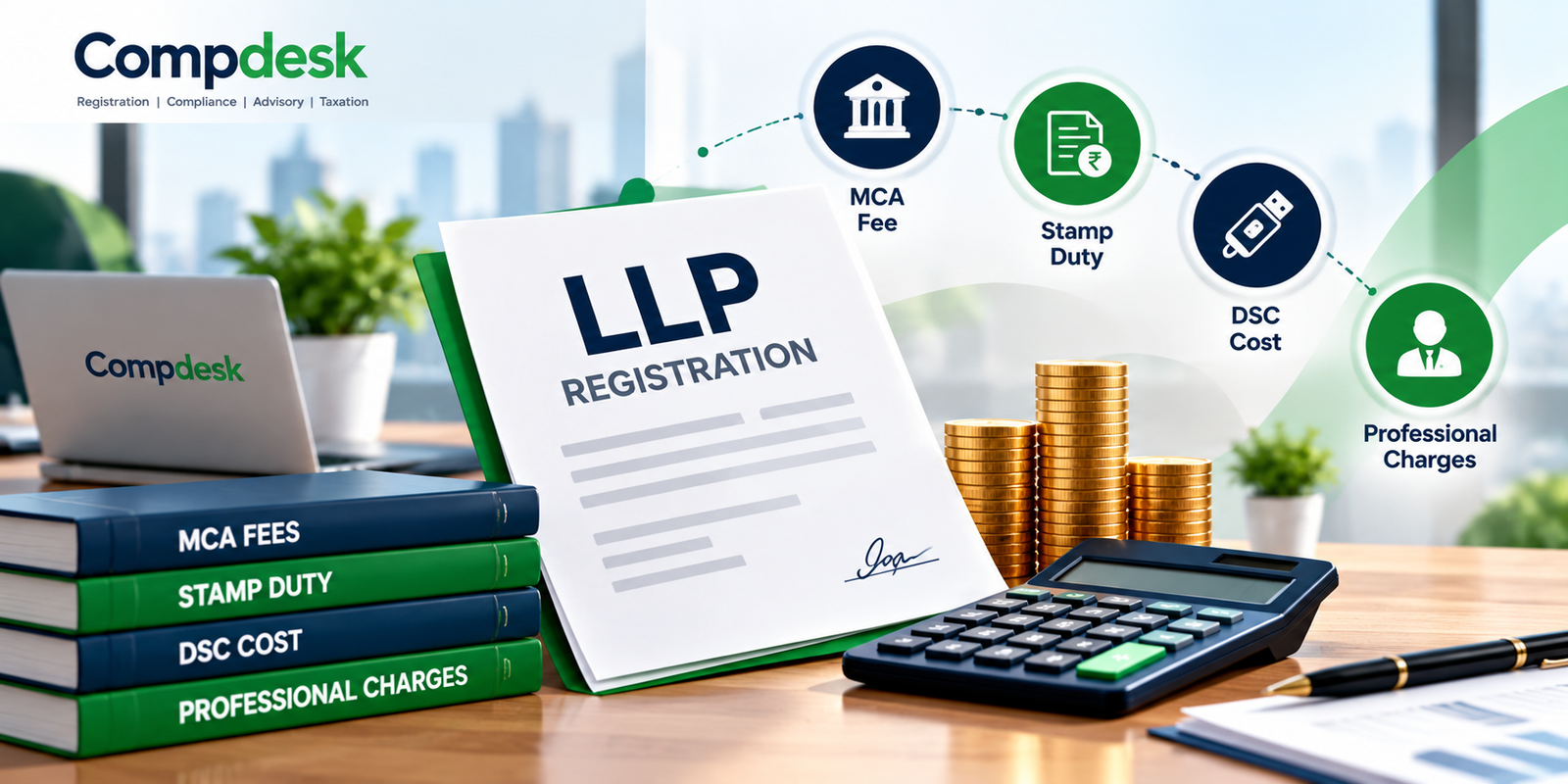
A genuine Private Limited Company registration cost is made up of several different components:
- MCA incorporation filing fees;
- name-reservation fee, depending on the filing route;
- State stamp duty;
- PAN and TAN charges;
- Digital Signature Certificates (DSCs);
- professional fees;
- notarisation/apostille costs in foreign-founder cases; and
- optional registrations or advisory work.
For a standard Private Limited Company with authorised capital up to ₹15 lakh, MCA currently provides a zero incorporation filing-fee concession through SPICe+. But this does not make company registration completely free: stamp duty, PAN/TAN, DSC and professional costs can still apply. MCA SPICe+ FAQ and MCA stamp-duty reference.
This guide explains how company registration costs are actually calculated in 2026, what is Government fee versus professional fee, how State stamp duty changes the total and how much founders should realistically budget.
Company Registration Cost in India 2026: Complete Fee Breakdown
For a straightforward Private Limited Company with:
- two Indian founders;
- two directors;
- authorised capital up to ₹15 lakh;
- standard objects;
- an Indian registered office; and
- no foreign shareholder or special regulatory approval,
a practical total budget can often fall broadly in the range of ₹6,000 to ₹15,000 or more, depending mainly on:
- State stamp duty;
- number of DSCs required;
- whether name reservation is filed separately;
- professional-service scope; and
- whether additional documentation or advisory work is required.
This is a market estimate, not a fixed Government tariff.
The actual statutory amount is calculated by MCA based on the filing details.
Company Registration Cost Components
| Cost component | Is it Government fee? | Typical treatment |
|---|---|---|
| SPICe+ incorporation filing fee | Yes | Nil up to ₹15 lakh authorised capital under current concession |
| Name reservation | Yes | ₹1,000 if SPICe+ Part A is filed separately |
| PAN | Yes | ₹66 |
| TAN | Yes | ₹65 |
| Stamp duty | Yes | Varies by State and authorised capital |
| DIN through SPICe+ | Integrated | No separate standalone DIR-3 process for eligible proposed directors filing through incorporation |
| Bank-account application through SPICe+ | Integrated | No separate MCA fee |
| DSC | No | Commercial charge by certifying authority/provider |
| Professional fee | No | Depends on CA/CS/CMA/service provider and scope |
| Notarisation/apostille | No | Case-specific, mainly foreign documents |
| Trademark registration | No, separate process | Not included in incorporation unless separately engaged |
| GST registration | Separate tax registration | Government GST registration application itself is normally free |
Most important point: “Government fee,” “professional fee” and “total package price” are three different numbers. Always ask for the breakup.
1. MCA Company Registration Fees: SPICe+ and ₹15 Lakh Exemption.
The main incorporation application is filed through SPICe+ on the MCA V3 portal.
The Government filing fee depends primarily on the company's authorised share capital and the applicable fee rules.
Zero Filing Fee up to ₹15 Lakh Authorised Capital
MCA's current SPICe+ guidance states that companies incorporated through SPICe+ with authorised capital up to ₹15,00,000 continue to enjoy the zero filing-fee concession.
This is one of the most misunderstood parts of company registration pricing.
If your authorised capital is within ₹15 lakh, the core MCA incorporation filing fee can be nil.
However, you can still have to pay:
- State stamp duty;
- PAN fee;
- TAN fee;
- name-reservation fee where Part A is filed separately;
- DSC cost; and
- professional charges.
What Happens Above ₹15 Lakh?
Once authorised capital exceeds ₹15 lakh, the zero-fee concession no longer applies in the same way.
The MCA fee schedule then becomes capital-linked and can rise materially.
The exact amount depends on:
- authorised capital;
- whether the entity qualifies for an applicable Small Company/OPC fee treatment;
- MOA registration fee; and
- AOA registration fee.
For example, MCA's current SPICe+ instruction kit prescribes capital-linked MOA registration fees once the authorised capital is above ₹15 lakh, with a separate AOA fee schedule.
Therefore, a founder planning authorised capital above ₹15 lakh should obtain the exact portal calculation rather than relying on a generic internet quote.
Should You Keep Authorised Capital at ₹15 Lakh to Save Fees?
Not automatically.
Authorised capital is a commercial and capital-structuring decision.
However, where a new company does not currently need authorised capital above ₹15 lakh, the current zero filing-fee concession can make a lower initial authorised-capital structure more cost-efficient.
2. Company Name Reservation Fee
Company names are handled through SPICe+ Part A.
There are two practical routes:
Route 1 : File SPICe+ Part A Separately
If you first apply only for name reservation and then file incorporation later:
Government fee: ₹1,000
MCA allows the applicant to submit the permitted name choices under the Part A workflow.
This route can be useful when:
- founders want certainty on the name before preparing full incorporation papers;
- trademark/name risk needs to be resolved first;
- foreign documents are still being prepared; or
- incorporation documentation will take time.
Route 2 : File Name and Incorporation Together
SPICe+ Part A and Part B can be filed as part of the integrated incorporation application.
In that case, the separate ₹1,000 standalone name-reservation charge does not arise in the same manner.
Cost vs Risk
Saving ₹1,000 is not always the most important consideration.
If the desired brand name is commercially critical, founders may prefer to:
- conduct an MCA name search;
- conduct a trademark search;
- reserve the name; and
- then complete incorporation.
A rejected name can cost more in lost time than the Government fee itself.
3. PAN and TAN Charges
PAN and TAN are integrated into the SPICe+ process.
MCA's current incorporation FAQ specifies:
- PAN charge: ₹66
- TAN charge: ₹65
These amounts form part of the consolidated incorporation payment.
Founders generally do not need to separately apply for company PAN and TAN after incorporation through the normal integrated SPICe+ process.
4. State-Wise Stamp Duty for MOA & AOA (Delhi, MH, Karnataka)
Stamp duty is often the biggest reason why two identical companies incorporated in different States have different Government costs.
MCA expressly states that stamp duty on:
- incorporation form;
- Memorandum of Association; and
- Articles of Association
is charged according to the applicable State stamp-duty law.
There is no single all-India stamp-duty figure.
Why Stamp Duty Varies
The amount can depend on:
- State/Union Territory;
- authorised share capital;
- MOA;
- AOA;
- company type; and
- applicable State amendments.
This means a company with ₹1 lakh authorised capital in Delhi can have a different Government outlay from an otherwise identical company in Haryana or Maharashtra.
Illustrative State Examples
MCA's published State-wise stamp-duty schedule currently displays the following structure for companies having share capital:
| State | Incorporation-form stamp duty | MOA stamp duty | AOA stamp duty |
|---|---|---|---|
| Delhi | ₹10 | ₹200 | 0.15% of authorised capital, subject to stated cap |
| Haryana | ₹15 | ₹60 | ₹60 up to ₹1 lakh authorised capital; ₹120 above ₹1 lakh |
| Maharashtra | ₹100 | ₹200 | ₹1,000 for every ₹5 lakh of authorised capital or part, subject to stated cap |
Illustration : ₹1 Lakh Authorised Capital
Using the published schedule purely as an illustration:
Delhi
- form stamp duty: ₹10
- MOA: ₹200
- AOA: ₹150
- total stamp duty: approximately ₹360
Haryana
- form stamp duty: ₹15
- MOA: ₹60
- AOA: ₹60
- total stamp duty: approximately ₹135
Maharashtra
- form stamp duty: ₹100
- MOA: ₹200
- AOA: ₹1,000
- total stamp duty: approximately ₹1,300
Important: Stamp-duty laws can be amended by States. The amount generated through MCA at the time of filing should be treated as the operative amount. Do not use this illustration as a substitute for the live MCA calculation.
5. Digital Signature Certificate Cost
A company-incorporation application is electronically signed.
A Digital Signature Certificate (DSC) is therefore required for the relevant subscribers/directors/signatories under the MCA process.
MCA does not sell DSCs.
They are issued by licensed certifying authorities or their authorised service channels.
How Much Does a DSC Cost?
There is no single Government-fixed retail price.
For a standard individual DSC, market pricing can commonly fall in the broad range of approximately:
₹2,000 per person for class 3 with two years of validity
How Many DSCs Are Required?
Do not assume the answer is always “two directors”.
Under MCA's standard e-MOA/e-AOA framework, the relevant subscribers and directors who sign the incorporation documents can require DSCs.
Examples:
Example A : Same Two Persons Are Shareholders and Directors
- Founder A: shareholder + director
- Founder B: shareholder + director
Likely DSC requirement: 2
Example B : Two Shareholders and Two Different Directors
- Shareholder A
- Shareholder B
- Director C
- Director D
Depending on the incorporation/signature structure, more DSCs may be required.
Therefore, pricing should be based on the number of actual electronic signatories, not just the number of directors.
6. DIN Cost
DIN means Director Identification Number.
In a normal SPICe+ incorporation, eligible proposed directors who do not already have DIN can apply for DIN directly through the incorporation form.
MCA currently permits DIN application for up to three proposed directors through SPICe+ for a normal company.
This avoids a separate pre-incorporation DIR-3 process for those eligible directors.
Accordingly, a quotation that separately adds a large “DIN registration fee” for each of the first eligible directors should be examined carefully.
DIN is part of the integrated incorporation workflow.
7. Professional Fees vs. Government Charges: What to Expect
Professional fees are not Government fees.
They are charged for services such as:
- entity-structure consultation;
- name search;
- trademark-risk review;
- capital structuring;
- DSC coordination;
- MOA/AOA drafting;
- SPICe+ preparation;
- AGILE-PRO-S filing;
- professional certification;
- resubmission handling;
- incorporation follow-up;
- post-incorporation checklist; and
- tax/compliance advisory.
Typical Professional Fee Range
Publicly advertised basic online incorporation services in India in 2026 often begin at roughly ₹1,499 plus taxes and Government charges.
A more realistic professional-service band for a standard Indian-founder incorporation can commonly be around:
₹1,499 to ₹10,000, depending on scope.
Higher fees can be justified where the engagement includes:
- bespoke MOA/AOA;
- shareholders' or founders' agreement;
- complex shareholding;
- foreign shareholders/directors;
- FEMA/FDI advice;
- regulatory approvals;
- multiple resubmissions;
- startup/ESOP structuring; or
- post-incorporation compliance.
Do Not Compare Professional Fees Without Comparing Scope
Two quotations can look like:
- Provider A: ₹2,999
- Provider B: ₹8,999
but they may not be offering the same service.
Check whether the price includes:
- DSCs;
- name reservation;
- stamp duty;
- MOA/AOA drafting;
- professional certification;
- resubmission;
- INC-20A;
- first auditor appointment support;
- share certificates;
- startup consultation; and
- annual compliance.
A low headline price with multiple add-ons can ultimately cost more.
8. Foreign Director or Foreign Shareholder Costs
Foreign-founder cases can cost substantially more than a simple domestic incorporation.
Potential additional costs include:
- foreign document notarisation;
- apostille;
- consularisation where applicable;
- courier;
- certified translation;
- foreign corporate documents;
- Board resolutions;
- FEMA/FDI advice;
- beneficial-ownership analysis; and
- bespoke MOA/AOA or investment documentation.
MCA's incorporation guidance distinguishes attestation requirements based on the jurisdiction where the foreign subscriber/director documents are executed.
Why a ₹1,499 Package Usually Does Not Cover a Foreign Subsidiary Properly
A foreign corporate subscriber can require:
- incorporation certificate;
- constitutional documents;
- Board authorisation;
- authorised representative;
- notarisation/apostille or consular authentication; and
- foreign-investment review.
The cost is driven by legal complexity, not merely by filling the SPICe+ form.
9. Registered Office Cost
There is no separate MCA charge merely because a founder uses a residential address as the company's registered office.
A company can potentially use:
- owned property;
- rented property;
- leased property; or
- premises used with valid owner consent,
subject to proper documentation.
However, additional private costs can arise where founders use:
- virtual office services;
- co-working registered-office packages;
- rent agreements;
- notarisation;
- NOC documentation; or
- commercial office services.
These are not MCA incorporation fees.
10. Is GST Registration an Extra Company Registration Cost?
GST registration is a separate tax registration.
The Government does not charge a normal GST registration application fee.
However, professional fees may apply if the incorporation package includes GST registration support.
More importantly, every newly incorporated company does not automatically require GST registration.
GST liability depends on:
- turnover;
- nature of supply;
- State;
- interstate/e-commerce facts; and
- compulsory-registration provisions.
Do not buy an unnecessarily expensive package simply because it includes registrations your business does not yet require.
11. Is EPFO or ESIC an Extra Incorporation Fee?
New company incorporation through AGILE-PRO-S integrates EPFO and ESIC registration under the MCA framework.
MCA's integrated bank-account/linked-registration service does not itself mean that a startup must immediately start paying contributions if the substantive labour-law applicability conditions are not met.
Registration generation and contribution liability are separate questions.
12. Bank Account Opening Fee
MCA's SPICe+ FAQ states that no additional MCA fee is payable for the integrated bank-account application through the incorporation workflow.
The selected bank may separately have:
- account-specific minimum-balance requirements;
- transaction charges; or
- banking service fees.
Those are banking costs, not company-registration Government fees.
Practical Cost Example : Standard Private Limited Company
Assume:
- two Indian founders;
- both founders are directors;
- authorised capital ₹1 lakh;
- subscribed capital ₹1 lakh;
- Indian registered office;
- standard business objects;
- no foreign ownership;
- SPICe+ authorised capital within the zero-fee concession.
Government Components
| Item | Indicative amount |
|---|---|
| SPICe+ incorporation filing fee | ₹0 under current concession |
| PAN | ₹66 |
| TAN | ₹65 |
| Separate Part A name reservation | ₹1,000, if used |
| State stamp duty | Variable |
Other Components
| Item | Practical range |
|---|---|
| 2 DSCs | Roughly ₹4,000 combined |
| Professional assistance | Roughly ₹3,000–₹10,000 for a standard case |
| GST on professional/private services | Additional where applicable |
| Special documents | Case-specific |
Indicative Total
For a straightforward case:
Approximately ₹6,000–₹15,000+
can be a reasonable practical budgeting range.
This is not a statutory fee quote. The actual amount depends on State stamp duty and service scope.
Example : Government Cost for ₹1 Lakh Capital in Selected States
Assume:
- authorised capital ₹1 lakh;
- zero MCA incorporation filing fee applies;
- PAN ₹66;
- TAN ₹65;
- name reserved separately through Part A for ₹1,000.
Using MCA's published State stamp-duty schedule as an illustration:
| State | Illustrative stamp duty | PAN + TAN | Separate name reservation | Illustrative Government outlay |
|---|---|---|---|---|
| Delhi | ₹360 | ₹131 | ₹1,000 | ₹1,491 |
| Haryana | ₹135 | ₹131 | ₹1,000 | ₹1,266 |
| Maharashtra | ₹1,300 | ₹131 | ₹1,000 | ₹2,431 |
If the name is not reserved through a separate Part A application, the separate ₹1,000 item does not apply in the same way.
These examples exclude:
- DSC;
- professional fee;
- GST on professional/private services;
- foreign-document costs;
- post-incorporation stamp duty on share certificates;
- trademark;
- registered-office commercial charges; and
- other optional work.
Company Registration Cost vs Annual Compliance Cost
A ₹5,000 difference in incorporation cost is usually less important than the recurring compliance cost over the next five years.
A Private Limited Company ordinarily has ongoing requirements involving:
- statutory audit;
- accounting;
- Board meetings;
- AGM;
- financial statements;
- AOC-4;
- MGT-7 or MGT-7A;
- income-tax return;
- TDS/GST where applicable;
- director and MCA compliances; and
- event-based filings.
Before incorporating, founders should ask:
"What will this entity cost to maintain every year?"
not only:
"What is the cheapest registration package?"
A company is often the correct structure for a scalable business, but recurring compliance should be budgeted from the beginning.
Can You Register a Company Yourself and Avoid Professional Fees?
The MCA system is digital, but incorporation is not entirely a self-service exercise in the same way as opening a basic online account.
SPICe+ incorporation involves:
- legal declarations;
- constitutional documents;
- e-MOA/e-AOA;
- DSCs;
- business objects;
- professional certification requirements; and
- Companies Act compliance.
An eligible practising professional is involved in certification of the incorporation documents.
Therefore, founders should distinguish between:
- preparing information themselves; and
- completing a professionally certified incorporation filing.
The value of professional support is highest where structure, name, objects, capital or ownership need judgement.
How to Reduce Company Registration Cost Without Creating Future Problems
1. Choose Sensible Authorised Capital
Do not declare an unnecessarily high authorised capital merely because it sounds impressive.
Where commercially appropriate, staying within the current ₹15 lakh zero-filing-fee band can reduce incorporation cost.
2. Finalise the Shareholding Before Filing
Changing ownership immediately after incorporation creates additional documentation and compliance.
3. Perform a Name and Trademark Search
A rejected name wastes time. A trademark conflict can create much larger future costs.
4. Prepare Clean Registered-Office Documents
Most avoidable resubmissions arise from documentation problems.
5. Use Existing Valid DINs
A director should not obtain another DIN where one already exists.
6. Know Exactly What the Professional Quote Includes
Avoid paying separately for items already included in an integrated package.
7. Do Not Buy Unnecessary Registrations
GST, trademark, Startup India and other registrations should be taken because they are required or commercially useful—not merely because they are sold as a bundle.
8. Do Not Underpay for Complex Structuring
Saving ₹5,000 on incorporation is a poor trade if founders later discover that:
- shareholding was structured incorrectly;
- IP ownership is unclear;
- foreign investment was non-compliant;
- the MOA objects are unsuitable; or
- the Articles do not reflect investor rights.
Common Mistakes When Estimating Company Registration Cost
1. Treating the Advertised Professional Fee as the Total Cost
Always check Government fees, stamp duty, DSC and GST separately.
2. Believing MCA Registration Is Completely Free Below ₹15 Lakh
Only the relevant filing-fee concession is zero. Other charges can remain.
3. Assuming Stamp Duty Is the Same Across India
It is State-specific.
4. Paying a Separate Large DIN Fee Without Checking SPICe+
DIN for eligible first directors can be obtained through the integrated incorporation process.
5. Buying Too Much Authorised Capital on Day One
This can unnecessarily increase Government cost where the higher capital is not yet needed.
6. Choosing Capital Only to Save Fees
The opposite mistake is also possible. A company expecting an imminent funding round may need enough authorised-capital headroom.
7. Ignoring Foreign-Document Costs
A foreign shareholder/director can materially change both cost and timeline.
8. Ignoring Post-Incorporation Compliance
INC-20A, auditor appointment, share certificates and initial corporate records are separate from simply obtaining the Certificate of Incorporation.
9. Comparing Packages With Different Inclusions
A ₹3,000 package and ₹10,000 package are not comparable unless the scope is the same.
10. Focusing Only on the Cheapest Provider
Incorporation establishes the legal ownership and governance foundation of the business. Errors can be far more expensive to correct later.
Frequently Asked Questions
1. How much does it cost to register a Private Limited Company in India in 2026?
For a straightforward two-founder Indian company with authorised capital up to ₹15 lakh, a practical overall budget can often be around ₹6,000–₹15,000 or more, depending on State stamp duty, DSC cost and professional fees. This is a market estimate, not a fixed Government tariff.
2. Is company registration free up to ₹15 lakh authorised capital?
MCA currently provides a zero incorporation filing-fee concession through SPICe+ for companies with authorised capital up to ₹15 lakh. Stamp duty, PAN/TAN, DSC and professional costs can still apply.
3. What is the Government fee for SPICe+?
For qualifying companies within the current ₹15 lakh authorised-capital concession, the incorporation filing fee is nil. Above that level, the prescribed capital-linked fee schedule applies.
4. How much is the company-name reservation fee?
Where SPICe+ Part A is filed separately for name reservation, the Government fee is ₹1,000.
5. What are the PAN and TAN charges during incorporation?
MCA's current SPICe+ guidance specifies ₹66 for PAN and ₹65 for TAN.
6. How much does DSC cost for company registration?
DSC is purchased from a certifying authority/service provider, not MCA. Market pricing varies, but a standard individual DSC can commonly cost roughly ₹500–₹1,500 per person before taxes and optional token/delivery charges.
7. Why does company registration cost differ from State to State?
State stamp duty on the incorporation instrument, MOA and AOA differs by jurisdiction and can also depend on authorised capital.
8. Is DIN charged separately?
Eligible proposed directors can obtain DIN through SPICe+ during incorporation. Up to three DIN applications are permitted through the normal SPICe+ company-incorporation process.
9. Does a ₹2,999 company-registration package include Government fees?
Not necessarily. Some providers advertise only their professional service fee. Check whether stamp duty, DSC, PAN/TAN, Government charges, GST and post-incorporation work are included.
10. Is it better to choose ₹15 lakh authorised capital to save MCA fees?
It can be cost-efficient where ₹15 lakh provides adequate capital headroom, because of the current zero filing-fee concession. However, authorised capital should still reflect the company's likely share-issuance and fundraising needs.
Need a Transparent Company Registration Quote?
A useful incorporation quote should tell you what goes to the Government, what goes to third parties and what you are paying as professional fee.
Compdeskcan help you structure the company, estimate the applicable Government and State charges and complete the incorporation process with a clearly defined scope.
Explore Compdesk services or review available service and pricing options.

Meera is the Compliance Head at Compdesk, with over 10 years of experience in ROC filings, GST, income tax, and statutory compliance. She helps businesses understand regulatory requirements, maintain accurate filings,...
View full profileDon’t let private Company Registration eat your week.
Our experts handle the filing end to end. You track every step online.