
In this guide 63 sections
- Company Registration Documents : Quick Checklist
- First Understand the SPICe+ Document Structure
- Documents Required From Indian Individual Subscribers and Directors
- 1. PAN
- 2. Identity Proof
- 3. Residential Address Proof
- 4. Email Address and Mobile Number
- 5. DIN, If Already Allotted
- 6. Digital Signature Certificate
- Is a Photograph Mandatory for SPICe+ Incorporation?
- Details of Interest in Other Entities
- Registered Office Documents
- If the Premises Are Owned by the Company / Promoter
- If the Premises Are Rented or Leased
- If the Registered Office Is a Founder or Family Member's Home
- Utility Bill Age
- If Correspondence Address and Registered Office Are Different
- MOA and AOA : Are Physical Documents Always Required?
- INC-9 Declaration
- Documents for Company Name Reservation
- Trademark Owner Consent / NOC
- Regulated Names / Activities
- Documents Required for an OPC
- Documents Required for a Corporate Subscriber
- Indian Company as Subscriber
- Indian LLP as Subscriber
- Foreign Body Corporate as Subscriber
- Documents for NRI / Foreign National Subscribers or Directors
- Passport
- Residential Address Proof
- Proof of Nationality
- Business Visa Point for Foreign Subscribers
- Does an NRI Need Aadhaar for Company Registration?
- AGILE-PRO-S Documents
- Bank Account Authorised Signatory
- GST Authorised Signatory
- EPFO Specimen Signature
- What Documents Are Not Automatically Mandatory?
- Common Document Mistakes That Cause Resubmission
- Frequently Asked Questions
- Need Help Preparing Company Registration Documents?
Last Reviewed 07 November 2026
Registering a Private Limited Company in India is now largely an online process through the Ministry of Corporate Affairs' SPICe+ framework, but the quality of the documents still determines how smoothly the incorporation moves.
Most incorporation delays do not arise because the founders forgot one universally mandatory document. They arise because:
- the name on PAN does not match another record;
- residential proof is too old;
- the registered-office document does not establish the right to use the premises;
- a foreign subscriber's documents are not correctly notarised/apostilled;
- a corporate subscriber has not passed the right board resolution;
- DSC details do not match the MCA profile; or
- applicants upload documents that are not actually required while missing a case-specific attachment.
The correct checklist therefore depends on who the subscribers and directors are, where they live, who owns the registered office, whether a company/body corporate is subscribing, and whether any foreign or regulated activity is involved.
This guide gives a practical 2026 checklist for Indian founders, NRIs/foreign nationals, corporate subscribers, registered-office documents, OPCs and linked SPICe+ filings.
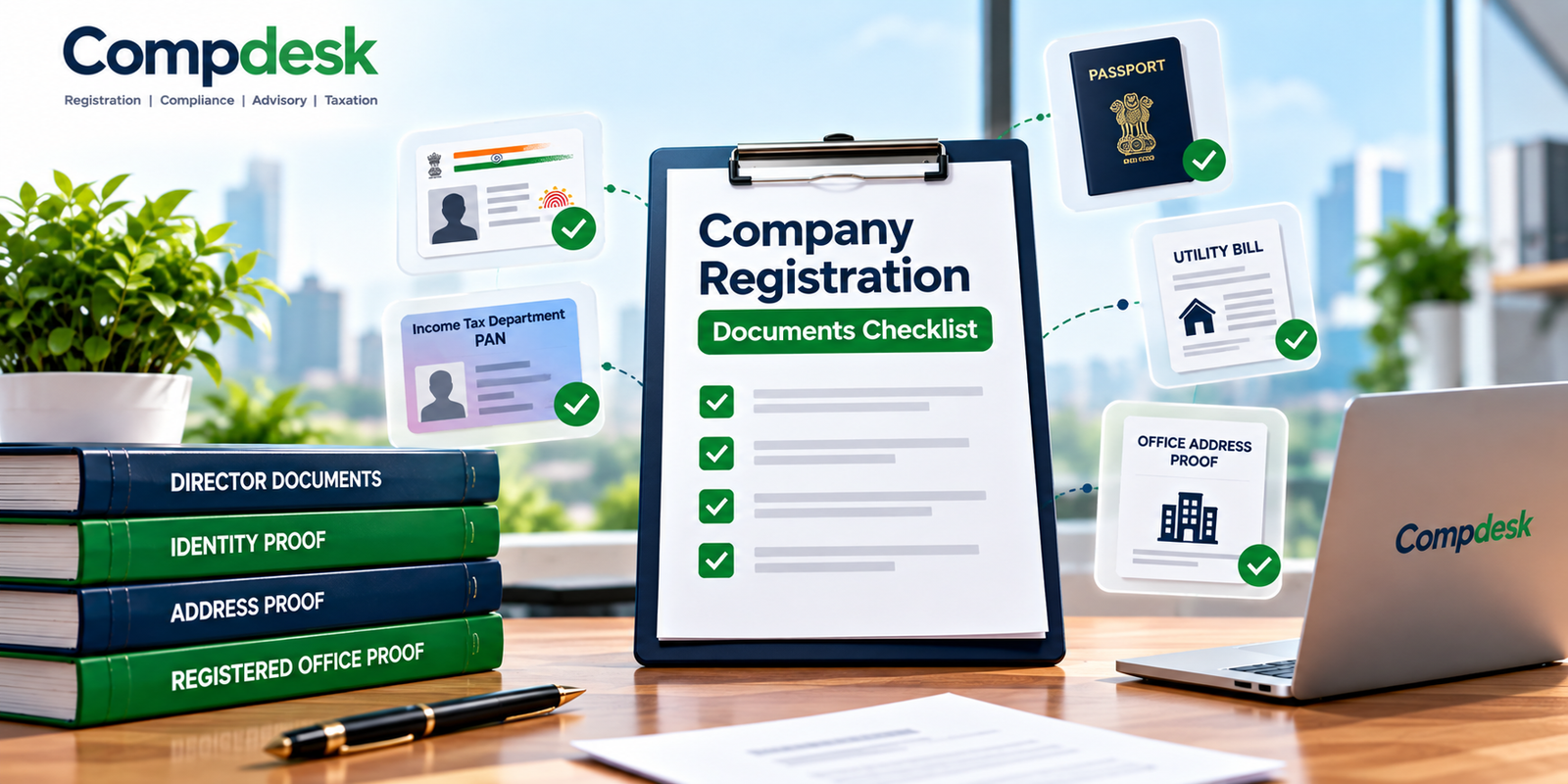
Company Registration Documents : Quick Checklist
For a straightforward Private Limited Company with two Indian individual founders who are also directors, the core information/documents usually include:
| Area | Common requirement |
|---|---|
| Founder / subscriber identity | PAN and applicable identity details |
| Residential address | Recent bank statement / electricity / telephone / mobile bill, where attachment is required |
| Director identification | Existing DIN, if any; otherwise DIN application through SPICe+ where eligible |
| Digital signing | Valid DSC for relevant electronic signatories |
| Registered office | Ownership / rent / lease / consent evidence |
| Utility bill | Recent utility bill, generally not older than 2 months |
| Owner consent | NOC / permission where premises belong to another person |
| Company constitution | e-MOA and e-AOA in standard eligible cases |
| Declarations | INC-9 / other declarations as generated or required by form logic |
| Linked registrations | AGILE-PRO-S documents, including authorised-signatory details |
| Name-specific documents | Trademark NOC / regulatory approval, where applicable |
Important: This is not a rule that every item must be attached in every incorporation. SPICe+ uses conditional attachments. The applicable list changes based on the subscriber/director profile and incorporation facts.
First Understand the SPICe+ Document Structure
Company incorporation is filed mainly through:
- SPICe+ Part A : name reservation;
- SPICe+ Part B : incorporation, directors, capital, registered office and other company particulars;
- INC-33 e-MOA, where applicable;
- INC-34 e-AOA, where applicable;
- AGILE-PRO-S (INC-35) : integrated registrations/services;
- INC-9 : declaration by subscribers/first directors in applicable cases; and
- other linked forms depending on the company type.
The MCA SPICe+ instruction framework distinguishes between:
- data entered directly in the webform;
- documents generated through linked e-forms; and
- attachments required only in specific situations.
This is why a checklist copied from an old incorporation article can be misleading.
Documents Required From Indian Individual Subscribers and Directors
A "subscriber" is a person subscribing to the Memorandum of Association and becoming an initial shareholder/member.
A "director" is a person appointed to the Board.
The same person can be both, but the roles are legally different.
1. PAN
For Indian nationals, PAN is a core identification detail used in the incorporation framework.
PAN details should exactly match:
- MCA profile;
- DSC;
- DIN records, if DIN already exists;
- name entered in SPICe+; and
- other KYC records.
2. Identity Proof
Under the Companies (Incorporation) Rules, recognised identity proof for an Indian individual can include prescribed records such as:
- PAN;
- Voter ID;
- passport;
- driving licence; or
- Aadhaar/UIN information, as permitted in the relevant workflow.
The exact attachment requirement depends on whether the subscriber/director already has a valid DIN and whether current particulars are already available and updated.
Important DIN relaxation
The incorporation rules provide that where a subscriber already holds a valid DIN, the particulars have been updated and the required declaration is given, separate identity and residence proof may not need to be attached in the same manner.
This means an incorporation checklist should not blindly demand duplicate KYC attachments from every existing director.
3. Residential Address Proof
Where required, residential proof can include prescribed recent documents such as:
- bank statement;
- electricity bill;
- telephone bill; or
- mobile bill.
Under Rule 16, the relevant bank statement / electricity / telephone / mobile bill should generally not be more than two months old.
4. Email Address and Mobile Number
Current email and mobile details are required for the incorporation workflow and related user/KYC processes.
Do not use a consultant's email or mobile in place of the founder's own details where the form requires the subscriber/director's information.
Founders should retain direct control over:
- MCA account;
- OTPs;
- incorporation communication; and
- future compliance notices.
5. DIN, If Already Allotted
If a proposed director already has a valid Director Identification Number, the existing DIN should be used.
Where eligible proposed directors do not yet have DINs, SPICe+ integrates DIN allotment for up to the permitted number of proposed directors.
For a normal company, SPICe+ currently permits DIN applications for up to three proposed directors.
6. Digital Signature Certificate
Relevant SPICe+ and linked forms are digitally signed.
Accordingly, the subscribers/directors who are required to sign electronically need valid DSCs under the MCA V3 framework.
Before filing:
- obtain the correct DSC;
- register/upgrade the MCA profile as required;
- associate DSC with the relevant MCA Business User; and
- ensure PAN/name details match.
For a detailed explanation, Compdesk also covers DSC requirements under its services.
Is a Photograph Mandatory for SPICe+ Incorporation?
A common old checklist still asks every subscriber to send passport-size photographs for SPICe+.
MCA's current incorporation FAQ clarifies that subscriber photographs are not required in SPICe+ under Rule 38.
That does not mean photographs can never be requested by a linked service or another regulator. For example, other registrations or KYC processes may have their own requirements.
But do not include "passport photo mandatory for SPICe+" merely because it appeared in older incorporation checklists.
Details of Interest in Other Entities
SPICe+ can require information regarding a proposed first director's interest in other entities.
Prepare details of relevant:
- company;
- LLP;
- firm;
- shareholding;
- directorship;
- designation; and
- nature of interest,
where required by the form.
This is information disclosure rather than necessarily a separate "document" in every case.
Registered Office Documents
The registered-office checklist deserves special attention because address defects are one of the most common incorporation problems.
A company must have a registered office capable of receiving official communication.
It may be:
- owned;
- rented;
- leased;
- located at a founder's residence;
- family-owned premises; or
- another premises used with valid consent.
A commercial office is not compulsory merely because the entity is a company.
If the Premises Are Owned by the Company / Promoter
Depending on the facts, prepare:
- ownership / conveyance / title-supporting document;
- recent utility bill for the premises; and
- any other address evidence required by the current form.
The name and address on the documents should be consistent.
If the Premises Are Rented or Leased
Common documents include:
- valid rent agreement or lease deed;
- recent utility bill;
- NOC / consent from the owner where required; and
- supporting proof of ownership/right of the landlord or person giving consent.
The agreement should identify the premises clearly.
If the Registered Office Is a Founder or Family Member's Home
This is generally possible if the company has a documented right to use the premises.
Prepare, as applicable:
- NOC / consent from the owner;
- ownership evidence;
- recent utility bill; and
- correspondence/address details matching the proposed registered office.
There is no general MCA rule that a startup must first take a commercial office on rent.
Utility Bill Age
The current SPICe+ instruction kit requires the registered-office utility bill attached with incorporation to be not older than two months.
Examples can include the accepted utility evidence applicable to the premises and filing facts.
Do not use an old bill simply because the address has not changed.
If Correspondence Address and Registered Office Are Different
MCA's current incorporation FAQ confirms:
- if the company is registered with the same address as the correspondence address, separate INC-22 is not required with incorporation; but
- if the registered office is different, INC-22 must be filed within 30 days of incorporation to intimate the registered-office address.
This means founders who do not have final registered-office documentation at the SPICe+ stage should not assume they can indefinitely operate using a temporary address.
MOA and AOA : Are Physical Documents Always Required?
No, For normal eligible incorporations, the MCA process uses:
- INC-33 — e-MOA; and
- INC-34 — e-AOA.
However, physical/PDF MOA and AOA attachments are required in specified scenarios.
MCA's current SPICe+ guidance identifies cases such as:
- more than seven subscribers;
- specified Section 8 / Part I company cases;
- non-individual first subscribers based outside India; and
- certain individual foreign-subscriber cases where the conditions for e-MOA/e-AOA are not met.
Therefore, do not automatically prepare scanned physical MOA/AOA for a routine two-founder Indian Private Limited Company. The form structure should decide the correct route.
INC-9 Declaration
INC-9 is the declaration by subscribers and first directors required under the incorporation framework.
In standard cases, the declaration is handled electronically/through the linked incorporation process.
The SPICe+ instruction kit specifies situations where the separate declaration attachment becomes mandatory—for example, where the total number of subscribers/directors exceeds the prescribed limit or where specified identity numbers are not available.
Practical point
Do not use old affidavit formats merely because an older company-incorporation checklist says every subscriber must execute a notarised affidavit.
MCA's current SPICe+ guidance specifically notes that an affidavit is not required to be attached merely for the first-subscriber/director declaration.
Documents for Company Name Reservation
Most ordinary name applications do not need a large document set.
However, additional attachments can become important where the proposed name involves:
- a registered trademark;
- a name resembling another entity;
- a parent/promoter company;
- a foreign holding company;
- regulated words; or
- business activities requiring sectoral approval.
Trademark Owner Consent / NOC
If the proposed company name contains a registered trademark or a mark for which another person has rights/applicant status, MCA guidance requires appropriate consent/NOC and KYC/supporting documentation.
Where the trademark owner is a body corporate, the NOC can require an appropriate Board Resolution.
Regulated Names / Activities
If the proposed name or objects contain regulated terms or activities for example banking, insurance, mutual fund or similar regulated business MCA can require approval/in-principle approval from the relevant regulatory authority.
Do not choose a regulated-sounding name and expect to resolve approval only after incorporation.
Documents Required for an OPC
A One Person Company uses the company-incorporation framework but includes a nominee structure.
In addition to the normal sole-member/director documents, prepare:
- nominee details;
- nominee identity and address information;
- nominee consent in the prescribed form/process; and
- any linked OPC declarations required by SPICe+.
The nominee is not an additional shareholder at incorporation.
The nominee is identified for the statutory succession mechanism if the sole member dies or becomes incapable of contracting.
Documents Required for a Corporate Subscriber
If a company, LLP or other eligible body corporate subscribes to shares of the proposed company, the documentation becomes more detailed.
Indian Company as Subscriber
Typically prepare:
- CIN / incorporation details;
- PAN / statutory entity details;
- registered-office information;
- certified Board Resolution approving:
- investment/subscription;
- number of shares;
- authorised representative;
- KYC/details of the authorised person signing on behalf of the subscriber; and
- other constitutional information required in SPICe+.
The Board Resolution should be specific.
A generic resolution saying "authorised to incorporate a company" may be insufficient if it does not identify the investment/subscription and authorised representative.
Indian LLP as Subscriber
Where an LLP subscribes, prepare:
- LLPIN;
- LLP registration details;
- registered-office information;
- partner resolution/consent in the prescribed manner;
- authorisation of the partner/person signing; and
- subscriber/investment details.
Foreign Body Corporate as Subscriber
Additional documents can include:
- foreign Certificate of Incorporation/registration;
- registered-office details;
- constitutional documents;
- Board Resolution authorising the subscription/investment;
- authorised-representative details;
- MOA/AOA of the proposed Indian company in the appropriate format; and
- notarisation/apostille/consular authentication depending on the country and place of execution.
Foreign investment must also be reviewed separately under FEMA/FDI rules.
Company incorporation approval does not itself confirm that the foreign-investment structure is compliant.
Documents for NRI / Foreign National Subscribers or Directors
Foreign and NRI cases need special care because the attestation rules depend on the country where the person resides or the documents are executed.
Passport
For foreign nationals and NRIs, passport is the core identity document under the incorporation framework.
The passport should be:
- valid;
- clear;
- consistent with the name entered in MCA forms; and
- properly attested where required.
Residential Address Proof
Prepare current residential proof.
Under the incorporation rules, accepted residential-proof categories include documents such as:
- bank statement;
- electricity bill;
- telephone/mobile bill,
subject to the prescribed recency requirement.
Proof of Nationality
Where the person is a foreign national, proof of nationality is required as applicable.
Business Visa Point for Foreign Subscribers
The Companies (Incorporation) Rules contain a specific rule for a foreign national who visits India and intends to incorporate a company.
A valid Business Visa is generally relevant in that situation, with exceptions for persons covered by the PIO/OCI clarification.
This should be checked before asking a foreign subscriber to travel to India simply to execute incorporation papers.
Does an NRI Need Aadhaar for Company Registration?
Aadhaar should not be presented as a universal mandatory incorporation document for every NRI or foreign subscriber.
The Companies (Incorporation) Rules recognise passport-based identity for foreign nationals and NRIs.
Aadhaar may become relevant to:
- DSC KYC;
- Indian-resident services;
- banking;
- tax processes; or
- other linked registrations,
depending on the individual and service.
But an incorporation checklist should not state that every foreign shareholder must have Aadhaar.
AGILE-PRO-S Documents
AGILE-PRO-S is a linked incorporation form used for integrated services such as:
- EPFO;
- ESIC;
- bank-account opening application;
- GST, where selected/applicable;
- professional tax in supported jurisdictions; and
- other linked registrations as enabled.
The documents depend on which linked service is being used.
Bank Account Authorised Signatory
The AGILE-PRO-S instruction kit requires:
- proof of identity of the authorised signatory for bank-account opening; and
- proof of address of that authorised signatory.
The bank can still perform its own KYC before activating the account.
The incorporation filing therefore does not eliminate bank-level KYC.
GST Authorised Signatory
Where GST registration is applied for through the linked incorporation process, supporting documents can include:
- proof of appointment of authorised signatory;
- letter of authorisation; or
- Board/Managing Committee resolution and acceptance, as applicable.
GST registration itself should be applied for only where required or commercially appropriate.
EPFO Specimen Signature
AGILE-PRO-S also includes the prescribed specimen-signature attachment/process for EPFO-related registration.
This is a linked registration document—not an independent proof that every employee becomes immediately liable for contribution from incorporation day.
What Documents Are Not Automatically Mandatory?
Many internet checklists include items that may be useful commercially but are not universal SPICe+ incorporation attachments.
Examples include:
- passport-size photograph of every subscriber;
- Aadhaar of every foreign subscriber;
- GST registration;
- Udyam certificate;
- office rent receipt in every case;
- bank statement of the proposed company before incorporation;
- professional tax registration in every State;
- a physical MOA/AOA for every company; and
- a separate DIN application before incorporation for every new director.
Common Document Mistakes That Cause Resubmission
1. PAN and DSC Name Mismatch
Use the exact legal name.
Do not mix initials, shortened names and expanded names without checking underlying records.
2. Residential Proof Older Than Two Months
Use recent proof where the incorporation rules require a two-month recency period.
3. Utility Bill Does Not Match Registered Office
The address should match the address entered in SPICe+.
Minor differences in flat number, floor, street spelling or PIN can lead to questions.
4. NOC Signed by the Wrong Person
The person giving consent should have a valid right to permit use of the premises.
5. Rent Agreement Does Not Clearly Identify the Premises
Include the complete property address and parties.
6. Corporate Subscriber Board Resolution Is Too Generic
Clearly approve:
- proposed investment;
- number of shares;
- authorised representative; and
- signing authority.
7. Foreign Documents Are Not Properly Attested
Check whether the jurisdiction requires notarisation, apostille or consular authentication.
8. Uploading Old Affidavits Because of an Outdated Checklist
Use the current SPICe+ linked declaration logic.
9. Assuming MCA Name Approval Means Trademark Clearance
Name approval does not replace trademark due diligence.
10. Uploading More Documents Than Necessary
Unnecessary attachments can create contradictions.
If a document is not required and contains outdated or inconsistent information, attaching it can create an avoidable query.
Frequently Asked Questions
1. What documents are required to register a Private Limited Company in India?
For a normal Indian-founder company, commonly required information/documents include PAN/identity data, residential proof where applicable, DSCs, DIN details if already allotted, registered-office evidence, a recent utility bill, owner consent where relevant and the SPICe+ linked incorporation documents.
2. Is Aadhaar mandatory for Private Limited Company registration?
Aadhaar is not a universal standalone incorporation attachment for every person. Indian identity/KYC and DSC processes may use Aadhaar, while foreign nationals and NRIs use passport-based identity under the incorporation rules. Applicability depends on the person and workflow.
3. Is a passport required for Indian directors?
Not necessarily. For Indian nationals, the incorporation rules permit prescribed Indian identity documents. Passport becomes particularly important for foreign nationals and NRIs.
4. How old can address proof be for company registration?
Where Rule 16 residential proof is required, bank statements, electricity bills and telephone/mobile bills should generally not be more than two months old. The registered-office utility bill under SPICe+ is also generally required to be not older than two months.
5. Can I use my home address as the company's registered office?
Yes, provided the company can establish a valid right to use the premises and submit the required ownership/consent/address evidence.
6. Is a rent agreement compulsory for company registration?
Not where the premises are owned or used under another valid arrangement. For rented/leased premises, appropriate rent/lease documentation is normally relevant together with supporting address and consent documents.
7. Are passport-size photographs required for SPICe+?
MCA's current SPICe+ FAQ states that subscriber photographs are not required in SPICe+ under Rule 38. Other linked KYC or external services may have their own requirements.
8. What documents are needed from a foreign shareholder?
Typically passport, recent residential proof, proof of nationality where applicable, correctly attested incorporation documents and any relevant FEMA/FDI documentation. The notarisation/apostille/consularisation route depends on the country.
9. Do MOA and AOA have to be physically signed?
Not in every case. Standard eligible incorporations use e-MOA and e-AOA. Physical/PDF MOA and AOA are used in specified cases such as certain foreign/corporate subscriber situations or where subscriber numbers exceed the e-form limit.
10. What documents are required for a company bank account during incorporation?
AGILE-PRO-S requires proof of identity and address of the authorised signatory for the bank-account application. The selected bank may require additional KYC before activating the account.
Need Help Preparing Company Registration Documents?
A company-registration checklist should be tailored to the actual founders, directors, shareholding and registered office.
can help review the documents before filing, identify missing or inconsistent KYC and prepare the incorporation application under the appropriate SPICe+ workflow.
Explore Compdesk Services or review available service and pricing options.

Meera is the Compliance Head at Compdesk, with over 10 years of experience in ROC filings, GST, income tax, and statutory compliance. She helps businesses understand regulatory requirements, maintain accurate filings,...
View full profileDon’t let private Company Registration eat your week.
Our experts handle the filing end to end. You track every step online.