
In this guide 71 sections
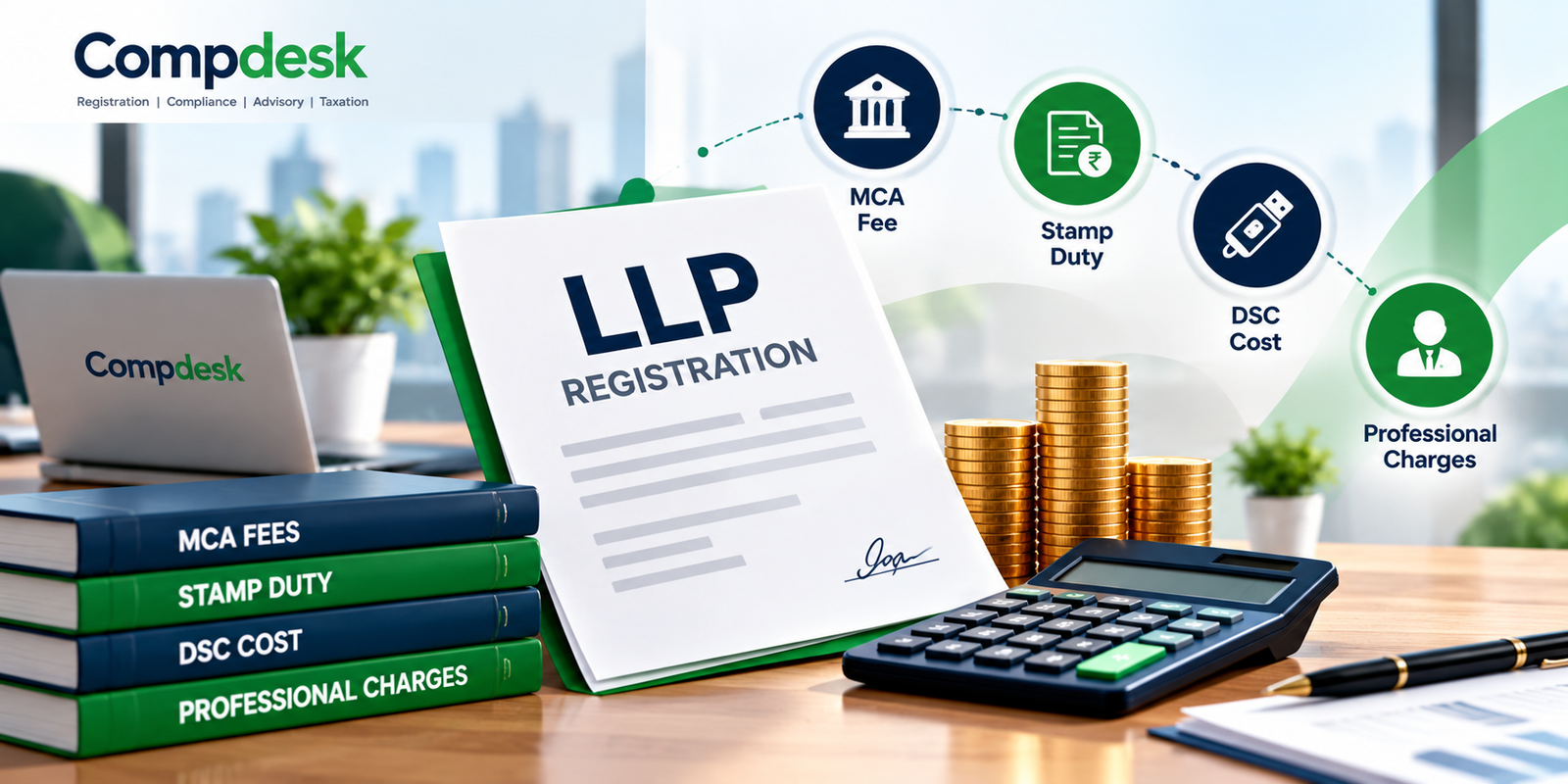
- LLP Registration Cost in India — Quick Breakdown
- 1. MCA FiLLiP Incorporation Fee
- Is There a Minimum Capital Requirement for an LLP?
- 2. RUN-LLP Name Reservation Fee
- 3. Form 3 Filing Fee for LLP Agreement
- Total Core MCA Fee by Contribution
- 4. Stamp Duty on LLP Agreement
- How Much Stamp Duty Should You Budget?
- 5. DSC Cost for LLP Registration
- 6. DPIN Cost — Is There a Separate DPIN Fee?
- 7. PAN and TAN Cost
- 8. Professional Charges for LLP Registration
- Compare Scope, Not Just Headline Price
- 9. Professional Certification Is Part of LLP Incorporation
- 10. Foreign Partner / NRI Registration Costs
- 11. Non-Cash Contribution Can Add Valuation Cost
- Practical Cost Example — Simple Two-Partner LLP
- Example — LLP With ₹5 Lakh Contribution
- Example — LLP With ₹20 Lakh Contribution
- LLP Registration Cost vs Company Registration Cost
- Hidden Costs to Check in LLP Registration Packages
- Common Mistakes When Estimating LLP Registration Fees
- How to Reduce LLP Registration Cost Properly
- Frequently Asked Questions
- Need a Transparent LLP Registration Quote?
Last Reviewed 07 November 2026
The cost of registering an LLP in India is not one fixed amount.
A genuine LLP registration cost can include:
- MCA incorporation fee through FiLLiP;
- RUN-LLP name-reservation fee, if that route is used;
- MCA filing fee for the initial LLP Agreement in Form 3;
- State stamp duty on the LLP Agreement;
- Digital Signature Certificate (DSC) cost;
- professional fees; and
- additional costs in foreign-partner, non-cash-contribution or complex-structure cases.
The most important cost driver on the MCA side is the total monetary value of partners' contribution.
For example, an LLP with contribution up to ₹1 lakh currently pays ₹500 as the MCA incorporation fee. After incorporation, the initial LLP Agreement is filed in Form 3, for which the normal MCA filing fee at the same contribution level is ₹50.
If the founders separately reserve the LLP name through RUN-LLP, another ₹200 Government fee applies.
This means the core MCA fees for a basic LLP with contribution up to ₹1 lakh can be as low as:
₹500 FiLLiP + ₹50 Form 3 = ₹550
or:
₹750 where a separate ₹200 RUN-LLP name reservation is also used
before adding State stamp duty, DSC cost and professional charges.
This guide explains every major LLP registration fee in India in 2026 and shows how to calculate the real cost before you engage a service provider.
LLP Registration Cost in India — Quick Breakdown
| Cost component | Current treatment |
|---|---|
| FiLLiP incorporation fee | ₹500 to ₹25,000 depending on contribution |
| Separate RUN-LLP name reservation | ₹200 |
| Initial Form 3 filing | ₹50 to ₹600 depending on contribution |
| LLP Agreement stamp duty | State-specific |
| DSC | Private/Certifying Authority charge; varies by provider and validity |
| DPIN | Integrated into FiLLiP for eligible proposed designated partners |
| PAN/TAN | Integrated into FiLLiP process |
| Professional fee | Market-driven; depends on scope and complexity |
| Foreign-document attestation | Case-specific |
| Valuation certificate | Can apply where contribution is other than cash |
Key distinction: An LLP does not have "authorised share capital" like a company. MCA incorporation fees are based on the partners' monetary contribution.
1. MCA FiLLiP Incorporation Fee
An LLP is incorporated through Form FiLLiP — Form for incorporation of Limited Liability Partnership on the MCA portal.
The current LLP Rules prescribe the following contribution-linked registration fees.
| Total contribution of partners | MCA FiLLiP registration fee |
|---|---|
| Up to ₹1 lakh | ₹500 |
| More than ₹1 lakh and up to ₹5 lakh | ₹2,000 |
| More than ₹5 lakh and up to ₹10 lakh | ₹4,000 |
| More than ₹10 lakh and up to ₹25 lakh | ₹5,000 |
| More than ₹25 lakh and up to ₹1 crore | ₹10,000 |
| More than ₹1 crore | ₹25,000 |
These are Government registration fees under the LLP fee schedule.
They are separate from:
- stamp duty on the LLP Agreement;
- DSC cost; and
- professional-service fees.
Example 1 — Contribution ₹50,000
FiLLiP Government fee:
₹500
Example 2 — Contribution ₹3 lakh
FiLLiP Government fee:
₹2,000
Example 3 — Contribution ₹8 lakh
FiLLiP Government fee:
₹4,000
Example 4 — Contribution ₹20 lakh
FiLLiP Government fee:
₹5,000
Example 5 — Contribution ₹50 lakh
FiLLiP Government fee:
₹10,000
The Government fee therefore increases in slabs rather than as a simple percentage of contribution.
Is There a Minimum Capital Requirement for an LLP?
The LLP framework does not operate with a minimum paid-up share-capital requirement comparable to old company-law capital concepts.
Partners agree their contribution based on the LLP's commercial requirements.
Contribution can take forms permitted under the LLP framework, including money or other recognised forms of contribution.
However, where the proposed contribution is other than cash, the incorporation process can require a valuation certificate as prescribed.
Therefore, choosing a very high contribution only to make the LLP "look bigger" can unnecessarily increase:
- MCA incorporation fee;
- State stamp duty; and
- potentially documentation costs.
At the same time, contribution should reflect the genuine agreement among partners and funding needs of the LLP.
2. RUN-LLP Name Reservation Fee
A proposed LLP name can be reserved through the RUN-LLP — Reserve Unique Name LLP service.
The current Government fee is:
₹200 per RUN-LLP application
MCA's RUN-LLP framework allows the applicant to propose up to the permitted number of names and, once approved, the reserved name is ordinarily valid for three months from the date of approval.
Is RUN-LLP Mandatory Before FiLLiP?
Not necessarily.
The current FiLLiP form itself supports application for reservation of name where the name has not already been approved.
Therefore, founders have two practical approaches:
Option A — Reserve the Name First
Use RUN-LLP.
Government fee:
₹200
This can be useful where:
- the name is commercially important;
- trademark conflict needs to be resolved first;
- incorporation documents are not ready;
- foreign documents are being prepared; or
- founders want name certainty before completing the full application.
Option B — Apply for Name Within FiLLiP
Where the name has not already been reserved, FiLLiP can incorporate the name-approval request into the incorporation workflow.
This can eliminate the separate RUN-LLP application step.
Should You Save ₹200 and Skip RUN-LLP?
Cost alone should not decide this.
If the brand name is critical, a separate name check and reservation may be commercially sensible.
Also remember that MCA name approval is not the same as trademark clearance.
A trademark search should be considered where the name will be used as a significant brand.
3. Form 3 Filing Fee for LLP Agreement
After incorporation, the partners' relationship is documented through the LLP Agreement.
The initial LLP Agreement must be filed with MCA in LLP Form No. 3 within 30 days of incorporation.
The current normal Form 3 filing fee is also linked to contribution.
| Contribution amount | Normal Form 3 filing fee |
|---|---|
| Up to ₹1 lakh | ₹50 |
| More than ₹1 lakh and up to ₹5 lakh | ₹100 |
| More than ₹5 lakh and up to ₹10 lakh | ₹150 |
| More than ₹10 lakh and up to ₹25 lakh | ₹200 |
| More than ₹25 lakh and up to ₹1 crore | ₹400 |
| More than ₹1 crore | ₹600 |
This fee is separate from the FiLLiP incorporation fee.
Why This Matters in Registration Quotations
A package may advertise:
"LLP Government fee ₹500"
but if contribution is up to ₹1 lakh, the complete MCA registration-stage cost also normally includes the ₹50 Form 3 filing fee after incorporation.
The quote should also clarify whether:
- drafting of the LLP Agreement;
- stamp duty;
- execution/notarisation where required; and
- Form 3 filing
are included.
Total Core MCA Fee by Contribution
The following table combines the FiLLiP incorporation fee and the normal initial Form 3 filing fee.
It excludes RUN-LLP, stamp duty, DSC and professional fees.
| Contribution | FiLLiP | Form 3 | Core MCA total |
|---|---|---|---|
| Up to ₹1 lakh | ₹500 | ₹50 | ₹550 |
| >₹1 lakh to ₹5 lakh | ₹2,000 | ₹100 | ₹2,100 |
| >₹5 lakh to ₹10 lakh | ₹4,000 | ₹150 | ₹4,150 |
| >₹10 lakh to ₹25 lakh | ₹5,000 | ₹200 | ₹5,200 |
| >₹25 lakh to ₹1 crore | ₹10,000 | ₹400 | ₹10,400 |
| Above ₹1 crore | ₹25,000 | ₹600 | ₹25,600 |
If you use a separate RUN-LLP application, add:
₹200
to the applicable amount.
4. Stamp Duty on LLP Agreement
Stamp duty is one of the most misunderstood components of LLP registration cost.
The MCA itself states that stamp duty payable on an LLP Agreement is a State subject and should be paid according to the applicable State Stamp Act.
Therefore, there is no single India-wide LLP Agreement stamp duty.
The amount may depend on:
- State/Union Territory of the LLP;
- total contribution;
- nature of contribution;
- wording/classification under the relevant Stamp Act; and
- subsequent amendments to the State schedule.
Stamp Duty Is Not the Same as Form 3 Fee
These are separate.
Form 3 fee: paid to MCA for filing information regarding the LLP Agreement.
Stamp duty: paid under the applicable State stamp law for execution of the LLP Agreement itself.
A ₹50 Form 3 filing fee therefore does not mean the LLP Agreement costs only ₹50.
How Much Stamp Duty Should You Budget?
For a small LLP, stamp duty can range from a modest fixed amount in some States to a contribution-linked percentage in others.
For example, current published professional references show materially different treatment across States such as:
- Haryana;
- Delhi;
- Maharashtra;
- Karnataka;
- Gujarat; and
- Rajasthan.
Because State stamp-duty schedules can change independently of MCA's LLP fee rules, the exact amount should be verified for the State and contribution amount on the date the agreement is executed.
Do Not Copy Another State's LLP Agreement Stamp Paper
An LLP registered in one State should not blindly use the stamp-duty amount seen in an online sample from another State.
Before executing the agreement, confirm:
- applicable State stamp-law article;
- contribution amount;
- required stamp value;
- permitted payment/e-stamp mechanism; and
- whether notarisation is required in the practical filing/documentation process.
Stamp Duty Can Increase With Contribution
This is one reason contribution should be chosen deliberately.
A contribution increase can affect:
- MCA registration fee;
- future Form 3 fee for changes; and
- stamp duty under State law.
5. DSC Cost for LLP Registration
LLP incorporation is electronic and FiLLiP must be digitally signed by the prescribed signatory.
A Digital Signature Certificate (DSC) is issued by a licensed Certifying Authority rather than by MCA itself.
How Much Does a DSC Cost?
There is no single MCA-fixed retail DSC price.
Current market pricing depends on:
- Certifying Authority;
- validity period;
- signature-only vs combined certificate;
- token requirement;
- KYC service; and
- reseller/service-provider charges.
For budgeting, standard individual DSC pricing is commonly advertised in the broad range of approximately:
₹800 to ₹2,000 per person
before considering optional token, delivery, support and GST.
This is a market range, not a statutory fee.
Do Both Designated Partners Always Need a New DSC?
Not necessarily.
The current MCA FiLLiP workflow requires the form to be digitally signed by a proposed designated partner.
Form 9 consent is linked to FiLLiP. Where proposed designated partners already have DPIN, the linked consent workflow can also require their DSCs.
For proposed designated partners without DPIN, current MCA guidance permits physically signed consent to be attached in specified cases.
Therefore, the number of DSCs you actually need depends on:
- whether the person already has a valid DSC;
- whether a DPIN already exists;
- who signs FiLLiP;
- the linked Form 9 workflow; and
- the constitution of the proposed LLP.
A package advertising "two DSCs included" may be convenient, but two fresh DSC purchases are not a universal legal fee in every case.
6. DPIN Cost — Is There a Separate DPIN Fee?
DPIN means Designated Partner Identification Number.
Current FiLLiP integrates the application for allotment of DPIN to eligible proposed designated partners who do not already have one.
The current FiLLiP instruction kit expressly provides for:
- name reservation;
- DPIN application;
- LLP registration;
- designated-partner consent; and
- PAN/TAN allocation
through the integrated workflow.
Accordingly, founders should be cautious if a service quotation separately describes a large standalone "DPIN registration fee" without explaining why an additional form/process is required.
Existing DIN Can Function in the LLP Framework
Where a designated partner already has an approved DIN/DPIN, the valid existing identification number is used rather than obtaining a duplicate number.
7. PAN and TAN Cost
PAN and TAN allocation are integrated into FiLLiP.
Once the form is successfully processed, the LLP receives:
- LLPIN;
- PAN; and
- TAN
through the integrated incorporation framework.
The current FiLLiP fee table is contribution-based and does not list a separate PAN/TAN application charge comparable to a standalone PAN/TAN filing process.
A registration quotation should therefore explain whether any amount described as a PAN/TAN charge is:
- an actual third-party cost;
- a service charge; or
- simply included in the overall professional package.
8. Professional Charges for LLP Registration
Professional fees are separate from Government fees.
A CA, CS, CMA, advocate or compliance platform may charge for work such as:
- structure consultation;
- name review;
- DSC coordination;
- partner/DP documentation;
- FiLLiP preparation;
- professional certification;
- drafting the LLP Agreement;
- stamp-duty guidance;
- Form 3 filing;
- resubmission/query handling;
- PAN/TAN follow-up; and
- post-registration compliance advice.
What Is a Reasonable Professional Fee?
There is no Government-prescribed market fee.
Current 2026 online-market references commonly place the overall LLP registration package for a straightforward case somewhere around ₹5,000 to ₹20,000, depending on contribution, State, DSCs and service scope.
Professional fees alone may therefore vary widely.
The relevant question is not:
"Who is cheapest?"
It is:
"What exactly is included in the quoted amount?"
Compare Scope, Not Just Headline Price
A ₹3,999 package may exclude:
- Government fee;
- stamp duty;
- DSC;
- RUN-LLP fee;
- Form 3;
- LLP Agreement drafting;
- notarisation;
- resubmission;
- GST; or
- post-incorporation support.
A higher-priced package may include most of these.
Ask for a written breakup before paying.
9. Professional Certification Is Part of LLP Incorporation
FiLLiP contains professional certification requirements.
The incorporation form is certified by the prescribed practising professional involved in formation, which can include an eligible:
- Chartered Accountant;
- Company Secretary;
- Cost Accountant; or
- advocate,
as permitted under the LLP filing framework.
Professional cost is therefore not always comparable to a simple "self-filed application" where no certification or drafting responsibility is involved.
10. Foreign Partner / NRI Registration Costs
An LLP can have foreign partners subject to applicable law and FEMA rules, but foreign-partner cases can materially increase the registration cost.
Possible additional costs include:
- passport/address-document attestation;
- notarisation;
- apostille;
- consularisation;
- certified translation;
- overseas DSC;
- courier;
- FEMA advice;
- valuation; and
- foreign-investment reporting support.
Foreign Investment Is Not Automatically Permitted in Every LLP Activity
Under the current foreign-investment framework, foreign investment in an LLP is generally allowed under the automatic route where:
- 100% foreign investment is permitted in the sector under the automatic route; and
- there are no FDI-linked performance conditions,
subject to applicable FEMA requirements.
Foreign-partner incorporation should therefore be costed as a specialised engagement rather than a basic domestic LLP package.
11. Non-Cash Contribution Can Add Valuation Cost
If a partner contributes something other than cash, such as:
- property;
- intellectual property;
- another economic benefit; or
- services with a monetary contribution value,
the FiLLiP workflow can require a valuation certificate.
This can add:
- valuation professional fees;
- documentation;
- stamp-duty considerations; and
- tax/FEMA analysis depending on the asset and partner.
A ₹500 FiLLiP fee does not capture these additional costs.
Practical Cost Example — Simple Two-Partner LLP
Assume:
- two Indian individual partners;
- both are designated partners;
- contribution ₹1 lakh;
- standard service business;
- Indian registered office;
- no foreign investment;
- cash contribution only.
Core MCA Cost
| Item | Amount |
|---|---|
| FiLLiP incorporation fee | ₹500 |
| Form 3 filing fee | ₹50 |
| RUN-LLP name reservation | ₹200 if filed separately |
| Core MCA total without separate RUN | ₹550 |
| Core MCA total with separate RUN | ₹750 |
Then add:
- State stamp duty on the LLP Agreement;
- required DSC cost;
- professional fee;
- GST on professional/private services where applicable; and
- any notarisation or ancillary document cost.
Practical Overall Budget
For a straightforward professional-assisted LLP registration, current market offerings often result in a total package broadly around:
₹5,000 to ₹15,000+
for a simple low-contribution domestic case.
More complex cases can move materially higher.
This is a market budgeting range, not a statutory Government fee.
Example — LLP With ₹5 Lakh Contribution
Assume total obligation of contribution is exactly ₹5 lakh.
MCA fees:
- FiLLiP: ₹2,000
- initial Form 3: ₹100
- separate RUN-LLP, if used: ₹200
Core MCA total:
₹2,100 without separate RUN
or:
₹2,300 with separate RUN
Then add State stamp duty, DSC and professional charges.
Example — LLP With ₹20 Lakh Contribution
MCA fees:
- FiLLiP: ₹5,000
- Form 3: ₹200
- RUN-LLP, if separate: ₹200
Core MCA total:
₹5,200 without RUN
or:
₹5,400 with RUN
Again, stamp duty may also increase because the LLP Agreement records a larger contribution.
LLP Registration Cost vs Company Registration Cost
LLP registration is often perceived as cheaper than incorporating and maintaining a Private Limited Company.
That can be true in a simple owner-managed case, but registration cost should not be the only criterion.
An LLP generally offers:
- limited liability;
- flexible partner economics;
- lower corporate-governance burden; and
- threshold-based statutory audit.
A Private Limited Company provides a stronger framework for:
- equity investors;
- preference shares;
- employee stock options;
- cap-table management; and
- multiple fundraising rounds.
Saving several thousand rupees at registration can be a poor decision if the business will need conversion before its first funding round.
Hidden Costs to Check in LLP Registration Packages
Before accepting a quote, check whether the following are included:
- RUN-LLP fee, if the name is being separately reserved;
- FiLLiP Government fee;
- DSC procurement;
- professional certification;
- LLP Agreement drafting;
- State stamp duty;
- Form 3 filing;
- notarisation;
- resubmission support;
- PAN/TAN follow-up;
- foreign-document work, where applicable;
- valuation certificate, where applicable;
- GST on professional services; and
- post-incorporation compliance advice.
Watch for "Government Fee Extra"
This phrase can materially change the final invoice.
Ask the provider to specify:
Government charges
State stamp duty
DSC/third-party charges
Professional fees
GST
separately.
Common Mistakes When Estimating LLP Registration Fees
1. Calling Contribution "Authorised Capital"
An LLP does not have share capital in the company-law sense.
Its MCA fee is linked to partner contribution.
2. Looking Only at the ₹500 FiLLiP Fee
For a low-contribution LLP, you should also account for:
- Form 3;
- stamp duty;
- DSC; and
- professional costs.
3. Assuming Stamp Duty Is the Same Across India
Stamp duty is governed by State law.
4. Buying Unnecessarily High Contribution
Higher contribution can increase both MCA fees and stamp-duty cost.
5. Assuming RUN-LLP Is Always Mandatory
FiLLiP can include name reservation where the name was not already approved.
6. Paying a Separate Large DPIN Charge Without Understanding FiLLiP
DPIN allotment is integrated into FiLLiP for eligible proposed designated partners.
7. Ignoring the 30-Day Form 3 Deadline
The initial LLP Agreement should be filed within 30 days of incorporation.
Late filing attracts additional MCA fees under the applicable fee schedule.
8. Treating Professional Fee as Government Fee
A professional-service charge belongs to the CA/CS/CMA/advocate/platform—not MCA.
9. Ignoring Foreign-Partner Documentation
A foreign partner can add attestation, DSC, valuation and FEMA costs.
10. Comparing Packages Without Checking Form 3 and Stamp Duty
A cheap incorporation package that ends at the Certificate of Incorporation may leave the most important LLP Agreement filing unfinished.
How to Reduce LLP Registration Cost Properly
Choose a Commercially Sensible Initial Contribution
Do not inflate contribution for appearance.
But do not choose an artificially low amount if the business genuinely requires more committed capital.
Decide Whether Separate RUN-LLP Is Useful
If speed and simplicity matter and the name is straightforward, name reservation can be handled through the FiLLiP workflow.
If brand certainty matters, separate RUN-LLP can be worth the ₹200 fee.
Prepare Correct Registered-Office Documents
Document defects cause avoidable resubmission and professional work.
MCA's current FiLLiP instructions require appropriate registered-office proof, including recent utility evidence where applicable.
Reuse Existing Valid DSC / DIN-DPIN Where Appropriate
Do not repurchase or duplicate credentials unnecessarily.
Finalise the LLP Agreement Commercial Terms Before Drafting
Partners should decide:
- contribution;
- profit-sharing ratio;
- management;
- remuneration;
- admission/retirement;
- decision rights;
- dispute mechanism; and
- exit terms
before the document is prepared.
Repeated agreement amendments create additional filing and professional costs.
Frequently Asked Questions
1. What is the Government fee for LLP registration in India?
The FiLLiP incorporation fee depends on total partner contribution. It currently starts at ₹500 for contribution up to ₹1 lakh and rises to ₹25,000 where contribution exceeds ₹1 crore.
2. What is the LLP registration fee for ₹1 lakh contribution?
For contribution up to ₹1 lakh, the FiLLiP fee is ₹500. The normal initial Form 3 fee is another ₹50. If RUN-LLP is filed separately for name reservation, add ₹200, apart from stamp duty, DSC and professional charges.
3. How much is the RUN-LLP name reservation fee?
The current Government fee for RUN-LLP is ₹200.
4. Is RUN-LLP compulsory?
No. FiLLiP itself supports name reservation where the name has not already been approved. RUN-LLP is useful where founders want to reserve the name separately before completing incorporation.
5. How much is the Form 3 fee?
The normal Form 3 filing fee ranges from ₹50 to ₹600 depending on the LLP's contribution.
6. How much stamp duty is payable on the LLP Agreement?
There is no single national rate. Stamp duty is a State subject and depends on the applicable State Stamp Act, contribution and instrument classification. The live State requirement should be checked before executing the agreement.
7. How much does a DSC cost for LLP registration?
DSC price is market-driven rather than fixed by MCA. Standard individual DSCs are commonly advertised around ₹800–₹2,000 per person depending on provider, validity, token and service package.
8. Is DPIN charged separately during LLP incorporation?
FiLLiP integrates DPIN application for eligible proposed designated partners. A separate standalone DPIN process is not automatically required for each new designated partner in a normal incorporation.
9. What is the total cost to register a small LLP?
For a straightforward two-partner domestic LLP with low contribution, professional-assisted registration packages commonly fall broadly around ₹5,000–₹15,000 or more after considering MCA fees, State stamp duty, DSCs and professional fees. Actual cost varies by State and scope.
10. Is the LLP Agreement included in LLP registration?
Legally, the incorporation certificate and the LLP Agreement filing are separate stages. The initial LLP Agreement must be filed in Form 3 within 30 days of incorporation. Always check whether the service provider's package includes drafting, stamp duty guidance and Form 3 filing.
Need a Transparent LLP Registration Quote?
A useful LLP registration quote should clearly separate:
- MCA Government fees;
- State stamp duty;
- DSC/third-party charges; and
- professional fees.
Compliance Desk can help you determine the appropriate contribution, prepare the incorporation application and LLP Agreement, and complete the applicable MCA filings with a clearly defined scope.
Explore Compliance Desk services or review available service and pricing options.

Meera is the Compliance Head at Compdesk, with over 10 years of experience in ROC filings, GST, income tax, and statutory compliance. She helps businesses understand regulatory requirements, maintain accurate filings,...
View full profileDon’t let LLP Registration eat your week.
Our experts handle the filing end to end. You track every step online.