
In this guide 41 sections
- Quick Comparison: LLP vs Pvt Ltd vs OPC vs Proprietorship
- First Question: What Kind of Business Are You Building?
- What Is a Private Limited Company?
- What is an LLP?
- What Is a One Person Company?
- What Is a Sole Proprietorship?
- Cost Comparison
- Decision Matrix: Choose Based on Your Priority
- Common Mistakes While Choosing a Business Structure
- Frequently Asked Questions
- Final Decision: Which Structure Fits Your Business?
- Need Help Choosing the Right Business Structure?
- Disclaimer
Last Reviewed 07 November 2026
Choosing a business structure is not merely a registration decision. It determines who owns the business, whether your personal assets are exposed, how profits can be withdrawn, whether you can bring in investors, whether employees can receive equity and how much compliance you will carry every year.
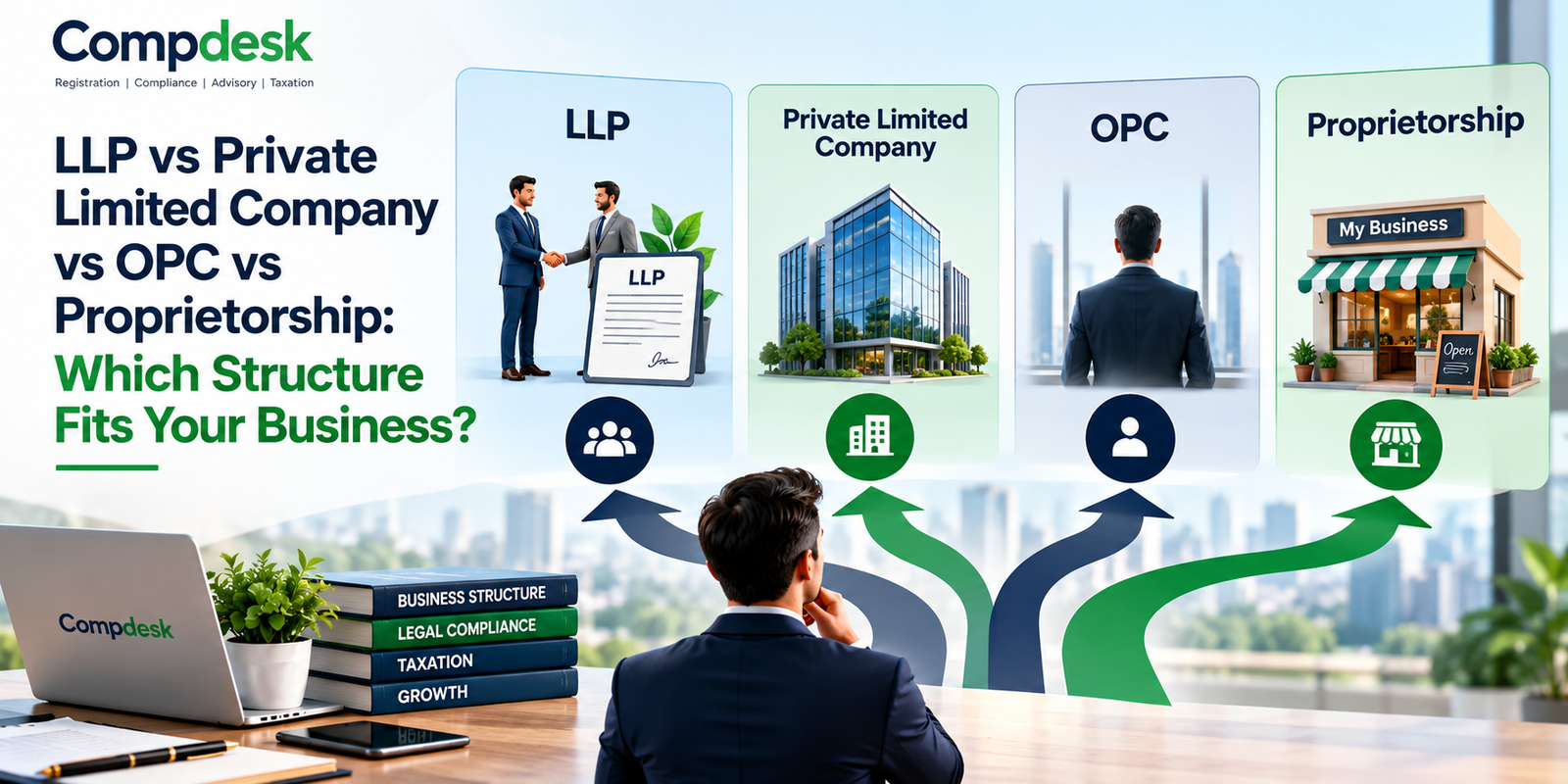
For most Indian founders and small businesses, the practical choice often comes down to four structures:
- Private Limited Company
- Limited Liability Partnership (LLP)
- One Person Company (OPC)
- Sole Proprietorship
There is no universally "best" structure.
A venture-backed technology startup and a two-partner consulting firm may both be profitable businesses, but they should not automatically use the same legal form. Similarly, a solo founder testing a small online business may not need the same structure as a solo entrepreneur signing large contracts and employing a team.
A useful way to think about the choice is:
- Private Limited Company: strongest fit for equity fundraising, ESOPs and scalable ownership.
- LLP: strong fit for closely held businesses with two or more active owners who value flexibility and lower corporate-law compliance.
- OPC: strong fit for a genuine solo founder who wants company status and limited liability without adding another shareholder.
- Proprietorship: simplest fit for a low-risk, owner-operated business where ease and low compliance matter more than legal separation.
This guide compares all four structures across liability, ownership, tax, audit, compliance, funding, Startup India eligibility, succession and long-term scalability.
Quick Comparison: LLP vs Pvt Ltd vs OPC vs Proprietorship
| Factor | Pvt Ltd Company | LLP | OPC | Proprietorship |
|---|---|---|---|---|
| Separate legal entity | Yes | Yes | Yes | No |
| Limited liability | Yes, subject to law | Yes, subject to law | Yes, subject to law | No, proprietor has personal exposure |
| Minimum owners | 2 members | 2 partners | 1 member | 1 owner |
| Minimum management requirement | 2 directors | 2 designated partners | 1 director | Proprietor |
| Ownership instrument | Shares | Partnership/contribution rights | Shares held by sole member | No separate ownership instrument |
| Statutory audit | Mandatory for company | Threshold-based under LLP Rules | Mandatory for company | No Companies Act/LLP statutory audit; tax audit may apply |
| AGM | Mandatory | Not required | Not required | Not applicable |
| Annual MCA filing | Yes | Yes | Yes | No MCA annual return |
| Equity fundraising | Strongest | Limited compared with company | Not possible from another shareholder while remaining OPC | Not possible through shares |
| ESOP framework | Yes | No company-style ESOP | Company framework exists, but single-member structure limits ownership while OPC | No |
| Venture capital / PE suitability | High | Usually low | Low until conversion | Very low |
| Profit-sharing flexibility | Through shares/dividend/remuneration | High through LLP Agreement | Sole shareholder economics | Entire profit belongs to proprietor |
| Current entity-level tax framework | optional 22% regime may apply subject to conditions | 30% on LLP income | Same company-tax framework | Taxed in proprietor's individual return |
| Perpetual succession | Yes | Yes | Yes, | Business legally tied to proprietor |
| Startup India recognition | Potentially eligible | Potentially eligible | Potentially eligible as OPC/private company | Proprietorship is not an eligible DPIIT entity form |
| Best fit | Scalable/funded business | Closely held multi-owner business | Solo founder seeking limited liability | Small, low-risk owner-operated business |
Decision shortcut: If you expect outside equity or ESOPs, evaluate a Private Limited Company first. If two or more owners will run a closely held business and outside equity is unlikely, evaluate an LLP. If you are genuinely the only owner but want a separate company, evaluate an OPC. If you are testing a low-risk business and simplicity is the main priority, a proprietorship may be sufficient.
First Question: What Kind of Business Are You Building?
Before comparing legal provisions, answer five commercial questions:
- Will there be one owner or multiple owners?
- Do you expect to raise external equity?
- Will employees need stock options?
- Will most profits be withdrawn by owners or reinvested?
- How much legal and financial risk will the business take?
These five answers usually narrow the choice quickly.
A founder expecting venture capital should not select a proprietorship merely because it is cheapest in year one.
A two-partner consulting business with no investment plan should not automatically select a Private Limited Company merely because "companies look bigger".
The right structure is the one that supports the business you expect to operate three to five years from now.
What Is a Private Limited Company?
A Private Limited Company is incorporated under the Companies Act, 2013.
It has a separate legal identity from its shareholders and can:
- own assets;
- enter contracts;
- borrow money;
- employ staff;
- issue shares;
- raise equity within the applicable legal framework;
- continue despite changes in shareholders; and
- sue or be sued in its own name.
A normal private company requires at least:
- 2 members/shareholders; and
- 2 directors.
At least one director must satisfy the Companies Act's resident-director requirement of staying in India for at least 182 days during the financial year, applied proportionately for a newly incorporated company.
A private company generally cannot have more than 200 members, subject to statutory exclusions.
Why Founders Choose a Private Limited Company
The biggest strength is not simply limited liability.
It is the ability to create a scalable ownership and capital structure through:
- equity shares;
- preference shares;
- rights issues;
- private placements;
- convertible securities;
- employee stock options; and
- investor governance rights.
That makes the structure familiar to:
- angel investors;
- venture-capital funds;
- private-equity investors;
- strategic investors;
- institutional lenders; and
- potential acquirers.
What is an LLP?
A Limited Liability Partnership is governed by the Limited Liability Partnership Act, 2008.
It is a body corporate with a legal identity separate from its partners.
An LLP must have at least:
- 2 partners; and
- 2 designated partners who are individuals.
At least one designated partner must be resident in India for LLP-law purposes, meaning the person has stayed in India for at least 120 days during the financial year.
The commercial relationship between partners is primarily governed by the LLP Agreement.
That makes LLPs particularly flexible for deciding:
- capital contribution;
- profit-sharing ratio;
- management responsibilities;
- partner remuneration;
- admission of partners;
- partner retirement;
- decision rights; and
- restrictions on transfer.
Why Owners Choose an LLP
An LLP is often attractive where:
- two or more owners actively run the business;
- outside equity is not central to the business model;
- profit-sharing flexibility matters;
- owners want limited liability; and
- they want a lighter corporate-governance structure than a company.
It is common to evaluate LLPs for:
- consulting firms;
- technology-service firms;
- agencies;
- family businesses;
- professional/advisory businesses, subject to professional-regulator rules; and
- closely held trading or service businesses.
What Is a One Person Company?
A One Person Company is a company with only one person as its member.
It is essentially a private-company structure designed for a solo entrepreneur.
A normal OPC requires:
- one member/shareholder;
- at least one director; and
- a nominee who can become the member on the sole member's death or incapacity to contract.
Under the current Companies (Incorporation) Rules, only a natural person who is an Indian citizen, whether resident in India or otherwise, can incorporate an OPC or act as nominee.
Why a Founder Chooses an OPC
An OPC can work where:
- there is genuinely one owner;
- the founder wants a separate legal entity;
- personal liability protection matters;
- the founder wants a corporate identity; and
- external shareholders are not expected immediately.
The key limitation is structural: an OPC can have only one member while it remains an OPC.
If an investor or co-founder needs equity ownership, conversion becomes relevant.
What Is a Sole Proprietorship?
A sole proprietorship is a business owned and managed by one individual.
Unlike a company or LLP, it does not have a separate legal existence from the owner.
The proprietor and the business are legally and economically intertwined.
There is no single central "incorporation certificate" that creates a proprietorship in the way MCA creates a company or LLP.
Instead, the business is generally evidenced through the registrations relevant to its activity, such as:
- GST registration, where applicable;
- Udyam registration;
- Shops and Establishments registration, where applicable;
- trade or municipal licences;
- FSSAI or other sectoral registration; and
- business bank-account documentation.
The official Udyam framework recognises proprietorship enterprises using the proprietor's Aadhaar and PAN-based information.
Why People Choose Proprietorship
It is easy to understand and usually has the lowest entity-level compliance burden.
It is commonly used by:
- freelancers;
- consultants starting small;
- local traders;
- small retailers;
- home businesses;
- small online sellers; and
- individuals validating a business idea.
Its biggest weakness is equally clear: there is no legal wall between the owner and the business.
Cost Comparison
Exact registration and annual costs depend on:
- State;
- authorised capital/contribution;
- stamp duty;
- DSCs;
- professional fee;
- turnover;
- audit requirement; and
- number of transactions.
A useful relative comparison is:
| Structure | Initial setup cost | Recurring legal/compliance cost |
|---|---|---|
| Proprietorship | Lowest | Lowest to moderate depending on tax/GST activity |
| LLP | Moderate | Moderate |
| OPC | Moderate | Moderate to high because company audit/ROC compliance remains |
| Private Limited Company | Moderate to high | Highest of the four in a normal case |
A higher compliance cost is not automatically a disadvantage.
If a Private Limited Company helps raise ₹10 crore of equity, the extra annual compliance cost may be commercially insignificant.
If a two-person consultancy will never need investors, paying for company-level complexity may add little value.
Decision Matrix: Choose Based on Your Priority
| Your priority | Structure generally worth evaluating first |
|---|---|
| VC / angel / PE funding | Private Limited Company |
| ESOPs | Private Limited Company |
| Multiple equity rounds | Private Limited Company |
| Two or more working owners | LLP |
| Flexible partner profit sharing | LLP |
| Lower corporate-law compliance with limited liability | LLP |
| One owner + limited liability | OPC |
| One owner + company identity | OPC |
| One owner + likely investor soon | OPC vs Private Limited depending on genuine ownership plan |
| Lowest structural compliance | Proprietorship |
| Testing a low-risk business idea | Proprietorship |
| Local small trading/service business | Proprietorship often sufficient |
| DPIIT Startup recognition | Private Limited / OPC / LLP can potentially qualify; proprietorship cannot |
| Foreign institutional investment | Private Limited Company often evaluated first |
| Long-term share-based succession | Private Limited Company |
| Regular distribution to active owners | LLP deserves detailed tax modelling |
Common Mistakes While Choosing a Business Structure
1. Choosing Only on Registration Cost
The cheapest structure to start can be expensive to restructure later.
2. Forming a Private Limited Company Only for "Credibility"
Use the company structure because its legal and capital features are useful—not merely because the suffix looks formal.
3. Choosing LLP and Assuming Investors Can Be Added Like Shareholders
LLP partner interests and company shares operate differently.
4. Using an OPC but Planning an Immediate Equity Round
If another shareholder will enter soon, factor conversion into the decision before incorporating.
5. Assuming OPC Must Convert at ₹2 Crore Turnover
That old compulsory turnover/capital rule was removed in 2021.
6. Assuming Proprietorship Means No Compliance
Tax, GST, labour, local and sector-specific compliances can still apply.
7. Assuming LLP Always Avoids Audit
LLP statutory audit depends on the Rule 24(8) thresholds, while tax audit is a separate test.
8. Comparing Only 22% Company Tax With 30% LLP Tax
Dividend taxation, partner profit treatment, remuneration and retained earnings can reverse the apparent headline-rate advantage.
9. Ignoring Personal Liability
A proprietorship can be easy to run until the business suffers a material contractual or financial claim.
10. Planning to "Convert Later" Without Modelling the Cost
Entity restructuring can involve:
- tax;
- stamp duty;
- asset transfers;
- contracts;
- licences;
- lender/customer consent; and
- compliance filings.
Do not assume every conversion is automatic or tax-neutral.
Frequently Asked Questions
1. Which is better: LLP or Private Limited Company?
Neither is universally better. A Private Limited Company is generally more suitable for equity fundraising, ESOPs and scalable ownership. An LLP is often better suited to closely held businesses where partners actively manage the business and outside equity is unlikely.
2. Which structure has the lowest compliance?
A proprietorship generally has the lowest entity-level legal compliance because there is no MCA annual filing. Tax, GST, labour and sectoral compliances can still apply.
3. Which is better for a solo founder: OPC or Proprietorship?
An OPC is worth evaluating where limited liability and separate corporate identity matter. A proprietorship is simpler where the business is small, low-risk and does not need corporate ownership features.
4. Can an OPC have more than one shareholder?
No. An OPC has only one member. If another shareholder needs to enter, the company should evaluate conversion into the appropriate company form.
5. Does an OPC have to convert after ₹2 crore turnover?
No. The old compulsory conversion thresholds linked to ₹50 lakh paid-up capital and ₹2 crore turnover were removed with effect from 1 April 2021.
6. Which structure is best for raising venture capital?
A Private Limited Company is generally the most suitable of these four structures because it has a conventional share-capital, securities and ESOP framework.
7. Is an LLP cheaper to maintain than a Private Limited Company?
Usually, an LLP has a lighter corporate-law compliance structure. The actual cost depends on audit, turnover, accounting complexity, GST, TDS, payroll and professional requirements.
8. Which structure pays the least tax?
There is no universal answer. A company's optional 22% regime, LLP's 30% entity rate and proprietor's individual slabs cannot be compared without considering profit distribution, remuneration, deductions, shareholder/partner tax and retained earnings.
9. Can a proprietorship get Startup India recognition?
A sole proprietorship is not one of the eligible entity forms under the current DPIIT startup definition. Eligible structures include private limited companies, registered partnerships, LLPs and specified cooperative societies. An OPC can potentially qualify as a private company.
10. Can I change the business structure later?
Restructuring is possible in many situations, but the method depends on the existing and target structure. Tax, stamp duty, contractual, licensing and regulatory consequences should be reviewed before relying on a future conversion.
Final Decision: Which Structure Fits Your Business?
Use the structure that matches the business model rather than the structure with the lowest first-year fee.
Consider a Private Limited Company if:
- you expect outside equity;
- ESOPs matter;
- you want a formal cap table;
- institutional investors are likely;
- ownership will change over time;
- you expect a strategic or investor exit; or
- the business is being built for significant scale.
Consider an LLP if:
- there are two or more genuine owners;
- owners actively manage the business;
- external equity is unlikely;
- flexible profit sharing is important;
- limited liability is required; and
- you want less corporate governance than a company.
Consider an OPC if:
- there is genuinely one owner;
- limited liability matters;
- corporate identity is useful;
- the founder wants continuity through a company structure; and
- no second equity owner is expected immediately.
Consider a Proprietorship if:
- there is one owner;
- the business is small and low-risk;
- external funding is not expected;
- legal separation is not currently essential; and
- simplicity and low compliance are the main priorities.
The best structure is the one that still works when the business becomes larger—not merely the one that is easiest to register today.
Need Help Choosing the Right Business Structure?
The right structure affects tax, personal liability, ownership, fundraising and future compliance.
Compdesk can help you compare the available structures based on your business model and complete the appropriate registration process.
Explore Compdesk services or review available service and pricing options.
Disclaimer
This article is for general informational purposes and reflects the Indian company, LLP, Startup India and income-tax framework reviewed as of 29 September 2026. Tax rates, MCA rules, foreign-investment requirements, State registrations and other legal provisions can change, and the appropriate structure depends on the specific facts of each business. Obtain professional advice before making a material incorporation, tax, investment or restructuring decision.

Meera is the Compliance Head at Compdesk, with over 10 years of experience in ROC filings, GST, income tax, and statutory compliance. She helps businesses understand regulatory requirements, maintain accurate filings,...
View full profileDon’t let private Company Registration eat your week.
Our experts handle the filing end to end. You track every step online.