
In this guide 25 sections
- Key Takeaways
- Should You Convert? Who Fits and Who Does Not
- Who Can Convert? Eligibility Conditions
- Documents Required to Convert a Private Limited Company into an LLP
- Step-by-Step Process to Convert a Pvt Ltd into an LLP
- How Long Does the Conversion Take?
- Government Fees and Other Costs
- What Changes After Conversion
- Tax Implications of Converting a Pvt Ltd into an LLP
- After You Receive the Certificate: Compliance Checklist
- Common Mistakes to Avoid
- Quick Decision Guide
- Frequently Asked Questions
- When Professional Help Is Useful
- Disclaimer
Last updated: November 2026
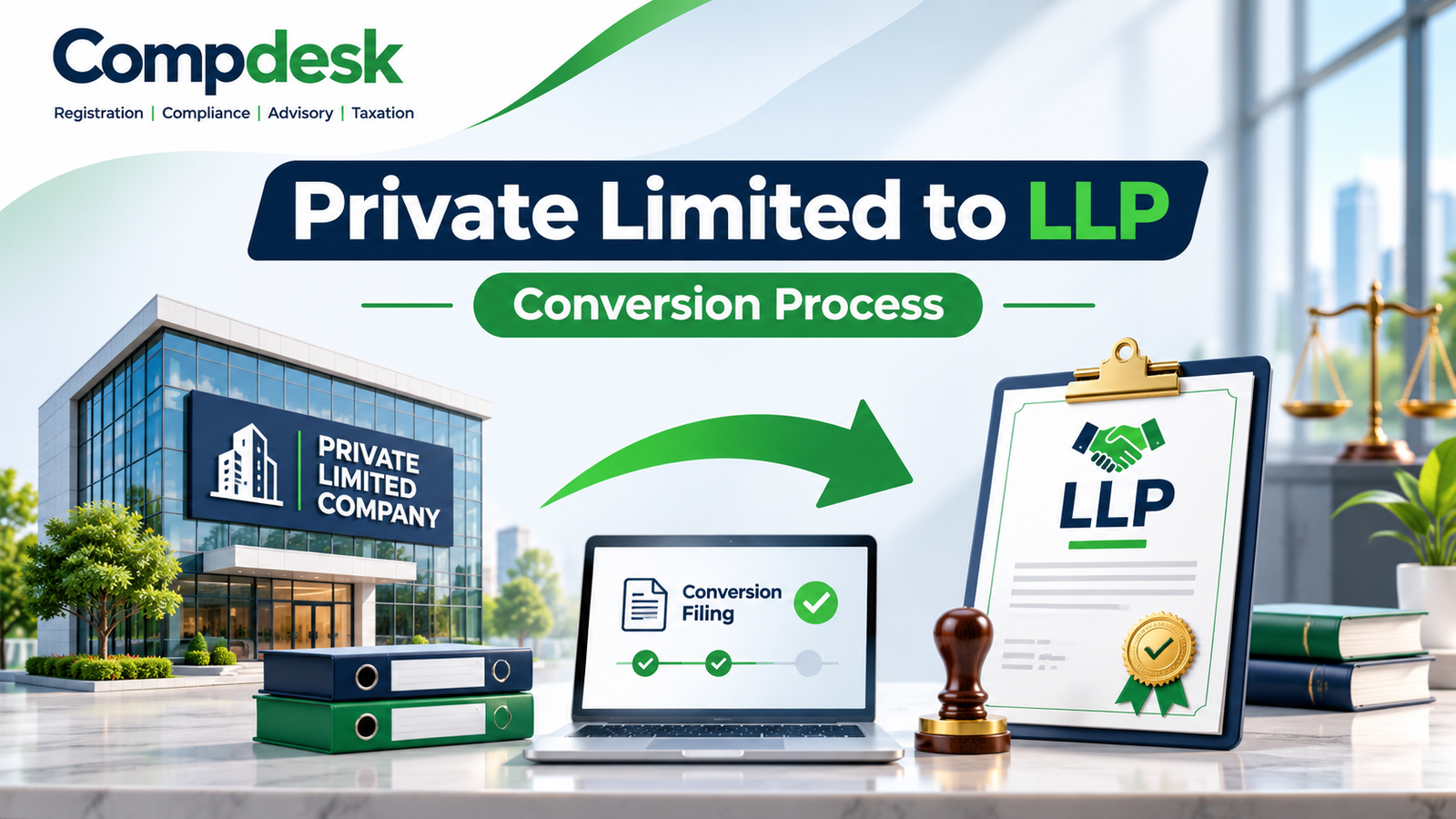
A private limited company can convert into an LLP under Section 56 and the Third Schedule of the LLP Act, 2008. You reserve the LLP name, file FiLLiP with the linked Form 18 on the MCA portal, receive the Certificate of Registration, and then file Form 14 within 15 days and the LLP agreement (Form 3) within 30 days.
If you run a small, closely held company, you already know the routine: board meetings, AGMs, a statutory auditor, AOC-4, MGT-7. Many owners ask whether an LLP would give them the same limited liability with less paperwork. Often it can. But conversion is not a simple name change. It has strict conditions, and one wrong step can turn a tax-free conversion into a taxable one.
This guide is for owners of private limited companies with no outside investors and no plans to issue shares or ESOPs. It explains who can convert, the exact steps and forms, what it costs, and the tax rules that apply now that the Income-tax Act, 2025 is in force.
Key Takeaways
- Legal route: Section 56 and the Third Schedule of the LLP Act, 2008 cover private companies. Unlisted public companies use Section 57 and the Fourth Schedule.
- Two hard conditions: no security interest (charge) on the company's assets when you apply, and the LLP's partners must be all the company's shareholders and nobody else.
- Forms: RUN-LLP for the name (optional), FiLLiP with linked Forms 9 and 18, then Form 14 within 15 days and Form 3 within 30 days of registration.
- Government fees: they depend on the LLP's contribution. At a contribution of up to ₹1 lakh, the registration fee is ₹500 and other forms cost ₹50 each.
- Tax: the conversion is tax-neutral only if every condition of Section 70(1)(ze) of the Income-tax Act, 2025 is met, including ₹60 lakh turnover and ₹5 crore asset limits.
- After conversion: the LLP gets a new PAN and TAN, needs a fresh GST registration, and the company's MAT credit does not carry over.
- Timing: MCA does not publish a fixed turnaround for this filing. Clearing pending issues before you apply matters more than anything else.
Should You Convert? Who Fits and Who Does Not
An LLP suits owners who run the business themselves and want a lighter compliance load. A company suits businesses that need to raise equity.
Conversion usually makes sense if you:
- run a closely held business with a small, stable group of owners;
- do not plan to raise venture capital, angel money or issue ESOPs;
- want to avoid the annual company filings and meetings;
- distribute most profits to owners and want to avoid dividends being taxed again in their hands.
Think twice if you:
- plan to bring in investors who will want shares, or to give employees stock options. An LLP has no share capital, so it cannot issue either;
- have a company with foreign investment. Foreign investment in an LLP is allowed only in sectors where 100% FDI is permitted under the automatic route and no FDI-linked performance conditions apply;
- have turnover above ₹60 lakh in any of the last three years, or assets above ₹5 crore. The company can still convert, but the tax exemption will not be available (see the tax section below);
- are currently paying tax under the company's lower 22% regime and expect large profits. An LLP pays a flat 30%, so run the numbers first.
If you convert and later need investors, the reverse move (LLP to private limited company) exists under Section 366 of the Companies Act, 2013. It is a separate process and is treated as a fresh registration, so it is better not to plan on it as a cheap undo button.
Who Can Convert? Eligibility Conditions
The Third Schedule sets two legal conditions. The company can apply only if:
- there is no security interest in its assets at the time of application; and
- the LLP's partners are all the shareholders of the company, and no one else.
Beyond the Act, the MCA's own instruction kit for FiLLiP lists checks the system applies when you file a conversion. Treat these as a pre-flight checklist:
| What MCA checks | What to do before you file |
|---|---|
| Company is a private company or an unlisted public company | Listed companies cannot convert. Section 8 companies are also excluded |
| No open (unsatisfied) charges | Repay the loan and file the charge satisfaction form so the MCA record shows the charge as closed |
| Balance sheets and annual returns are filed | File every overdue AOC-4 and MGT-7 or MGT-7A first |
| No pending form, payment or master-data updation request | Close or complete anything sitting in your MCA work queue |
| No inspection, investigation or prosecution pending (a follow-up inspection is not a bar) | Check with your CS if you have received any MCA notice |
| Company is not marked as having a management dispute | Resolve or clarify the dispute status |
| No open cost audit orders | Applicable only if cost audit applies to you |
| The company has share capital | Confirm in your MCA master data |
| LLP name matches the company name | Keep the same name and swap "Private Limited" for "LLP" |
| LLP is registered in the same state as the company's registered office | You cannot change states during conversion |
| At least two designated partners, at least one resident in India | Decide who will be designated partners before filing |
A note on overdue filings: MCA ran a one-time relief window, the Companies Compliance Facilitation Scheme, 2026, from 15 April to 15 July 2026 (General Circular No. 01/2026). It has closed, so pending annual filings now attract the normal additional fees. Clear them before you start.
Documents Required to Convert a Private Limited Company into an LLP
Keep these ready before you open the form. Your professional may ask for more, and the Registrar can ask for additional documents during review.
From the company
- Board resolution approving the conversion and authorising someone to file.
- Special resolution of shareholders and written consent of every shareholder. Companies commonly file the resolutions in Form MGT-14 within 30 days of passing them. Confirm this with your company secretary.
- Statement of assets and liabilities, certified by the auditor. Practitioners note the Registrar expects financial statements that are very recent (not older than about 15 days).
- List of secured creditors with their consent. If there are no secured creditors, add a declaration saying so.
- Acknowledgement of the latest income tax return.
- Certificate of incorporation of the company.
- Approval from the sector regulator, if the company operates in a regulated sector.
From the partners
- PAN, identity proof and address proof of each designated partner.
- DSC and DPIN for each designated partner. FiLLiP lets you apply for the DPIN of up to five individuals within the form itself.
- Consent to act as a designated partner (Form 9).
- If a body corporate is a shareholder: its resolution and a nominee's authorisation on letterhead.
For the registered office
- Rent agreement or ownership proof, with the owner's NOC if rented.
- A utility bill not older than two months.
LLP agreement
- Draft the LLP agreement on proper stamp paper before you finalise contributions and profit-sharing ratios. You will file it in Form 3 after registration.
Step-by-Step Process to Convert a Pvt Ltd into an LLP
Here is the sequence most professionals follow.
- Clear the pre-conditions. Satisfy all charges, file pending ROC returns and check your MCA records against the table above.
- Hold a board meeting. Approve the conversion, authorise a director to file, and approve the name reservation.
- Get shareholder approval. Pass a special resolution at a general meeting and collect written consent from every shareholder. File the resolutions in MGT-14 where applicable.
- Arrange DSCs and DPINs. Every designated partner needs a DSC. Anyone without a DPIN can apply through FiLLiP.
- Reserve the LLP name (RUN-LLP). Choose the conversion option. The Registrar can reserve the name for about three months (90 days). You can also propose the name inside FiLLiP, but a rejection there means working through the form again.
- File FiLLiP with Forms 9 and 18. On the MCA portal, choose "Conversion of private company/unlisted public company into LLP" and enter the company's CIN. Form 9 (consent) and Form 18 (the conversion application and statement) are filed as linked forms. Attach the documents, sign with DSC and pay the fee. The same form also applies for the LLP's PAN and TAN.
- Registrar's review. FiLLiP is processed manually (non-STP). If the Registrar asks for corrections, you must resubmit within 15 days of the request. If registration is refused, the Third Schedule allows an appeal to the Tribunal.
- Certificate of Registration (Form 19). The LLP exists from the date on the certificate. The company is deemed dissolved and its name is removed from the ROC records.
- Inform the ROC (Form 14). Within 15 days of registration, the LLP must tell the Registrar of Companies where the company was registered.
- File the LLP agreement (Form 3). Within 30 days of registration.
How Long Does the Conversion Take?
MCA does not publish a fixed turnaround for Form 18 and FiLLiP, and published estimates vary from about two weeks to six weeks. Cases where the company is already clean (no charges, no pending filings, all consents signed) sit at the short end. Cases that need clean-up first take much longer, because that work comes before the filing.
| Stage | Time limit or typical time | What affects it |
|---|---|---|
| Clean-up (charges, pending filings) | Depends on your case | Lender cooperation, number of overdue returns |
| Board and shareholder approvals, MGT-14 | A few days to a week (practical estimate). MGT-14 within 30 days of the resolution | Availability of every shareholder |
| DSC and DPIN | A few days (practical estimate) | Video verification, correct identity documents |
| Name reservation | Name held for about 90 days once approved | Name similarity, trademark issues |
| FiLLiP and Form 18 review | No fixed MCA timeline | Document quality, resubmission requests (15 days to respond) |
| Form 14 | Within 15 days of registration (statutory) | Late filing adds a fee |
| Form 3 | Within 30 days of registration (statutory) | Late filing adds a fee that grows with the delay |
Government Fees and Other Costs
Government fees for conversion are set by Annexure A of the LLP Rules, 2009, as amended from 1 April 2022. They depend on the LLP's contribution, meaning the total capital contributed by all partners.
| Total LLP contribution | Registration fee (FiLLiP) | Fee for each other form (Form 18, 14, 3) |
|---|---|---|
| Up to ₹1 lakh | ₹500 | ₹50 |
| Above ₹1 lakh up to ₹5 lakh | ₹2,000 | ₹100 |
| Above ₹5 lakh up to ₹10 lakh | ₹4,000 | ₹150 |
| Above ₹10 lakh up to ₹25 lakh | ₹5,000 | ₹200 |
| Above ₹25 lakh up to ₹1 crore | ₹10,000 | ₹400 |
| Above ₹1 crore | ₹25,000 | ₹600 |
RUN-LLP costs ₹200 in addition. If you increase the contribution later, you pay the difference in the registration fee through Form 3. Check the MCA portal's fee calculator at the time of filing, since fees can change.
Example (for illustration only): if the LLP's total contribution is ₹8 lakh, the MCA fees come to ₹4,650. That is ₹200 for RUN-LLP, ₹4,000 for FiLLiP and ₹150 each for Forms 18, 3 and 14.
Other costs sit outside the MCA fee table:
| Cost | Who charges it | Notes |
|---|---|---|
| DSC for each designated partner | Licensed certifying authority | Price varies by provider and validity |
| Stamp duty on the LLP agreement | State government | Varies widely by state and contribution. Check your state's rules |
| CA certification of assets and liabilities | Chartered Accountant | Depends on the size and condition of your books |
| Charge satisfaction filing, MGT-14 | MCA | Needed only if you have open charges or file the resolutions |
| Professional fee | Your service provider | Compare what is included. See Compdesk pricing |
Some states may also charge stamp duty when immovable property moves to the LLP. Check your state's law before conversion if the company owns property.
What Changes After Conversion
| Area | Private limited company | LLP |
|---|---|---|
| Governing law | Companies Act, 2013 | LLP Act, 2008 |
| Constitution | MoA and AoA | LLP agreement |
| Owners | Shareholders | Partners (all former shareholders) |
| Management | Board of directors | Designated partners (at least two, one resident in India) |
| Identity number | CIN | LLPIN |
| Raising equity | Shares and ESOPs possible | Not possible (no share capital) |
| Annual filings | AOC-4, MGT-7 or MGT-7A, AGM, board meetings | Form 11 (due 30 May) and Form 8 (due 30 October) |
| Audit | Mandatory every year | Needed only if turnover exceeds ₹40 lakh or contribution exceeds ₹25 lakh |
Under the Third Schedule, the company's assets, liabilities, contracts and pending proceedings vest in the LLP without further assurance, act or deed. Employment contracts continue. Approvals and licences carry over, but only as far as the law under which they were issued allows, so you must still inform each authority.
Tax Implications of Converting a Pvt Ltd into an LLP
Conversions happening now fall under the Income-tax Act, 2025, which replaced the 1961 Act from 1 April 2026. The capital gains exemption for company-to-LLP conversion now sits in Section 70(1)(ze). Under the old law it was Section 47(xiiib). Many older articles still quote the old number.
When the conversion is tax-neutral
Section 70(1)(ze) says the transfer of the company's assets and the shareholders' shares is not treated as a transfer for capital gains if all of these conditions are met:
- All assets and liabilities of the company become those of the LLP.
- All shareholders become partners, and their capital contribution and profit-sharing ratio are in the same proportion as their shareholding on the date of conversion.
- Shareholders receive no consideration or benefit other than their profit share and capital contribution.
- The shareholders' combined profit share stays at 50% or more at all times during the five years from conversion.
- Total sales, turnover or gross receipts did not exceed ₹60 lakh in any of the three tax years before the year of conversion.
- Total value of assets in the books did not exceed ₹5 crore in any of those three years.
- No amount is paid to any partner out of the company's accumulated profit (as on the date of conversion) for three years from conversion.
If a condition is breached later, the exemption can be withdrawn and the gain taxed in the year of the breach. The 2025 Act has a claw-back rule for this (Section 71; Section 47A under the old law).
Other tax effects to plan for
| Area | What to know |
|---|---|
| Tax rate | An LLP pays 30% flat, plus 12% surcharge if income exceeds ₹1 crore, plus 4% cess (about 31.2%, or about 34.94% above ₹1 crore). A company that opts for the concessional 22% regime pays about 25.17% with surcharge and cess. LLPs claiming certain deductions may also face alternate minimum tax |
| Profit distribution | An LLP's profit share is generally not taxed again in the partner's hands. Company dividends are taxed in the shareholder's hands |
| Losses and unabsorbed depreciation | The LLP can carry them forward only if the conversion meets the tax-neutral conditions. Confirm the exact provision with your CA |
| MAT credit | Does not pass to the LLP, because MAT does not apply to LLPs |
| GST | Transfer of a business as a going concern is generally exempt (Entry 2, Notification No. 12/2017-Central Tax (Rate)), subject to conditions. The LLP needs a fresh GST registration because GST registration is PAN-based, and unused input tax credit can move through Form GST ITC-02 with a CA or cost accountant certificate |
| PAN and TAN | The LLP is a new entity. It gets its own PAN and TAN, which you can apply for through FiLLiP |
After You Receive the Certificate: Compliance Checklist
- Form 14 within 15 days of the registration date shown on the certificate.
- Form 3 within 30 days. Late filing attracts an additional fee that is a multiple of the normal fee and rises with the delay.
- Conversion statement on official correspondence. For 12 months, starting no later than 14 days after registration, every official correspondence (including invoices and letters) must state that the business was converted from a company into an LLP and give the company's name and registration number. The Third Schedule prescribes a fine of ₹10,000 to ₹1 lakh for failing to do this, plus a daily fine while the default continues.
- Banking and PAN. Open a bank account in the LLP's name and move transactions to it.
- GST. Apply for the LLP's GST registration, transfer eligible input tax credit through Form GST ITC-02 and cancel the company's registration, in that order.
- Other registrations. Update Udyam, IEC, FSSAI, EPFO, ESIC, professional tax, trademark ownership and any property records.
- Stakeholders. Inform customers, vendors, lenders and employees. Re-issue letterheads and invoices.
- Closing the company's final period. Ask your CA how to close the company's final income tax and TDS filings.
- Annual calendar for the LLP. Form 11 by 30 May, Form 8 by 30 October, and the income tax return (ITR-5).
Common Mistakes to Avoid
| Mistake | How to avoid it |
|---|---|
| Applying with an open charge on company assets | Satisfy the charge and confirm it shows as closed on the MCA record before filing |
| Leaving pending AOC-4 or MGT-7 filings | File them first. The one-time relief scheme has ended |
| Changing the name during conversion | Keep the company name and change only the suffix |
| Choosing a registered office in a different state | The LLP must be in the same state as the company's registered office |
| Leaving a shareholder out, or adding an outsider as partner | Partners must be all the shareholders and no one else. Clean up the share register first |
| Different profit-sharing ratio from shareholding ratio | Keep contribution and profit share in the same proportion as shareholding on conversion day |
| Paying shareholders anything beyond profit share and capital contribution | This can break the tax exemption |
| Taking out accumulated profits within three years | Plan withdrawals around the three-year restriction |
| Diluting the original owners below 50% profit share within five years | Be careful when admitting new partners |
| Missing the Form 14 or Form 3 deadlines | Set reminders from the registration date on the certificate |
| Forgetting GST steps | Apply for the new GSTIN and file ITC-02 before cancelling the old registration |
Quick Decision Guide
- Planning to raise equity or offer ESOPs? Stay a private limited company.
- Turnover above ₹60 lakh or assets above ₹5 crore in any of the last three years? The tax exemption will not apply. Get tax advice before converting.
- Open bank loans secured on assets? Clear the charge first. You cannot convert with a subsisting charge.
- Foreign investors in the company? Check that your sector qualifies for LLP investment before applying.
- Small, closely held business that wants lighter compliance? Conversion is worth a serious look, provided the numbers work after tax.
Example (for illustration only): three shareholders hold 50%, 30% and 20% of a trading company. Turnover in the last three years was ₹45 lakh, ₹52 lakh and ₹58 lakh. Assets are ₹1.8 crore. There are no secured loans and all filings are up to date. They convert into an LLP in which they hold the same 50:30:20 profit-sharing ratio as they held shares. They take no payout from the company's accumulated profits for three years and keep their combined share above 50% for five years. On these facts, all the Section 70(1)(ze) conditions appear to be met. This is only an example. Real cases often have details that change the answer.
Frequently Asked Questions
Can a private limited company be converted into an LLP?
Yes. Section 56 and the Third Schedule of the LLP Act, 2008 allow a private company to convert into an LLP if it has no subsisting security interest and all its shareholders become the LLP's partners. Unlisted public companies can convert under Section 57. Listed companies cannot.
Do all shareholders have to agree?
Yes. The partners of the LLP must be all the shareholders of the company and no one else, and every shareholder gives a statement and consent as part of the filing. If even one shareholder does not agree, conversion in this route is not possible.
Is there capital gains tax on conversion?
Not if every condition of Section 70(1)(ze) of the Income-tax Act, 2025 is met, including the ₹60 lakh turnover limit and ₹5 crore asset limit in each of the three preceding years. If a condition is not met, the conversion may be treated as a transfer and tax may arise. Get case-specific advice.
How long does conversion take?
MCA does not prescribe a fixed time for this filing. Published estimates run from about two weeks to six weeks. The biggest factor is whether charges, pending filings and consents are ready before you apply.
Do my PAN, GST registration and bank account stay the same?
No. The LLP is registered as a new entity. It gets a new PAN and TAN, needs a fresh GST registration and should open its own bank account. Eligible unused input tax credit can be transferred using Form GST ITC-02.
Can I convert if my company has a bank loan?
A secured loan that creates a charge on company assets blocks conversion until the charge is satisfied. Unsecured liabilities do not block it and pass to the LLP along with the other liabilities.
What happens to employees, contracts and ongoing cases?
Contracts, employment arrangements and pending proceedings continue in the LLP's name under the Third Schedule. Licences and approvals carry over subject to the law that issued them, so notify each authority.
Can an LLP be converted back to a private limited company?
Yes, under Section 366 of the Companies Act, 2013, but it is a separate process and is treated as a fresh registration. Plan the structure carefully so you do not need to reverse it.
When Professional Help Is Useful
Most of the risk in this conversion sits in the preparation, not in the portal. A professional is worth involving if you have any open charge, overdue ROC filing, a shareholder who is hard to reach, or a company whose turnover or assets are near the ₹60 lakh and ₹5 crore limits. A small error in contribution ratios or timing can cost far more than the filing itself.
If you are unsure whether conversion suits your business or whether you will keep the tax exemption, Compdesk can review your position and help you choose the right route. You can see our compliance services or check pricing to get started.
Disclaimer
This article is for general information only and is not legal, tax or financial advice. Laws, rules, fees and procedures change, and how they apply depends on the facts of each case. Please consult a qualified Chartered Accountant, Company Secretary or lawyer before making decisions about your company. Fees and timelines are indicative; check the MCA portal and the relevant authority for current requirements.

Meera is the Compliance Head at Compdesk, with over 10 years of experience in ROC filings, GST, income tax, and statutory compliance. She helps businesses understand regulatory requirements, maintain accurate filings,...
View full profileDon’t let private Limited Company Annual Compliance eat your week.
Our experts handle the filing end to end. You track every step online.